rile*books

Search books

Search books by title, author, publisher, keywords...

Cover of Ill Feelings

Feminist Press

Ill Feelings

Alice Hattrick

€18.00

An intrepid, galvanizing meditation on illness, disability, feminism, and what it means to be alive.

In 1995 Alice’s mother collapsed with pneumonia. She never fully recovered and was eventually diagnosed with ME, or Chronic Fatigue Syndrome. Then Alice got ill. Their symptoms mirrored their mother’s and appeared to have no physical cause; they received the same diagnosis a few years later. Ill Feelings blends memoir, medical history, biography and literary nonfiction to uncover both of their case histories, and branches out into the records of ill health that women have written about in diaries and letters.

Their cast of characters includes Virginia Woolf and Alice James, the poets Elizabeth Barrett Browning and Emily Dickinson, John Ruskin’s lost love Rose la Touche, the artist Louise Bourgeois and the nurse Florence Nightingale.

Published in 2022 ┊ 352 pages ┊ Language: English

recommendations

Cover of Johnny Would You Love Me If My Dick Were Bigger

Feminist Press

Johnny Would You Love Me If My Dick Were Bigger

Brontez Purnell

Fiction €18.00

A dirty cult-classic put out in a small batch by an underground publisher (Rudos and Rubes) in 2015, Johnny Would You Love Me If My Dick Were Bigger recounts the life of an artist and "old school homosexual" who bears a big resemblance to author Brontez Purnell.

Our hero doesn't trust the new breed of fags taking over San Francisco, though. They wear bicycle helmets, seat belts, and condoms. Meanwhile, he sabotages his relationships, hallucinating affection while cruising in late night parks, bath-houses, and other nooks and crannies of a newly-conservative, ruined city.

Furiously original, vital, and messy, this funny "non-memoir" uncovers a revelatory truth for the age: there are things far scarier than HIV.

Cover of Little F

Feminist Press

Little F

Michelle Tea

LGBTQI+ €18.00

A new epic novel about a teenage queer runaway from cult classic author of Black Wave and Valencia Michelle Tea. A Literary Hub Notable Small Press Book of 2025.

In Spencer's fantasies, the breezy, queer streets of Provincetown, MA, are utopia, a place where he can be free. Yet when a violent attack in his suburban Arizona schoolyard sends him to the hospital, he decides queer utopia can't wait. And one night, with the help of his best friend, the teenage witch Joy, he hitches a ride to find it.

The cross-country road odyssey that follows brings Spencer from new moon rituals in Arizona canyons to Texas bus stations, from the luxe drag stages of Houston's Montrose district to the jazz-soaked streets of the French Quarter and beyond. This new novel from Michelle Tea tells the story, by turns raw, romantic, and sweet, of a sheltered boy taking his first leap into queer life, among all the complicated queers who live it.

"Tea's conversational tone and her way of writing deeply personal experience . . . presents a very necessary counter-narrative to mainstream histories of American punk, feminism, and sexual identity." – The Brooklyn Rail

Michelle Tea is the author of over twenty books of fiction, memoir, poetry and children's literature. Her autofiction Valencia, a cult classic, won the Lambda Literary Award for Best Fiction. Her essay collection Against Memoir was awarded the PEN/Diamonstein-Spielvogel Award for The Art of the Essay. Tea is also the recipient of awards from the Rona Jaffe Foundation and the Guggenheim Foundation. The founder of Drag Queen Story Hour, she has received honors from the American Library Association and Logo Television. Tea curated the Sister Spit Books series at City Lights Publishers and founded the ongoing imprint Amethyst Edition at the Feminist Press.

Cover of Men in the Off Hours

Vintage Contemporaries

Men in the Off Hours

Anne Carson

Poetry €16.00

In Men in the Off Hours, Carson offers further proof of her tantalizing gifts. Reinventing figures as diverse as Oedipus, Emily Dickinson, and Audubon, Carson sets up startling juxtapositions: Lazarus among video paraphernalia, Virginia Woolf and Thucydides discussing war, Edward Hopper paintings illuminated by St. Augustine. And in a final prose poem, she meditates movingly on the recent death of her mother. With its quiet, acute spirituality and its fearless wit and sensuality, Men in the Off Hours shows us a fiercely individual poet at her best.

Cover of the she

Gevaert Editions

the she

Asger Taiaksev, Sylvie Eyberg

‘the she’ compares texts by Virginia Woolf with their French translation, reproducing parts of the novelles ‘The String Quartet' & ‘Blue and Green’ and the novel ‘The Years’. Of the novellas, she kept only the articles the in English and le, la, les in French, exactly as they appear in the editions. Of the novel, only the pronouns she in English and elle in French remain.

The publication includes identical two booklets, one bound and one unbound, both uncut, referring to old books which were often sold bound but uncut.

Offset printing. Printed by Cultura, Wetteren

Edition of 123 numbered copies

Cover of A Room of One's Own

Mariner Books

A Room of One's Own

Virginia Woolf

Essays €14.00

In A Room of One's Own, Virginia Woolf imagines that Shakespeare had a sister—a sister equal to Shakespeare in talent, and equal in genius, but whose legacy is radically different. This imaginary woman never writes a word and dies by her own hand, her genius unexpressed. If only she had found the means to create, argues Woolf, she would have reached the same heights as her immortal sibling.

In this classic essay, Woolf takes on the establishment, using her gift of language to dissect the world around her and give voice to those who are without. Her message is a simple one: women must have a steady income and a room of their own in order to have the freedom to create.

With a Foreword by Mary Gordon

Cover of Theory & Practice

Catapult

Theory & Practice

Michelle de Kretser

Fiction €25.00

With echoes of Shirley Hazzard and Virginia Woolf, a new novel of startling intelligence from prize–winning author Michelle de Kretser, following a woman looking back on her young adulthood, and grappling with the collision of her emotions and her values.

In the late 1980s, the narrator of Theory & Practice—a first generation immigrant from Sri Lanka who moved to Sydney in her childhood—sets up a life in Melbourne for graduate school. Jilted by a lover who cheats on her with another self-described "feminist," she is thrown into deeper confusion about her identity and the people around her.

The narrator begins to fall for a man named Kit, who is in a “deconstructed relationship” with a woman named Olivia. She struggles to square her feminism against her jealousy toward Olivia—and her anti-colonialism against her feelings about Virginia Woolf, whose work she is called to despite her racism.

What happens when our desires run contrary to our beliefs? What should we do when the failings of revered figures come to light? Who is shamed when the truth is told? In Theory & Practice, Michelle de Kretser offers a spellbinding meditation on the moral complexities that arise in this gap. Peopled with brilliantly drawn characters, the novel also stitches together fiction and essay, taking up Woolf’s quest for adventurous literary form.

Cover of Hand That Touch This Fortune Will

Ma Bibliotheque

Hand That Touch This Fortune Will

Sam Dolbear

Enchanted €18.00

Take my hand. Trace the lines on my palm with your fingers. What size and shape are they? Take note of their form: are they forked, tasselled, wavy, chained, broken? Now examine my fingers. Tell me my disposition; tell me what beholds me.

Mapping the hand as cosmos as clinic as history as biography, hand reading is a technique suspended between medical and mystical judgement, empirical diagnosis and speculative divination. This book weaves the lives and work of the ‘reader’ and the ‘read’ together in an intricate fabric. The central ‘reader’ is Charlotte Wolff (1897–1986), a friend of Walter Benjamin, Helen Grund, and Ernst Schoen, who after fleeing from Germany’s new regime in 1933, took up hand reading in Paris to make ends meet. The ‘read’ are anonymous acrobats, dancers, and department-store managers, and members of the avant-gardes of Paris and London, from Antonin Artaud to Romola Nijinsky, Marcel Duchamp to Virginia Woolf. Arranged as an index, this book is both a guide to the techniques of hand reading and a critical theory of its history and practice, mixed with Wolff’s later work as a theorist of gender and sexuality.

"Hand That Touch This Fortune Will is a study devoted to friendship, refracted through the portal of the upturned palm. Charlotte Wolff met the world by examining what was written on the hands of the times.  What did she read in the landscapes of this intimate organ of touch, and what, through reading, was she fatally unable to see?  Through a gentle fragmentation reminiscent of The Arcades Project, Dolbear acts as a thoughtful guide through fascinating and nearly forgotten passages in the European history of palmistry under late capitalism—along with all the political uncertainties and faggy gestures that formed its nimbus.  With extraordinary attention to the peculiar experiments in living that have scarcely left a trace in the archive, Hand That Touch gathers the reader around those bars, clinics, and drawn curtains, where, under the shadow of fascist diagnosis, the occult comes palm to palm with the queer past." — M. Ty

Each book holds a very lovely insert of a hand reading chart, designed by Ana Cecilia Breña and Sam Dolbear. Printed on tracing paper, it allows the reader to read their hand as they read the book.

Sam Dolbear was a Fellow at the ICI Berlin Institute for Cultural Inquiry in Berlin from 2020 to 2024. His research addresses the life and work of Walter Benjamin and those around him. He has taught and published widely, including, with Esther Leslie, Dissonant Waves: Ernst Schoen and Experimental Sound in the 20th Century (2023). He is a co-founder of the sound and radio collective MayDay Radio.

Cover of Faltas: Letters to Everyone in My Hometown Who Isn't My Rapist

LittlePuss Press

Faltas: Letters to Everyone in My Hometown Who Isn't My Rapist

Cecilia Gentili

Memoir €19.00

A rich and moving epistolary memoir about transgender childhood, sexual trauma, motherhood, and a young queer life in 1970s Argentina.

In these hilarious and heartbreaking letters, Cecilia Gentili reinvents the trans memoir, putting the confession squarely between the writer and her enemies, paramours and friends.

Writing to childhood figures such as her rapist’s daughter, her father’s mistress, her best friend, and her mother, Gentili probes deeply into the bitter cruelty, buried secrets, and delicious gossip of a small town. 

Is she here for revenge, or forgiveness? Both! And more! A story of sex, theft, murder, motherhood, and outrageous fashion choices, Faltas is a beautiful, messy meditation on what it takes to heal, and even grow.

Cover of Chesil Cliff House and other failures

Sticky Fingers Publishing

Chesil Cliff House and other failures

Sam Moore

Orbiting around the saddest house in the history of Grand Designs, Sam Moore’s Chesil Cliff House and other failures takes us to North Devon where, standing at the cliff’s edge, we meet Edward Short: a man with a Fred Perry shirt and a dream. Amongst a chorus of characters including Kevin Mcloud as Father Time, Moore by means of Short leads us into a study of creative failure, gender, and, ultimately, the desire to keep writing.

"I struggle to see anyone living here. It feels like a distorted wonder of the world, a cautionary tale. Something that could never have been lived in, but that had to be made."

About the author:
Sam is a writer, artist, and editor. They are the author of All my teachers died of AIDS (Pilot Press), Long live the new flesh (Polari Press), and Search history (Queer Street Press). They are one of the co-curators of TISSUE, a trans reading and publishing initiative based in London.

About A Series of Attempts:
This new series published by Sticky Fingers Publishing explores the essay form through the etymological root of essay: to try, trial or attempt. In 1508, French theorist Michel de Montaigne published a collection of 107 texts called Essais, described by his contemporaries as ‘self-indulgent and embarrassingly confessional.’ It is through these roots we find the attitude and intentions at the heart of this series; that through thinking together, through trying to figure it out on the page, we can reach new and increasingly nuanced ways to understand each other and the worlds we inhabit.

Cover of Sick issue 6

Self-Published

Sick issue 6

Olivia Spring

Poetry €16.00

Writing on the fragmentation of chronic illness, why ‘full access’ isn’t something arts venues should aim for, the complexities of receiving gender-affirming care while living with chronic illness, the realities of constantly having to ration your energy, an interview with musical artist Dead Gowns, abortion access and bodily autonomy, poetry, artwork, book recommendations, and much more.

Essays, features, poetry, art, interviews & more from Vida Adamczewski, A/Bel Andrade, Amy Berkowitz, Khairani Barokka, Jax Bulstrode, Sarah Courville, Jen Deerinwater , Amy Dickinson, Mizy Judah Clifton, Alton Melvar M Dapanas, Dead Gowns, Sergey Isakov, Theo LeGro, Elias Lowe, Cathleen Luo, Jameisha Prescod, Olivia Spring, Leigh Sugar, Oriele Steiner, Emerson Whitney, Chantal Wnuk, Caroline Wolff, and Emma Yearwood

SICK is an independent, thoughtful magazine exploring illness and disability, founded & edited by Olivia Spring and designed by Kaiya Waerea. Founded in Norwich, UK in 2019, we are currently based in Maine, USA and London, UK. We typically publish one issue per year.

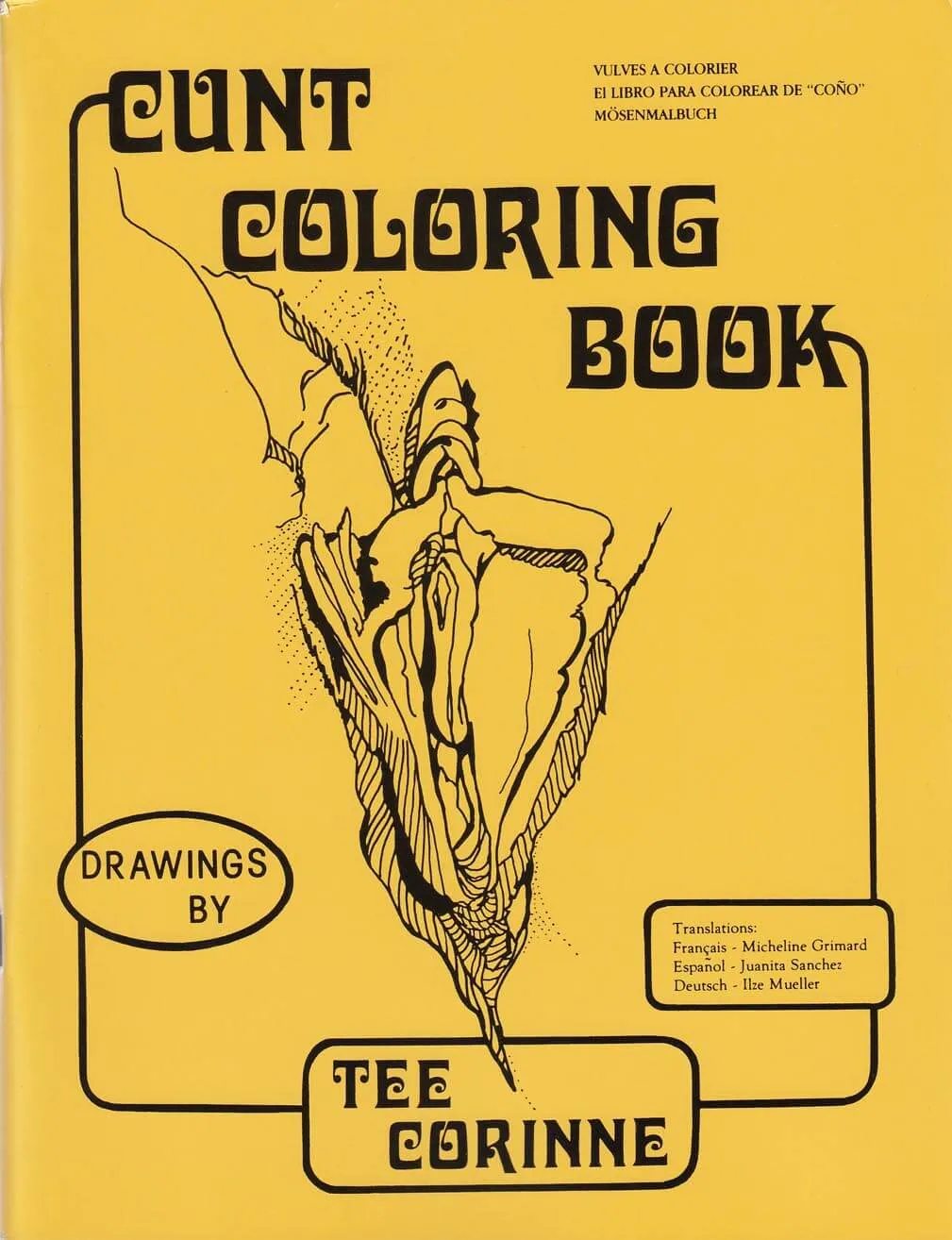
Cover of Cunt Coloring Book

Last Gasp

Cunt Coloring Book

Tee A. Corinne

Over three dozen c**ts of every size and description for you to color. Originally used for a sex-education class. Crayons not included. First published in 1975 by lesbian activist and artist Tee Corinne.

"In 1973 I set out to do drawings of women’s genitals for use in sex education groups. I wanted the drawings to be lovely and informative, to give pleasure and affirmation. I organized the drawings into a coloring book because a major way we learn to understand the world, as children, is by coloring. As adults many of us still need to learn about our external sexual anatomy." —Tee Corinne

Tee Corinne was born November 3rd, 1943 and grew up in St. Petersburg, Florida. Her mother, also an artist, introduced her to the creative principles and techniques that would serve her all her life. She received a B.A. in printmaking and painting from the University of South Florida, then went on to get an M.F.A. in drawing and sculpture at Pratt Institute, graduating in 1968. Afterwards she taught for many years, traveled through Europe, and finally became enmeshed in the back-to-the-land movement and communal living. After nearly ten years of marriage to a man she referred to as her "best friend," Corinne came out of the closet amidst severe depression in 1975. The strength to accomplish this difficult effort would later propel her to heights and achievements that would distinguish her as "one of the most visible and accessible lesbian artists in the world." From the mid-1960’s to the day she died Corinne created, published, and exhibited her art and writing around the world. She was a co-facilitator of the Feminist Photography Ovulars and a co-founder of The Blatant Image, A Magazine of Feminist Photography. She was the author of one novel, three collections of short stories, four books of poetry and numerous arts publications. In 1980, she was one of ten selected artists invited to have their work exhibited in the Great American Lesbian Art Show. The world lost Tee Corinne to cancer in 2006.

Cover of Night School

Ma Bibliotheque

Night School

Erin Honeycutt

Fiction €15.00

A synthesis of dreamwork and bookwork, combining collaboration with dream-vision report, creative writing, and AI—a “Media Archaeology of Dreams.” Its central character is the author’s voice in this process through ekphrasis. What/where is the separation between the ekphrastic object, the dream, and its description?