rile*books

Search books

Search books by title, author, publisher, keywords...

Cover of Forty-Five Years: A Tribute to the Lesbian Herstory Archives

Sinister Wisdom

Forty-Five Years: A Tribute to the Lesbian Herstory Archives

Julie R. Enszer ed.

€14.00

Forty-five years ago movements of liberation made possible the birth of a new project in the world, the Lesbian Herstory Archives. In Sinister Wisdom 118 are some of the founding stories, telling what it meant to walk first into an apartment and later into a four-story limestone building, where shame became history, secrets became shared connections and complex lesbian, queer histories were enriched by maintaining intergenerational community.

A grassroots collection, the Archives was intentional about engaging with all facets and complexities of lesbian life, inclusive of diversity in race and gender-identity, from the bar life of the fifties and before, to the lesbian-feminist cultural richness of the mid-twentieth century and beynd, to the gender richness of the tweny-first. This issue honors an Archives that articulates the complexities of how lesbians make our way in the world.

Language: English
recommendations

Cover of Celebrating the Michigan Womyn's Music Festival

Sinister Wisdom

Celebrating the Michigan Womyn's Music Festival

Sinister Wisdom

Sinister Wisdom 103: Celebrating the Michigan Womyn's Music Festival honors the forty-year legacy of the Michigan Womyn’s Music Festival (1976–2015). Sinister Wisdom 103: Celebrating the Michigan Womyn's Music Festival celebrates this embodiment of radical feminist separatist collaboration, transformational self-defined autonomous spaces, a commitment to sisterhood and matriarchal culture, and a musical city sprung from the earth for one week in the woods.

A collective of five womyn each with a deep connection to Fest operated by consensus to create this issue. Striving to represent a range of womyn’s voices, values, traditions, and experiences of Fest, the collective highlighted what Fest has meant to generations of womyn, documented its chronology, and bore witness to the power of this community. Sinister Wisdom 103: Celebrating the Michigan Womyn's Music Festival includes womyn from multiple races, geographies, sexualities, generations, and gender and other social identities. Just as Fest brought together womyn from various backgrounds, our collection includes a range of artistic experience, from seasoned authors and photographers to those womyn new to publishing.
Sinister Wisdom 103: Celebrating the Michigan Womyn's Music Festival remembers the transformations, possibilities, and hopes for spaces cultivating the ongoing empowerment of womyn.

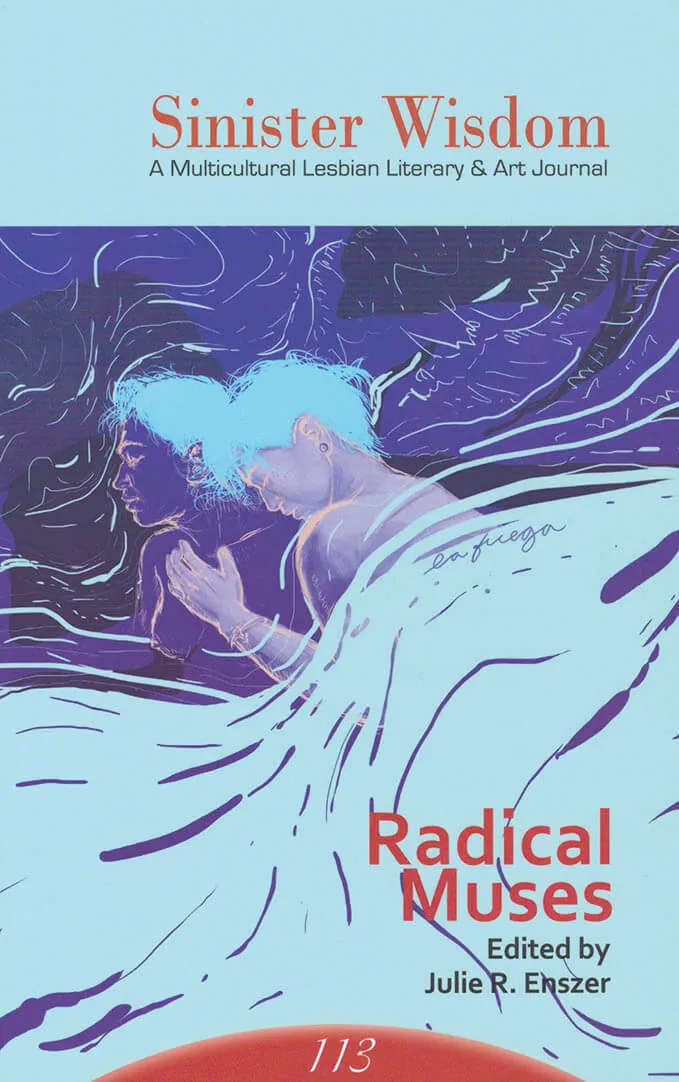
Cover of Radical Muses (Sinister Wisdom nr. 113)

Sinister Wisdom

Radical Muses (Sinister Wisdom nr. 113)

Julie R. Enszer

Sinister Wisdom 113: Radical Muses features an eclectic array of contemporary poetry, prose, and art by lesbians from around the world, including new work by: Andrea Assaf, Tara Shea Burke, Cheryl Clarke, Marina Chirkova, Estela González, Barbara Haas, Nancy E. Lake, Vi Khi Nao, H. Ní Aódagaín and much more!

Cover of The Letters of Audre Lorde and Pat Parker 1974-1989

the87press

The Letters of Audre Lorde and Pat Parker 1974-1989

Julie R. Enszer

Poets Audre Lorde and Pat Parker first met in 1969; they began exchanging letters regularly five years later. Over the next fifteen years, Lorde and Parker shared ideas, advice, and confidence through the mail. They sent each other handwritten and typewritten letters and postcards often with inserted items including articles, money, and videotapes.

The Letters of Audre Lorde and Pat Parker 1974-1989 gathers this unique correspondence in which Lorde and Parker discuss their work as writers as well as the intimate details of their lives, including periods when each lived with cancer. These letters are a rare opportunity to glimpse inside the minds and friendship of two great twentieth century poets.

Introduction by Mecca Jamilah Sullivan.

Cover of Theory, A Sunday

Belladonna* Collaborative

Theory, A Sunday

Louky Bersianik, Nicole Brossard and 4 more

Non-fiction €17.00

Collectively authored by Louky Bersianik, Nicole Brossard, France Théoret, Gail Scott, Louise Cotnoir, Louise Dupré, Lisa Robertson, and Rachel Levitsky. Twenty-five years after its first French language publication, Theory, A Sunday (2013), a collaborative feminist poetics text, marks the first in Belladonna’s new Germinal Texts series. Written through Sunday meetings in Montreal, this volume gathers six women’s theoretical feminist texts, with a new introduction by Lisa Robertson and afterword by Gail Scott and Rachel Levitsky. Translators of this text include Erica Weitzman, Luise von Flotow, Popahna Brandes, and Nicole Peyrafitte.

Germinal Texts trace feminist avant-garde histories and the poetic lineages they produce. Focused on authors and texts that provide generative grounds for other writers and their work, Germinal Texts gesture to networks of affiliation, whether explicit or subterranean; to kinships and inheritances; to the unfolding of a text through its readership; and to always provisional origins without endings. Germinal Texts are works that gather dense histories and, for this reason, the series is designed to hold a space for critical discussion, with contextualizing front and back matter that launches new conversations.

Louky Bersianik (1930-2011) is the author of twelve books of poetry and prose. Essayist, novelist and poet, her much admired novel L’Eugélionne is considered Québec’s first feminist novel (translated by Howard Scott as The Eugélionne (1996). Her novel Permafrost, 1937-38, won the Governor General’s award in 1997. Louky was born in Montréal and studied at Université de Montréal, the Sorbonne, and Centre d’études de radio et de television.

Nicole Brossard was born in Montréal. Poet, novelist and essayist, she has published more than forty books. Her work has been influential on a generation of poets and feminists. Her work has been widely acknowledged and translated in many languages. Her most recent book, translated into English by Erin Mouré and Robert Majzels, is WHITE PIANO (Coach House Books, 2013). Nicole Brossard lives in Montréal.

Louise Cotnoir has published seventeen books of poetry, fiction and drama. She was twice nominated for the Governor General’s Award for Poetry, most recently for Les îles (2005). Dis-moi que j’imagine was a finalist for the prestigious Académie des lettres du Québec poetry prize (1996). She has participated in numerous conferences on women and writing, notably “Women and Words” (Vancouver, 1983), “L’écriture des femmes au Québec” (Sweden, 1992), “L’originalité de l’écriture au féminin au Québec” (New Jersey, 1995). She has contributed to or served on the editorial boards of Sorcières (Paris), Estuaire, Arcade, Tessera, Matrix, Moebius, Room of One’s Own, Ellipse, Trivia (USA), Silencíada Festada Palabra (Barcelona), El Ciervo (Barcelona) and Cahiers internationaux du symbolisme (Brussels). Her work has been translated into English, Spanish, Catalan, Finnish and Chinese. Her last collection of poetry, Les soeurs de, appeared with Éditions du Noroît (2011), with a stage adaptation in Ottawa (2012) and Montréal (2013). Les îles, translated by Oana Avasilichioaei, appeared as The Islands in 2011. She lives in Montréal.

Poet, novelist and essayist, Louise Dupré has published twenty books. Her work has received numerous awards and has been translated in various languages. She has collaborated with artists of visual arts, cinema, video and dance. Her play Tout comme elle was produced on stage and directed by Brigitte Haentjens in Montréal in 2006 and in Toronto in 2011, during the Luminato Festival. Plus haut que les flammes won the Governor General’s Award for poetry as well as the Grand Prix du Festival international de la poésie de Trois- Rivières in 2011. She is a member of the Académie des lettres du Québec and the Royal Society of Canada. She was professor of creative writing and women’s writing in Université du Québec à Montréal for twenty years.

Gail Scott’s fourth novel, THE OBITUARY (Nightboat Books, 2012), was a finalist for the 2011 Montréal Book of the Year (Grand prix du livre de Montréal). Scott’s other experimental novels include My Paris (Dalkey Archive), HEROINE (Talonbooks, 1999), and Main Brides. She has published collections of essays, stories, manifestos, and collaborations with Robert Glück et al BITING THE ERROR (Coach House Books, 2004), shortlisted for a Lambda award (2005). Scott’s translation of Michael Delisle’s Le Déasarroi du matelot was a finalist for the Canadian Governor General’s award in translation. The Canadian journal Open Letter devoted its autumn 2012 edition to Scott’s work. She lives, mostly, in Montréal and teaches Creative Writing at Université de Montréal.

France Théoret is a Montreal poet, novelist and essayist. She holds a doctorate in French studies from the University of Sherbrooke, and taught literary studies from 1968 to 1987. She was a member of the editorial board of the journal La Barre du jour from 1967 to 1969, and is the author of one of the monologues in the 1976 theatre piece La Nef des sorcières. In that same year she co-founded the feminist journal Les Têtes de pioche and in 1979, the cultural magazine Spirale, which she directed from 1981 to 1984. She has published over twenty books and been nominated for many prizes. Most of her work has been translated into English. Her poetry is available in Italian, Spanish, and Portuguese and has appeared in anthologies in Quebec and abroad. In 2012, she was awarded the Athanase-David Prix du Québec for her entire oeuvre. She lives in Montreal.

Cover of Viscose 01: Style

Viscose Journal

Viscose 01: Style

Jeppe Ugelvig

Periodicals €35.00

The very first issue of Viscose tackles the expansive notion of “style”. Both a noun and a verb, style can be understood as the most basic unit or currency of fashion. Style names the very movement of aesthetics in society, and thus holds an important place in the critique of art and visual culture more broadly.

As a verb, it connotes a tactic: a dynamic tool for persuasion and communication through the bricolage of signifiers. It also relates directly to the contemporary profession of “styling”; a practice native to the fashion industry, but increasingly prevalent across the arts, media, consumerism, and politics. Thiss issue of Viscose sets out to critically gesture to all of these connotations and their potential intermingling through concrete case studies and cross disciplinary philosophical speculation.

with contributions by:
Shanzhai Lyric, David Lieske, Bakri Bakhit, Dena Yago, Matthew Linde, Burke Battelle & Ada O’Higgins, Davide Stucchi, Taylore Scarabelli, Mahoro Seward, Jordan Richman, Giorgi Gago Gagoshidze, Hito Steyerl, & Milos Trakilović, Laura Gardner, Avena Gallagher, Alex Esculapio, Elise by Olsen and Jeppe Ugelvig

Cover of Mousse #92

Mousse Publishing

Mousse #92

Various

Periodicals €16.00

Regions surface often in this issue—across arts, tales, and gatherings of individuals and meanings—as a possibility to bypass the borders of nation-states and the meta-geographies of colonial modernity.

Slavs and Tatars; Hera Chan on Stephanie Comilang; Stephanie Bailey on Ho Tzu Nyen; Drifting into the Atmospheric by Sohrab Mohebbi; Lauren Cook contributes nine newly commissioned note-like fiction pieces; Asad Raza on Édouard Glissant; Mira Dayal in conversation with Shanzhai Lyric, TJ Shin, and jina valentine; Temporary Communities, Four Points on Radically Public Institutions by Elvira Dyangani Ose; A Signature Truer Than the Name by Dani Blanga Gubbay; tidbits: Ruoru Mou by Amy Jones; Virginia Ariu by Brit Barton; Bagus Pandega by Harry Burke; Ceidra Moon Murphy by Alex Bennett; Oshay Green by Ikechúkwú Onyewuenyi; Shafei Xia in conversation with Danielle Shang; books by Christian Rattemeyer; Guest Design: Lamm & Kirch.

This issue comes with different covers, randomly distributed.

Mousse is a bimonthly contemporary art magazine. Established in 2006, Mousse contains interviews, conversations, and essays by some of the most important figures in international criticism, visual arts, and curating today, alternated with a series of distinctive articles in a unique tabloid format.

Cover of BRAIDS

beuys bois collective

BRAIDS

Natalia Irena Nikoniuk, Gabriela Galeao Batres

Periodicals €15.00

BRAIDS is a 130 pages-long publication that features both visual and written works of 20 young creatives. The desire of BRAIDS is to expand the idea of queerness beyond the borders of identity. The journal exists to host bodies that deny framing and dare to expose the vulnerability of their difference. The publication is thus a woven story of the contemporary globalised queer, insecure but daring, honey-glazed yet continuously aching. 

Cover of DUB

Duke University Press

DUB

Alexis Pauline Gumbs

Dub: Finding Ceremony takes inspiration from theorist Sylvia Wynter, dub poetry, and ocean life to offer a catalog of possible methods for remembering, healing, listening, and living otherwise.

"In DUB Alexis Pauline Gumbs continues with the third book in her poetry series, the first two books being Spill, inspired by Hortense Spillers, and M Archive, inspired by Jacqui Alexander. Whereas Spill deals with the contemporary afterlives of slavery and M Archive describes the post-dated evidence of our imminent apocalypse, DUB destroys Gumbs' own origin story, as she questions the assumptions and histories she has held onto most of her life. This text, through engagement with Sylvia Wynter's rigor, reinvents language outside of personal histories.

DUB is organized into topical sections, where spacious prose poems animate the voice of an underwater chorus in ceremonies that flow into one another. Beginning a daily writing practice, Gumbs wrote DUB based on moments of emphasis in Sylvia Wynter's essays (and one interview over several decades).

This book is influenced by the promiscuity and prolificity of dub music, the confrontational home-grown intimacy of dub poetry, and the descendants of this work. Dub uses the impact of repetition and the incantatory power of the spoken broken word. Gumbs uses dub to emphasize that Sylvia Wynter learned every colonial language and came to the conclusion that the ways of thinking that made colonialism and slavery imaginable were constructed over time and heretical to the ways of thinking that came before them; and so it must be possible to construct ways to understand life and place differently now as well.

Gumbs goes back to the origin stories that precede her and turns the blood into paint, emphasizing that "then" is also "now" through the broken and intense voices of ancestors. Inspired by Wynter's heretical poetic action against our deepest beliefs, DUB is an artifact and tool for breath retraining and interspecies ancestral listening.

Throughout the text, listening includes speakers who have never been considered human: whales and algae. Gumbs is attentive to kindred beyond taxonomy, questioning kinship loyalty, and suggests that our perceived survival needs are responses to a story we made up and told ourselves was written by our genes, a story that can be changed. This book will be of interest to scholars of African-American studies, diaspora studies, feminism, queer theory, English, creative writing and poetry"