rile*books

Search books

Search books by title, author, publisher, keywords...

Cover of Dances of Time and Tenderness

Nightboat Books

Dances of Time and Tenderness

Julian Carter

€18.00

A cycle of stories linking queer memory, activism, death, and art in a transpoetic history of desire and touch.

Dances of Time and Tenderness is a bold, sensual cycle of transpoetic stories that blend memory and movement in an innovative choreo-text of rage, sweetness and sorrow. A dance hall where the dead and the living meet, the tales take us from the dungeons of 1990s San Francisco to the goldsmith’s forges of the earliest cities, tracing a transgenderational lineage of queer carnality. Not a memoir, but a collective memory, Julian Carter invites us to join artists and AIDS activists, sailors and skeletons, to fulfill the trans promise: “what we do with our bodies changes worlds.”

Language: English

recommendations

Cover of Dreaming in the Fault Zone: A Poetics of Healing

Nightboat Books

Dreaming in the Fault Zone: A Poetics of Healing

Eleni Stecopoulos

Essays €28.00

A virtuosic inquiry into the forms and uses of healing, from ancient and modern medicine to contemporary literature, ecology, and protest.

In the era of the “chronic acute” long predating COVID-19, Eleni Stecopoulos set out to investigate the imagination, aesthetics, and ideology of healing—its mysteries and mystifications, its many channels and codes. Fusing lyric inquiry with cultural criticism, Dreaming in the Fault Zone explores art’s treatment of our conditions at a time of both increased cynicism about healing and longing for it. Stecopoulos talks to physicians, poets, psychotherapists, disability activists, ethnographers, spiritual seekers; curates performances and takes part in community rituals; documents pilgrimages and visits therapeutic landscapes. Whether writing about the poet H.D.’s psychoanalysis with Freud or madness and apartheid in Bessie Head’s novel A Question of Power, the salve of demagogues or a global alliance of people with contested illnesses, Stecopoulos confronts the poetics and politics of affliction, empathy, memory, and survival. Weaving together esoteric scenes and everyday practice, with flashes of humor, these essays travel in a space of impasse and unending experiment.

Cover of Memories That Smell Like Gasoline

Nightboat Books

Memories That Smell Like Gasoline

David Wojnarowicz

Biography €23.00

David Wojnarowicz, one of the most provocative artists of his generation, explores memory, violence, and the erotism of public space—all under the specter of AIDS.

Here are David Wojnarowicz’s most intimate stories and sketches, from the full spectrum of his life as an artist and AIDS activist. Four sections—”Into the Drift and Sway,” “Doing Time in a Disposable Body,” “Spiral,” and “Memories that Smell like Gasoline”—are made of images and indictments of a precocious adolescence, and his later adventures in the streets of New York. Combining text and image, tenderness and rage, Wojnarowicz’s Memories That Smell Like Gasoline is a disavowal of the world that wanted him dead, and a radical insistence on life.

The new and revised edition features a foreword by Ocean Vuong and a note from the editor, Amy Scholder.

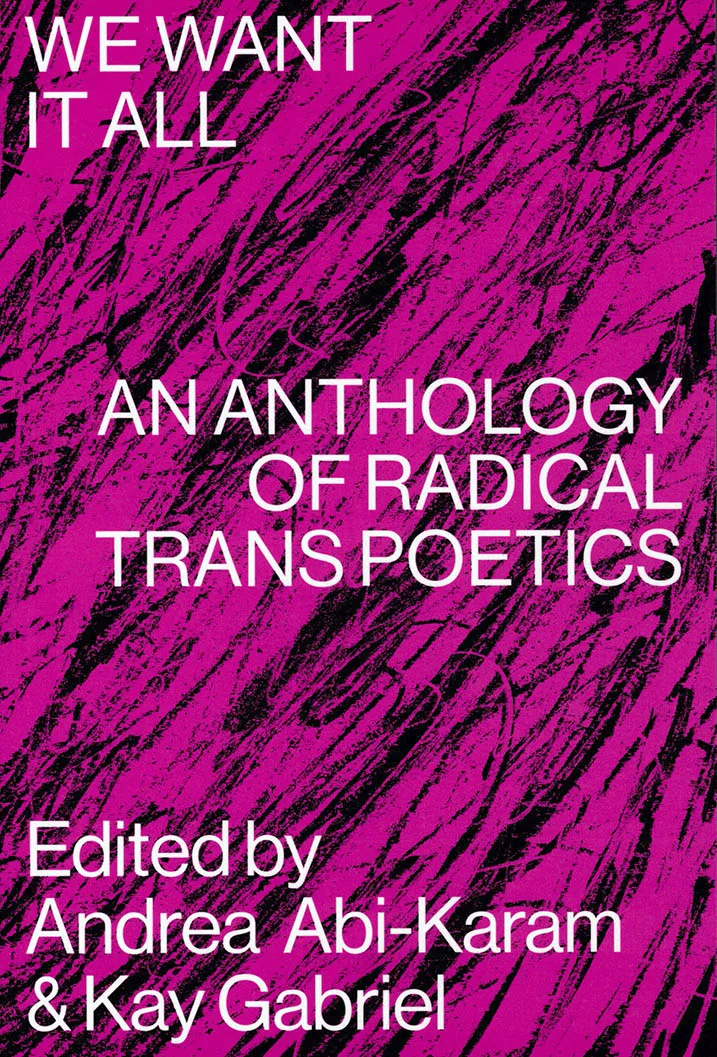
Cover of We Want It All: An Anthology of Radical Transpoetics

Nightboat Books

We Want It All: An Anthology of Radical Transpoetics

Kay Gabriel, Andrea Abi-Karam

LGBTQI+ €23.00

An anthology of formally inventive writing by trans poets against capital and empire.

With texts by: Andrea Abi-Karam, New York City Sam Ace, South Hadley, MA Bahaar Ahsan, Berkeley, CA jasper avery, Philadelphia, PA Ari Banias, Berkeley, CA Jo Barchi, Chicago, IL Joss Barton, St. Louis, MO Levi Bentley, Philadelphia, PA Jessica Bet, Baltimore, MA Rocket Caleshu, Los Angeles, CA Ching-in Chen, Seattle, WA listen chen, Vancouver, BC Faye Chevalier, Philadelphia, PA Cody-Rose Clevidence, Arkansas Miles Collins-Sibley, Easthampton, MA Valentine Conaty, New York City CA Conrad, Philadelphia, PA Jimmy Cooper, Rochester, MI Maxe Crandall, Oakland, CA José Díaz, Boston, MA Aaron El Sabrout, New Mexico Ian Khara Ellasante, Lewiston, ME Caelan Ernest, New York City, NY NM Esc, San Diego, CA joshua jennifer espinoza, Los Angeles, CA Logan February, Ibadan, Nigeria Ray Filar, Brighton, UK Nora Collen Fulton, Montreal, Canada Kay Gabriel, New York City Callie Gardner, Cardiff, Wales Jesi Gaston, Chicago, IL Harry Josephine Giles, Edinburgh, Scotland Aeon Ginsberg, Baltimore, MD Caspar Heinemann, Berlin, Germany Kamden Hilliard, Greenville, SC Stephen Ira, New York City Cyrée Jarelle Johnson, New York City Peach Kander, New York City Jayson Keery, Western, MA Evan Kleekamp, Los Angeles, CA Noah LeBien, New York City Ty Little, Richmond, VA Zavé Martohardjono, New York City Amy Marvin, Philadelphia, PA Natalie Mesnard, New York City Bianca Rae Messinger, Iowa City, IA Liam O'Brien, New York City Xandria Phillips, Madison, WI Rowan Powell, Santa Cruz, CA Nat Raha, Edinburgh, Scotland Holly Raymond, Philadelphia, PA Jackie S, New York City Trish Salah, Toronto, Canada Raquel Salas Rivera, Philadelphia, PA Mai Schwartz, New York City Kashif Sharma-Patel, London, UK Julian Talamantez Brolaski, Oakland, CA Charles Theonia, New York City Jamie Townsend, Oakland, CA Nora Treatbaby Laurel Uziell, London, UK Rachel Franklin Wood, Boulder, CO Clara Zornado Akasha-Mitra xtian w. and Anaïs Duplan, NYC.

Kay Gabriel is a poet and essayist. She's the author of Elegy Department Spring / Candy Sonnets 1 (BOAAT Press, 2017), the recipient of fellowships from Lambda Literary and the Poetry Project, and recently completed her PhD at Princeton University.

Andrea Abi-Karam is an arab-american genderqueer punk poet-performer cyborg, writing on the art of killing bros, the intricacies of cyborg bodies, trauma & delayed healing. Their chapbook, THE AFTERMATH (Commune Editions), attempts to queer Fanon's vision of how poetry fails to inspire revolution. Andrea's first book, EXTRATRANSMISSION (Kelsey Street Press, 2019), is a poetic critique of the U.S. military's role in the War on Terror.

Cover of A Queen in Bucks County

Nightboat Books

A Queen in Bucks County

Kay Gabriel

Poetry €18.00

An epistolary sequence about sex, exchange and social space set along the Northeast Corridor. 

In A Queen in Bucks County, our protagonist Turner, who both is and is not the writer, makes his pleasurable way through miserable space. Men "buy him things," lovers drive across state lines, users down volatile cocktails to see what happens, landlords turn tenants out, and Turner writes poetic tracts to friends about it. Part pornography, part novel, all love letter, A Queen in Bucks County is an experiment in turning language upside down to see what falls out.

2023 LAMBDA LITERARY AWARD FINALIST

Cover of The Nightmare Sequence

Nightboat Books

The Nightmare Sequence

Omar Sakr, Safdar Ahmed

An extraordinary collaboration by an award-winning duo—poet Omar Sakr and visual artist Safdar Ahmed–that bears witness to the genocide in Gaza.

The Nightmare Sequence is a searing response to the atrocities in Gaza and beyond since October 2023. Heartbreaking and humane, it is a necessary portrait of the violence committed by Israel and its Western allies. Through poetry and visual art, Omar Sakr and Safdar Ahmed capture these historic injustices, while also critiquing the role of art and media—including their own—in this time. Born of collective suffering and despair, their collaboration interrogates the position of witness: the terrible and helpless distance of vision, the impact of being exposed to violence of this scale on a daily basis, and what it means to live in a society that is actively participating in the catastrophic destruction of Arabs and Muslims overseas. With a foreword by Palestinian American poet George Abraham, this book will serve as a vital record in decades to come.

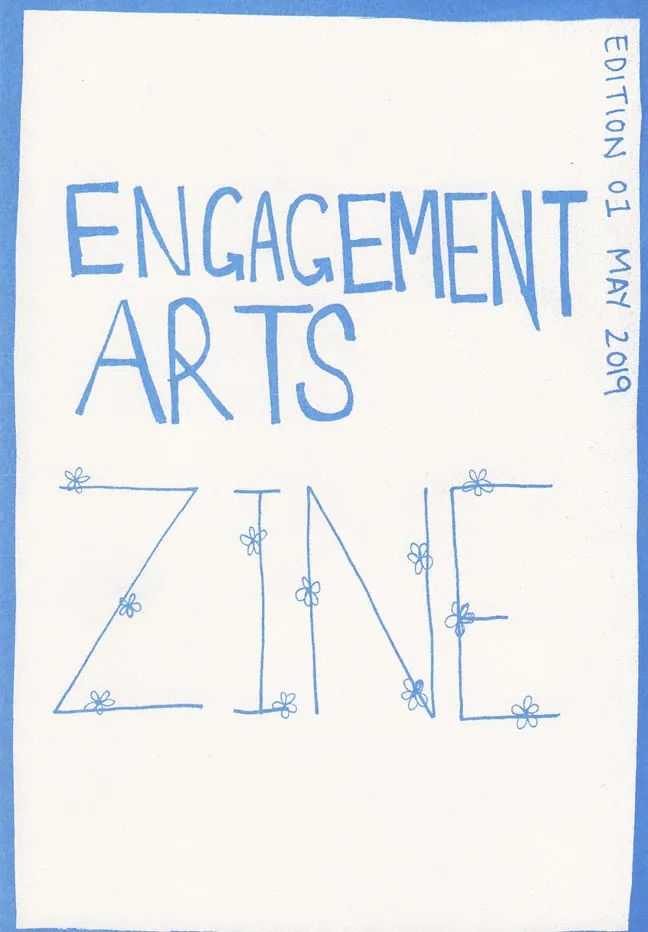
Cover of Engagement Arts Zine #1

Self-Published

Engagement Arts Zine #1

Engagement Arts

First edition of the Engagement Arts Zine.

Published May 2019

Cover of Christian Eschatology of Artificial Intelligence: Pastoral Technologies of Cybernetic Flesh

becoming press

Christian Eschatology of Artificial Intelligence: Pastoral Technologies of Cybernetic Flesh

Giorgi Vachnadze

Non-human €12.00

The book tracks the overlap of various “regimes of truth” from the Greco- Roman period through to the AI and cybernetic period, in order to present a continuity that ties together Christian Pastoralism and Neoliberal Self-Governance. The result is a fascinating and detailed examination of western hegemonial doctrines and signs, such as the Logos, the Flesh, and the Fall. 

Vachnadze leaves us with no conclusion besides a certain feeling in our stomachs, a feeling that often comes when someone makes you aware of something fascinating, but deeply unnerving. The author weaves scripture and theory together in a way which can be as exciting as conspiratorial fictions, but it is executed without compromising the respectable position he has established at the point where non meets sense.

Cover of T (poem)

Materials

T (poem)

Laurel Uziell

Poetry €13.00

T is a long poem in multiple parts and its author's second book. “The two genders are YES and NO, so you stutter or else shut up forever”. 

From the Afterword: "Between 2017-2018 I was involved in a trial with a group of TERFs after a scuffle emerged during a counter protest against a ‘debate’ about sex-based rights in light of proposed reforms to the Gender Recognition Act which would have made trans people’s lives marginally easier. Luckily I wasn’t actually in the dock, but I appeared to give evidence, and for everyone involved it was a humiliating ordeal as we were doxxed, harrassed online and in real life, while the relentless media campaign which ensued took a toll on the entire trans community. The caricaturesque reduction of a complex interrelation of political positions, epistemologies, traumas and personal grievances into two ‘sides’ ultimately worked to further the persecution of trans people, but nevertheless highlighted a social logic on whose terms the so called debate was forced to appear: sex was pitted against gender (or more revealingly ‘gender identity’), objective biology against subjective ‘self-identification’, nature against culture, or perhaps, first nature against second nature."

What does a poet say (what does anyone say), when placed on the stand, how answer the binary logics forced like a cage in the legally-grounded violence which splittingly interrogates solidarity, the splitting invocation of law? In answer, T spreads across the page as if desperately finding a form for speech acts forced into a garrotted tick-box, a witness stand, video evidence, Nature’s originary disguise as history or vice versa, wrapped inside ‘common sense’ as a pronominal shroud, in the policing of body, speech, and every fungible fibre of being. The author writes: “I want the whole text to be a kind of horrific inorganic body with awkward parts, both to replay at the level of form some of the critiques of organicist thinking with reference to nature that the poem tries to articulate, and also, more glibly, to be somewhat like a trans body, awkwardly fitting together with some parts undercutting others”. An extended enquiry into Materialism and its material (fleshed) stakes, driven through the heart and to the heart of things, T sees lyric poem shudder to line-broken essay to fragment of play to citational drop; in tight compression sprawling, a poem whose argument is necessary and necessarily incomplete, poetry can do thinking, this thinking we do outside and within it, sprung trap, open and closing door. 

Cover of The Fantasy and Necessity of Solidarity

Penguin Books

The Fantasy and Necessity of Solidarity

Sarah Schulman

Non-fiction €30.00

From award-winning writer Sarah Schulman, a longtime social activist and outspoken critic of the Israeli war on Gaza, comes a brilliant examination of the inherent psychological and social challenges to solidarity movements, and what that means for the future. 

For those who seek to combat injustice, solidarity with the oppressed is one of the highest ideals, yet it does not come without complication. In this searing yet uplifting book, award-winning writer and cultural critic Sarah Schulman delves into the intricate and often misunderstood concept of solidarity to provide a new vision for what it means to engage in this work—and why it matters. 

To grapple with solidarity, Schulman writes, we must recognize its inherent fantasies. Those being oppressed dream of relief, that a bystander will intervene though it may not seem to be in their immediate interest to do so, and that the oppressor will be called out and punished. Those standing in solidarity with the oppressed are occluded by a different fantasy: that their intervention is effective, that it will not cost them, and that they will be rewarded with friendship and thanks. Neither is always the case, and yet in order to realize our full potential as human beings in relation with others, we must continue to pursue action towards these shared goals. 

Within this framework, Schulman examines a range of case studies, from the fight for abortion rights in post-Franco Spain, to NYC’s AIDS activism in the 1990s, to the current wave of campus protest movements against Israel’s war on Gaza, and her own experience growing up as a queer female artist in male dominated culture industries. Drawing parallels between queer, Palestinian, feminist, and artistic struggles for justice, Schulman challenges the traditional notion of solidarity as a simple union of equals, arguing that in today’s world of globalized power structures, true solidarity requires the collaboration of bystanders and conflicted perpetrators with the excluded and oppressed. That action comes at a cost, and is not always effective. And yet without it we sentence ourselves to a world without progressive change towards visions of liberation. 

By turns challenging, inspiring, pragmatic, and poetic, The Fantasy and Necessity of Solidarity provides a much-needed path for how we can work together to create a more just, more equitable present and future.

Cover of Through an Addict’s Looking-Glass

Hajar Press

Through an Addict’s Looking-Glass

Waithera Sebatindira

Non-fiction €18.00

Through an Addict’s Looking-Glass is an exercise in meaning-making, a thinking-out-loud. Waithera Sebatindira unravels how it feels to live as an addict under capitalism, pondering how engaging with these experiences could bring the horizon of liberation towards us.

Through embodied explorations of addiction and recovery, Sebatindira invites us to inhabit crip time, a concept that describes different temporal realities in the lives of disabled people. In this collection, the addict’s crip time is distorted, mutable and non-linear, hopping backwards and forwards through memory loops and memory loss. Blackout is time travel; sobriety is failure; finitude, freedom.

An uncompromising rejection of the objectification of addicts across the political spectrum, this powerful meditation on illness, disability, solidarity and spirituality illuminates their indispensable contributions to the building of a new world.

Waithera Sebatindira is a Kenyan writer based in London. Their previous writing and research interests have included food imperialism, drag kings and gender transformation. They are a co-author of A FLY Girl’s Guide to University.