rile*books

Search books

Search books by title, author, publisher, keywords...

Cover of An Image of My Name Enters America: Essays

Graywolf Press

An Image of My Name Enters America: Essays

Lucy Ives

€20.00

What would you risk to know yourself? Which stories are you willing to follow to the bitter end, revise, or, possibly, begin all over? In this collection of five interrelated essays, Lucy Ives explores identity, national fantasy, and history. She examines events and records from her own life―a childhood obsession with My Little Pony, papers and notebooks from college, an unwitting inculcation into the myth of romantic love, and the birth of her son―to excavate larger aspects of the past that have been suppressed or ignored. With bracing insight and extraordinary range, she weaves new stories about herself, her family, our country, and our culture. She connects postmodern irony to eighteenth-century cults, Cold War musicals to a great uncle’s suicide to the settlement of the American West, museum period rooms to the origins of her last name to the Assyrian genocide, and the sci-fi novel The Three-Body Problem to the development of modern obstetrics. Here Ives retrieves shadowy sites of pain and fear and, with her boundless imagination, attentiveness, and wit, transforms them into narratives of repair and possibility.

Language: English

recommendations

Cover of The Slicks: On Sylvia Plath and Taylor Swift

Graywolf Press

The Slicks: On Sylvia Plath and Taylor Swift

Maggie Nelson

Essays €12.00

In The Slicks, Maggie Nelson positions culture-dominating pop superstar Taylor Swift and feminist cult icon Sylvia Plath as twin hosts of the female urge toward wanting hard, working hard, and pouring forth—and as twinned targets of patriarchy’s ancient urge to disparage, trivialize, and discipline creative work by women rooted in autobiography and abundance. 

A buoyant melding of popular culture and literary criticism, The Slicks is a captivating and unexpected assessment of two iconic female artists by one of the most revered and influential critics of her generation.

Cover of Dysphoria Mundi: A Diary of Planetary Transition

Graywolf Press

Dysphoria Mundi: A Diary of Planetary Transition

Paul B. Preciado

LGBTQI+ €22.00

A revolutionary book tracing the collapse of the paradigms that have organized the world for centuries. 

In Dysphoria Mundi, Paul B. Preciado, best known for his 2013 cult classic Testo Junkie, has written a mutant text assembled from essays, philosophy, poetry, and autofiction that captures a moment of profound change and possibility. Rooted in the isolation of the COVID-19 pandemic, and taking account of the societal convulsions that have ensued, Preciado tries to make sense of our times from within the swirl of a revolutionary present moment.

The central thesis of this monumental work is that dysphoria, to be understood properly, should not be seen as a mental illness but rather as the condition that defines our times. Dysphoria is an abyss that separates a patriarchal, colonial, and capitalist order hurtling toward its end from a new way of being that, until now, has been seen as unproductive and abnormal but is in fact the way out of our current predicament.

With echoes of visionaries such as William S. Burroughs and Kathy Acker, Preciado’s theoretical writing is propelled by lyric power while providing us with a critical toolbox full of new concepts that can guide our thinking and our transition, cognitive emancipation, denormalization, disidentification, “electronic heroin,” digital coups, necro-kitsch. Dysphoria Mundi is Preciado’s most accessible and significant work to date, in which he makes sense of a world in ruins around us and maps a joyous, radical way forward.

Cover of The Hormone of Darkness: A Playlist

Graywolf Press

The Hormone of Darkness: A Playlist

Tilsa Otta, Farid Matuk

Poetry €19.00

In Tilsa Otta’s The Hormone of Darkness, we find a queer, Latinx person who has lived through iterations of authoritarian rule, and who answers these conditions by creating poetry that doubles down on a life force that precedes and exceeds received notions of the poetic. Here poetry is bawdy, fabulist, and spiritual—in short, it is alive. Otta has created a heaven where readers can go after they die. 

Drawing from four volumes spanning Otta’s career, translator-poet Farid Matuk has curated a playlist we can dance and dream to, one that honors Otta’s drive toward liberation through both perreo in the club and transdimensional wandering among the stars.

We can go on like that forever
building paradise from our urges
out of our fetishes our loves our vices
How lucky
We’ll wait for you then
Don’t be too long
Bookmark the page
We’ll be Here
—From “The New Heaven”

Translated from the Spanish by Farid Matuk.

Cover of Don't Call Us Dead

Graywolf Press

Don't Call Us Dead

Danez Smith

Poetry €16.00

Award-winning poet Danez Smith is a groundbreaking force, celebrated for deft lyrics, urgent subjects, and performative power. Don’t Call Us Dead opens with a heartrending sequence that imagines an afterlife for black men shot by police, a place where suspicion, violence, and grief are forgotten and replaced with the safety, love, and longevity they deserved here on earth. Smith turns then to desire, mortality—the dangers experienced in skin, body, and blood—and a diagnosis of HIV positive. “some of us are killed / in pieces,” Smith writes, “some of us all at once.” Don’t Call Us Dead is an astonishing collection, one that confronts America where every day is too often a funeral and not often enough a miracle. 

Danez Smith is the author of [insert] boy, winner of the Lambda Literary Award for Gay Poetry and the Kate Tufts Discovery Award. Smith has received fellowships from the McKnight Foundation and the Poetry Foundation, and lives in Minneapolis.

Cover of The Argonauts

Graywolf Press

The Argonauts

Maggie Nelson

Autofiction €17.00

Maggie Nelson's The Argonauts is a genre-bending memoir, a work of autotheory offering fresh, fierce, and timely thinking about desire, identity, and the limitations and possibilities of love and language. It binds an account of Nelson's relationship with her partner and a journey to and through a pregnancy to a rigorous exploration of sexuality, gender, and family. An insistence on radical individual freedom and the value of caretaking becomes the rallying cry for this thoughtful, unabashed, uncompromising book.

Cover of Glaring

Wendy's Subway

Glaring

Benjamin Krusling

Poetry €18.00

Glaring: a sustained look of anger, an obvious fact, a situation of such brightness and intensity that vision is obscured. In his debut book of poems, Benjamin Krusling is concerned with reading domination and violence and entering their psychotic motion, the better to do otherwise. Through the thicket of anti-blackness, militarism, surveillance, impoverishment, and interpersonal abuse and violence, Glaring investigates the things that haunt daily life and make love difficult, possible, necessary.

Benjamin Krusling's Glaring is the winner of our 2019 Open Reading Period, and was selected by guest judge Lucy Ives.

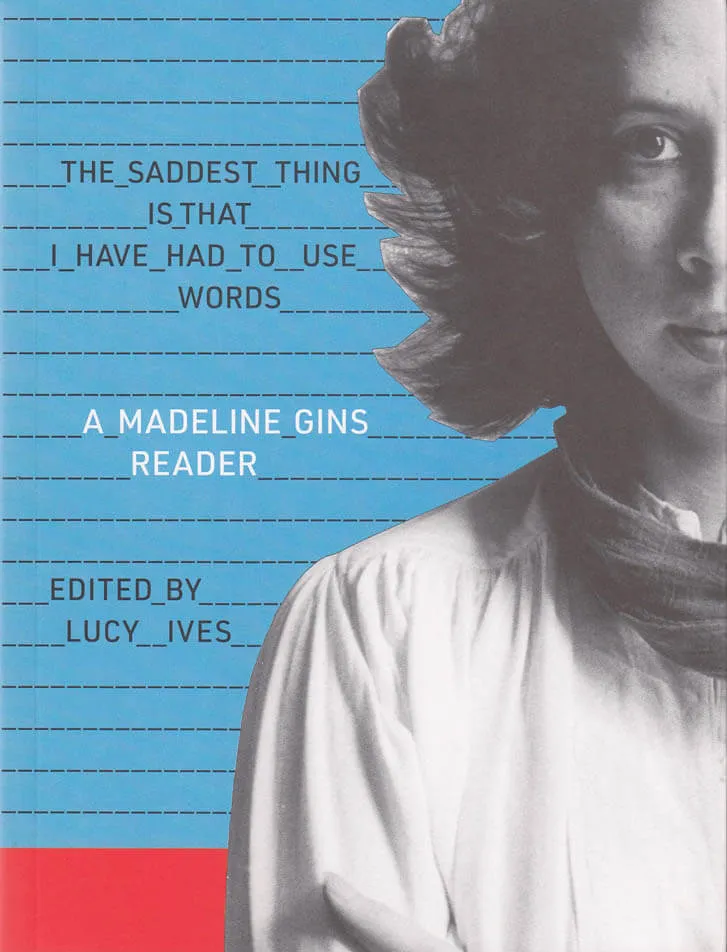
Cover of The Saddest Thing Is That I Have Had to Use Words: A Madeline Gins Reader

Siglio Press

The Saddest Thing Is That I Have Had to Use Words: A Madeline Gins Reader

Madeline Gins

Poetry €28.00

Poet, philosopher, speculative architect and transdisciplinary artist, Madeline Gins is well known for her collaborations with her husband, the artist Arakawa, on the experimental architectural project Reversible Destiny, in which they sought to arrest mortality by transforming the built environment. Yet, her own writings — in the form of poetry, essays, experimental prose and philosophical inquiries — represent her most visionary and transformative work. Like Gertrude Stein before her, Gins transfigures grammar and liberates words. Like her contemporaries in conceptual art, her writing is attuned to the energized, collaborative space between reader and page.

The Saddest Thing Is That I Have Had to Use Words: A Madeline Gins Reader is a revelatory anthology, edited and with an introduction by the writer and critic Lucy Ives. It brings never-before-published poems and essays together with a complete facsimile reproduction of Gins' 1969 masterpiece, WORD RAIN (or A Discursive Introduction to the Intimate Philosophical Investigations of G, R, E, T, A, G, A, R, B, O, It Says), along with substantial excerpts from her two later books What the President Will Say and Do!! (1984) and Helen Keller or Arakawa (1994). Long out of print or unpublished, Gins' poems and prose form a powerful corpus of experimental literature, one which is sure to upend existing narratives of American poetics at the close of the 20th century.

Edited by Lucy Ives. 

Cover of Devenir minéral | L’éditeur du dimanche

Avarie Publishing

Devenir minéral | L’éditeur du dimanche

Giuliana Prucca

Essays €38.00

Echoing Jean Dubuffet's idea that thought must arise from material in artistic practice, Giuliana Prucca, through this essay, reinterprets a moment in the history of 20th-century art using materials such as stone, sand, earth, and dust. She employs the mineral to illustrate that the creative act would be a trace of the body's disappearance. The loss of humanity and the deconstruction of the subject objectify themselves in the image. In other words, art resides in the tension between representation and its loss, ultimately leaving nothing but an image.

Drawing from the influential figure of Antonin Artaud, she weaves critical and poetic connections between the texts and works of various artists, writers, and thinkers, ranging from Jean Dubuffet to Jan Fabre and Anselm Kiefer, Yves Klein and Gutaï, Joë Bousquet to Camille Bryen and Francis Ponge, Gaston Bachelard to Gilles Deleuze, and Georges Bataille to Aby Warburg.

The material is not merely a thematic pretext; it is an active and explosive catapult that questions the arbitrary linearity of a conventionally assimilated art history. Following Ponge's example, Prucca applies the principles of poetry to criticism, starting from Artaud's material, the most undisciplined of poet-artist-thinkers of the modern era. This results in a critically inventive approach dangerously suited to its object, celebrating an anti-critique. The chosen writing materials, stonepaper for the cover and recycled paper for the pages, is consistent, intending to give the impression of being covered in dust.

The essay disrupts traditional reading habits and shatters the conservatism of art criticism by inhabiting writing space differently, presenting a physically engaging interaction. This is an essay in the literal sense, an experience where form never contradicts content, urging readers to take the risk of thinking deeply and embracing a new rhythm. A complex and challenging design invites them to choose different reading options, ultimately treating criticism as one would poetry.

Giuliana Prucca [Paris | Berlin] is an independent curator, researcher, and writer. She is the founder and art director of the publishing house AVARIE, specialising in contemporary art books that explore the relationships between text and image, body and space.

Graphic design, art direction by Vito Raimondi