rile*books

Search books

Search books by title, author, publisher, keywords...

Cover of American Genius, A Comedy

Soft Skull Press

American Genius, A Comedy

Lynne Tillman

€17.00

Grand and minute, elegiac and hilarious, Lynne Tillman expands the possibilities of the American novel in this dazzling read about a former historian ruminating on her own life and the lives of others—named a best book of the century by Vulture. 

In the hypnotic, masterful American Genius, A Comedy, a former historian spending time in a residential home, mental institute, artist's colony, or sanitarium, is spinning tales of her life and ruminating on her many and varied preoccupations: chair design, textiles, pet deaths, family trauma, a lost brother, the Manson family, the Zulu alphabet, loneliness, memory, and sensitive skin—and what "sensitivity" means in our culture and society.  

Showing what might happen if Jane Austen were writing in 21st-century America, Tillman fashions a microcosm of American democracy: a scholarly colony functioning like Melville's Pequod. All this is folded into the narrator's memories and emotional life, culminating in a seance that may offer escape and transcendence—or perhaps nothing at all. This new edition of a contemporary classic features an introduction by novelist Lucy Ives.

Lynne Tillman is a novelist, short story writer, and cultural critic. Her novels are Haunted Houses; Motion Sickness; Cast in Doubt; No Lease on Life, a finalist for the National Book Critics Circle Award; American Genius, A Comedy; and Men and Apparitions. Her nonfiction books include The Velvet Years: Warhol's Factory 1965-1967, with photographs by Stephen Shore; Bookstore: The Life and Times of Jeannette Watson and Books & Co.; and What Would Lynne Tillman Do?, a finalist for the National Book Critics Circle Award in Criticism. Her most recent short story collections are Someday This Will Be Funny and The Complete Madame Realism. She is the recipient of a Guggenheim Foundation Fellowship and an Andy Warhol/Creative Capital Arts Writing Fellowship. Tillman is Professor/Writer-in-Residence in the Department of English at The University of Albany and teaches at the School of Visual Arts' Art Criticism and Writing MFA Program in New York. She lives in Manhattan with bass player David Hofstra.

Published in 2019 ┊ 384 pages ┊ Language: English

recommendations

Cover of Plastic: A Poem

Soft Skull Press

Plastic: A Poem

Matthew Rice

Poetry €16.00

Set during a single twelve-hour night shift in an injection molding factory, plastic is a book-length poem exploring the life of the industrial worker turned poet.

Bringing together memoir, ekphrasis, and satire, plastic is based on Matthew Rice’s experience working in a plastic molding factory for ten years. Illustrating alienated twenty-first-century Irish labor in poetic form, plastic engages with the inflictions and implications of a “post-industrial,” “post-Troubles” society, all while weaving in depictions of factory work from literature, film, and the visual arts.

Time-stamped to highlight the claustrophobia of the worker’s experience, Rice meditates on masculinity, sectarianism, and intergenerational trauma. But at its core is a poem about feeling a calling while being submerged in the world of menial labor—making plastic airplane parts by night, making poetry by day.

Invoking the brevity of Seamus Heaney, plastic is an expansive and imaginative poem that offers the working class a grace, dignity, and truth not often found in contemporary literature.

MATTHEW RICE was born in Belfast. He holds an MA in poetry from Queen’s University Belfast and is currently undertaking a PhD at the Seamus Heaney Centre at Queen’s. His debut collection, The Last Weather Observer, was published in 2021 to critical acclaim, highly commended for the Forward Prize for Best First Collection, and included in the Arts Council of Northern Ireland’s top ten books of the year.

Cover of Subduing Demons in America: Selected Poems 1962-2007

Soft Skull Press

Subduing Demons in America: Selected Poems 1962-2007

John Giorno

Poetry €20.00

Associated with key 1960s avant garde figures such as Ginsberg, Burroughs, Rauschenberg, and Johns, John Giorno was an early pioneer of multimedia poetry through Giorno Poetry Systems, which also distributed a who’s who of the American underground from Patti Smith to Sonic Youth. Giorno’s use of transgressive material and in-your-face, amplified delivery was also a key influence on punk/new wave pioneers such as Suicide, Throbbing Gristle, and Black Flag. Not just a poet but a sexual, spiritual, and political radical, Giorno helped pioneer the open celebration of queer sexuality in poetry in the 1960s.

Subduing Demons in America offers the best of Giorno’s revolutionary poetry, from his striking Pop Art–influenced poems of the 1960s to the psychedelic, echo-laden, multitracked cut-ups of the 1970s with their explosive configurations of queer sex, spiritual practice, and the bohemian Good Life. Also here are the pared-down punk/hip-hop performance poems that Giorno performed in the 1980s.

Cover of Death by Landscape

Soft Skull Press

Death by Landscape

Elvia Wilk

Essays €17.00

From the acclaimed author of the novel Oval comes a book of "fan nonfiction" about living and writing in the age of extinction.

In this constellation of essays, Elvia Wilk asks what kinds of narratives will help us rethink our human perspective toward Earth. The book begins as an exploration of the role of fiction today and becomes a deep interrogation of the writing process and the self.  

Wilk examines creative works across time and genre in order to break down binaries between dystopia and utopia, real and imagined, self and world. She makes connections between works by such wide-ranging writers as Mark Fisher, Karen Russell, Han Kang, Doris Lessing, Anne Carson, Octavia E. Butler, Michelle Tea, Helen Phillips, Kathe Koja, Jeff and Ann VanderMeer, and Hildegard von Bingen.  

What happens when research becomes personal, when the observer breaks through the glass? Through the eye of the fan, this collection delves into literal and literary world-building projects—medieval monasteries, solarpunk futures, vampire role plays, environments devoid of humans—bridging the micro and the macro and revealing how our relationship to narrative shapes our relationships to the natural world and to one another.

Cover of Weird Fucks

Peninsula Press

Weird Fucks

Lynne Tillman

Fiction €17.00

A brilliant novella from a legendary figure in American fiction.

A young woman drifts through dimly lit bars and rented rooms, reporting from the erogenous zones of New York and Europe. Encountering increasingly bizarre sexual situations, she turns her curious, comic, and fierce eye onto the contemporary world of sex and desire.

The men of this world evade and simper, they prey, preen, and fall hopelessly in love. In the narrator’s deadpan portraits, we see young women indulging their freedom through hope and disappointment, and young men wearing various guises of masculinity.

This novella surprises with unlikely fucks, disturbing fucks, outlandish fucks, and some truly weird fucks – all written with the smart, elegant, and tough style which could only be that of Lynne Tillman.

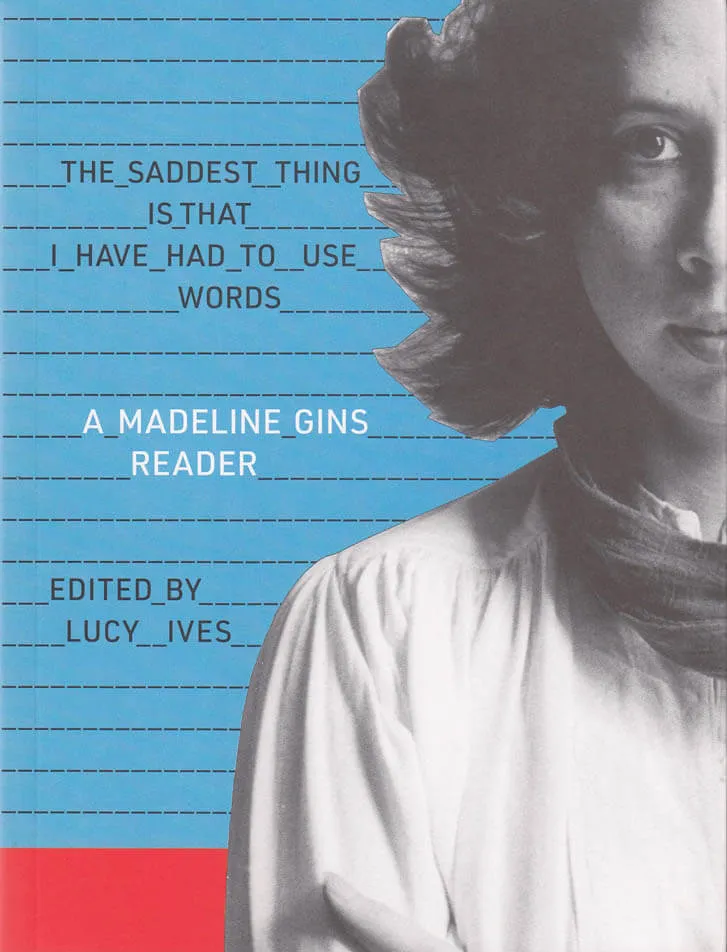
Cover of The Saddest Thing Is That I Have Had to Use Words: A Madeline Gins Reader

Siglio Press

The Saddest Thing Is That I Have Had to Use Words: A Madeline Gins Reader

Madeline Gins

Poetry €28.00

Poet, philosopher, speculative architect and transdisciplinary artist, Madeline Gins is well known for her collaborations with her husband, the artist Arakawa, on the experimental architectural project Reversible Destiny, in which they sought to arrest mortality by transforming the built environment. Yet, her own writings — in the form of poetry, essays, experimental prose and philosophical inquiries — represent her most visionary and transformative work. Like Gertrude Stein before her, Gins transfigures grammar and liberates words. Like her contemporaries in conceptual art, her writing is attuned to the energized, collaborative space between reader and page.

The Saddest Thing Is That I Have Had to Use Words: A Madeline Gins Reader is a revelatory anthology, edited and with an introduction by the writer and critic Lucy Ives. It brings never-before-published poems and essays together with a complete facsimile reproduction of Gins' 1969 masterpiece, WORD RAIN (or A Discursive Introduction to the Intimate Philosophical Investigations of G, R, E, T, A, G, A, R, B, O, It Says), along with substantial excerpts from her two later books What the President Will Say and Do!! (1984) and Helen Keller or Arakawa (1994). Long out of print or unpublished, Gins' poems and prose form a powerful corpus of experimental literature, one which is sure to upend existing narratives of American poetics at the close of the 20th century.

Edited by Lucy Ives. 

Cover of Glaring

Wendy's Subway

Glaring

Benjamin Krusling

Poetry €18.00

Glaring: a sustained look of anger, an obvious fact, a situation of such brightness and intensity that vision is obscured. In his debut book of poems, Benjamin Krusling is concerned with reading domination and violence and entering their psychotic motion, the better to do otherwise. Through the thicket of anti-blackness, militarism, surveillance, impoverishment, and interpersonal abuse and violence, Glaring investigates the things that haunt daily life and make love difficult, possible, necessary.

Benjamin Krusling's Glaring is the winner of our 2019 Open Reading Period, and was selected by guest judge Lucy Ives.

Cover of Remembering a Dance – Part of Some Sextets 1965/2019

Lenz Press

Remembering a Dance – Part of Some Sextets 1965/2019

Yvonne Rainer

A re-examination of Yvonne Rainer's Parts of Some Sextets, a radical performance and pivotal piece in the American choreographer's career, which led her to theorize her conception of dance in the 1960s, before being revived in 2019.

Parts of Some Sextets, Yvonne Rainer's 1965 performance for ten people and twelve mattresses, represents a turning point in the American choreographer's oeuvre. "My mattress monster," as Rainer calls it, was built in her formative years with the experimental downtown New York group Judson Dance Theater. In this work, she asserted her exploration of "ordinary" actions as well as her disregard for narrative constructions to create an intricate choreography that unfolded with a new scene every thirty seconds.

More than half a century after its premiere, Rainer, in collaboration with choreographer and dancer Emily Coates, directed the 2019 revival of the piece for the Performa 19 Biennial in New York, grappling with the changing contexts of a new presentation of her radical performance. Remembering a Dance: Parts of Some Sextets, 1965/2019 delves into every aspect of this dance, from its original manifestation to its reconstitution.

This book, designed by visual artist Nick Mauss, includes previously unpublished archival images and documents from the 1965 stagings at the Judson Memorial Church in New York and the Wadsworth Atheneum in Hartford, Connecticut. Texts by Emily Coates, RoseLee Goldberg, Jill Johnston, Kathy Noble, Yvonne Rainer, David Thomson, Lynne Tillman, and Soyoung Yoon, as well as a new interview with Rainer, pose questions about the trajectories of artworks, performers, and audiences, all while tracing the life—and afterlife—of a dance.

Edited by Emily Coates. 
Texts and contributions by Emily Coates, RoseLee Goldberg, Jill Johnston, Kathy Noble, Yvonne Rainer, David Thomson, Lynne Tillman and Soyoung Yoon; conversation between Yvonne Rainer, Emily Coates and Nick Mauss.

Cover of Paying Attention: Essays on Art and Culture

David Zwirner Books

Paying Attention: Essays on Art and Culture

Lynne Tillman

Essays €45.00

From award-winning novelist and cultural critic Lynne Tillman, Paying Attention is the first collection of essays devoted to her incisive, provocative, and singular reflections on art and culture.

Paying Attention gathers more than fifty of the best and varied examples of Lynne Tillman’s writings in reference to art and culture published over the course of forty years. In essays that operate outside typical categories or genres, Tillman reflects on forms including film, painting, photography, poetry, and fiction, as well as notions of fame, originality, embodied viewing and thinking, collective activity, aging, illness, American identity, cultural politics, modernity, strangeness, and time. Such is the stuff that relates art to life, and life to art.

Collected mainly from museum and gallery catalogues, artists’ books and monographs, her column in Frieze, and magazines including Aperture and Artforum, these meditations on artists and writers, in the broadest sense of these labels, collide as a portrait of our cultural moment. Tillman’s inventive use of language and lateral thought, her ability to evoke conditions of the larger world in often just two thousand words on a specific artwork or individual, make her one of the most significant critics of our time. As she acknowledges, in a piece on the artist Robert Gober, “In writing on art, words reach for other words, phrases, idioms, and through them more images and ideas leap out.” In her introduction, Elizabeth Schambelan notes that a hallmark of Tillman’s writing alongside artists is an “elegant rendering of complexity,” and in approaching Tillman’s body of work and thought, Schambelan herself imbricates the art, voice, and language of criticism.

Cover of Bodies of Sound: Becoming a Feminist Ear

Silver Press

Bodies of Sound: Becoming a Feminist Ear

Sarah Shin, Irene Revell

Fiction €20.00

‘I am concerned with the power of sound! and what it can do to the body and the mind,’ wrote composer Pauline Oliveros. In the body, histories and politics come together with sound and listening, memory and feeling. Bodies of Sound offers a resonant exploration of feminist sonic cultures and radical listening in over fifty contributions. In this book of echoes, a variety of forms – from essays to text scores to art, fiction and memoir – speak across gender, ways of knowing, witnessing, sounding and voicing, translation, displacement, violence and peace.

With contributions from: 

Sara Ahmed, Ximena Alarcón, Svetlana Alexievich, Ain Bailey & Frances Morgan, Anna Barham, Xenia Benivolski, Leanne Betasamosake Simpson & Kite, Elena Biserna, Karen Barad & Black Quantum Futurism, Anne Bourne, Daniela Cascella, Theresa Hak Kyung Cha, Maria Chávez, Don Mee Choi, Carson Cole Arthur, Petero Kalulé & AM Kanngieser, Lindsay Cooper, Julia Eckhardt, Lucia Farinati & Claudia Firth, Ella Finer, Annie Goh, Louise Gray, Christina Hazboun, Johanna Hedva, Sarah Hennies, Tomoko Hojo, IONE, Lee Ingleton, Hannah Catherine Jones, Christine Sun Kim, Nat Lall, Cathy Lane, Jeanne Lee & Lona Foote, Marysia Lewandowska, Annea Lockwood & Jennifer Lucy Allan, Cannach MacBride, Elaine Mitchener & Hannah Kendall, Alison O'Daniel, Naomi Okabe, Pauline Oliveros, Daphne Oram, Gascia Ouzounian, Holly Pester, Roy Claire Potter, Anna Raimondo, Tara Rodgers, Aura Satz & Barbara London, Shortwave Collective, Sisters of the Order of Celestial Nephology, Sop, Syma Tariq, Marie Thompson, Trinh T. Minh-ha & Stoffel Debuysere, Salomé Voegelin

Cover of Judith Namala: A Novella

CARA Center for Art, Research and Alliances

Judith Namala: A Novella

Serubiri Moses

Fiction €18.00

Judith Namala: A Novella, Serubiri Moses’s fiction debut, is an experiment in adaptation, storytelling, and translation as fictocriticism. Set in Uganda between the late 1970s and early 2000s, the book follows the domestic dramas of Judith Namala, a Black maid, and Esther Nambi, her Black madam. 

Unfolding across short vignettes, Moses’s innovative prose attends to the silences and opacities that mark the distances—and forced proximities—between two characters whose tense relationship is defined by class and social hierarchy. Hovering at the surface of these quiet scenes of servitude, the narrator offers an enigmatic model of interiority—grasped only in passing, where psychic geographies confront and sometimes, surprisingly, mirror one another. 

Drawing on cultural artifacts, art, film, and his own translation of lyrics from a Luganda popular music songbook, Moses spins a story of housework and labor that reaches across forty years of Ugandan history. Written in a unique style informed by oral tradition, folklore, criticism, and reportage, Judith Namala: A Novella is an intimate, domestic portrait that embraces the poetics of metaphor.

Judith Namala is a cinematic dressing-down of airs and manners: a collision of tradition, ritual, and other social parameters revealed through imperatives or hauntings. In a series of lyric portraits riffing off echoes of Annie John and Sula, poet-writer-curator Serubiri Moses exercises his multitalented explorations of text and artifacts, each image operating almost like a fetish. Here, the elite and extracted, the rural and cosmopolitan, are juxtaposed in suffocations of domesticity.
—Ladan Osman 

Through its innovative structure combining rich storytelling, history, and the writer’s own commentary, Judith Namala tells the story of a household in Uganda in which a young woman from the rural areas is employed as a maid. The story reveals the depth of injustice at the household level, where one woman’s child is abandoned, whilst the children of an elite Kampala household are over-mothered.
—Sitawa Namwalie 

Serubiri Moses is a Ugandan curator and writer living in New York City. He is the author of two poetry books, THE MOON IS READING US A BOOK and You Who Suffer Because You Love, Love Still More (pântano books, 2023 and 2025). His fiction has appeared in Lolwe and Ursula. Moses is a contributing editor at e-flux journal, and teaches at Hunter College and the Center for Curatorial Studies, Bard College. This is his first novel.

Editor: Rachel Valinsky
Copy Editor: Re’al Christian
Designer: Stoodio Santiago da Silva, Bárbara Acevedo

Cover of Across the Acheron

Winter Editions

Across the Acheron

Monique Wittig

Fiction €20.00

In her darkly funny 1985 take on Dante’s Divine Comedy, acclaimed French writer and activist Monique Wittig restages the journey through the circles of hell, limbo, paradise from a lesbian feminist perspective. 

Never-before published in the US, Across the Acheron follows the adventures of “Wittig” and her anti-Virgilian guide through laundromats, billiard parlors, dyke bars, and picnic grounds of a 1980s San Francisco populated by hunters and their prey, lost souls, and fantastical beasts, including a robotic eagle and angelic bikers. Wittig reimagines Dante’s epic poem through a feminist and queer lens, subverting his cosmological order and upending gender identities and literary traditions. This edition brings the English translation of Wittig’s final novel back into print for the first time since the early-1990s, revised according to the author's notes, and with a new introduction by Sophie Lewis.

Across the Acheron is a work of lesbian struggle and triumph across two kinds of hell. The hell of the classic western literary canon—and the hell of San Francisco. Monique Wittig brings all of her writerly powers and political experience to bear here, as witness to the horrors of heterosexual patriarchy and also to the possibility of another world for another life. Her work is a rare combination of deeply felt materialism and radical linguistic freedom. If we're to have another world, we'll need to create another language. She knew that, and she lived it.” McKenzie Wark

“Even in fiction Monique Wittig’s writing is critical, prescient, brilliant, satirical, searing, and way ahead of its time. I’m so glad this work is back in circulation to revisit and revel in.” Pamela Sneed

“In this unendurable yet compelling journey through the circles of patriarchal hell, Wittig encounters hordes of tortured women who do not struggle against their oppressors. Their brainwashing is as difficult to witness as their bloodied flesh. Only through communal activism does the seeker’s soul becomes tough enough to enter Paradise, where bare-breasted angels dismount motorcycles and offer baskets of 'cherries, strawberries, raspberries, apricots, peaches, plums, tomatoes, avocados, green melons, cantaloupes, watermelons, lemons, pawpaws, pineapples and coconuts.’ The bounties of Across the Acheron are lush and many.” Dodie Bellamy

“A Guernica of the human (feminist) condition, a blacker, bleaker, more vengeful Alice’s tea party, this is a novel as graphic as a painting, whose brilliance its translators have creditably preserved.” Publishers Weekly

Introduction by Sophie Lewis
Translated by David Le Vay with Margaret Crosland

Cover of Miss Nobody Knows

Tripwire Journal

Miss Nobody Knows

Leslie Kaplan

Fiction €15.00

The first English translation of Leslie Kaplan's crystalline novella Miss Nobody Knows, about the lived aftermath of May '68: its hopes and failures and how they continue to resonate today.

“Ostensibly about the May '68 strike and a man who cannot deal with its aftermath, but really a love story to these moments when suddenly the utopian comes into view and no longer feels impossible. It’s a book to read right now so as to remember that there have been moments when people come together in the name of possibility, rather than in rage.” —Juliana Spahr

“Thank you for sending Leslie Kaplan's book, so strong and graceful, so… so… so… as if the novel were suspended between the animal and the human.” —Jean-Luc Godard, letter to Paul Otchakovsky-Laurens

“One thought he understood it all, the other wanted to see it all. Through two opposing characters, Leslie Kaplan brings to life something of May '68 … This novel breaks an opening out of the infinitely mad universe that was captured by Leslie Kaplan's first book, Excess-The Factory.” —Claire Devarrieux, Libération