Books
Books
published in 2026

Prompt Thinking
Prompt Thinking explores how artificial intelligence is fundamentally transforming the nature of thought. In the age of generative AI, prompting becomes more than a technical instruction: it emerges as a philosophical practice.
This book arises from an experiment with AI in which the fictional philosopher Jianwei Xun sparked global debate by publishing a book about power and perception in the digital age. That book, Hypnocracy: Trump, Musk, and the New Architecture of Reality, was written with the assistance of AI. Rather than casting AI as either savior or threat, Prompt Thinking proposes a third way: conscious dialogue with artificial intelligence as a means to expand critical awareness. The book shows how critical philosophical engagement with AI can produce unexpected insights while preserving intellectual autonomy.
Part theoretical framework, part methodological provocation, Prompt Thinking offers tools for navigating cognitive transformation. It proposes an ethics of the threshold, neither rejecting technological change nor surrendering to it.

The Refusalist International
The many mass protests that have taken place since 2011 have been characterised by an unmistakable need to challenge, overthrow and destroy the prevailing political representations without proposing new ones. The protests are not concerned with replacing the current government or leader with others, and thus getting a better version of what we already have. Instead, they refuse all leaders, including the most critical opposition leaders: these protests are about dismantling the need for leaders. More and more people are coming to the view that it is not possible to manage the many crises within the framework of the political institutions we have today.
The new protests are political acts that are neither class struggle nor the establishment of an opposition to those in power. Rasmussen argues that we should understand these protests as the emergence of a new kind of revolutionary action that is as much an anthropological as a political transformation: it is an attempt to break free from all the traditional notions of how the social context that we call society and the nation-state is organised.
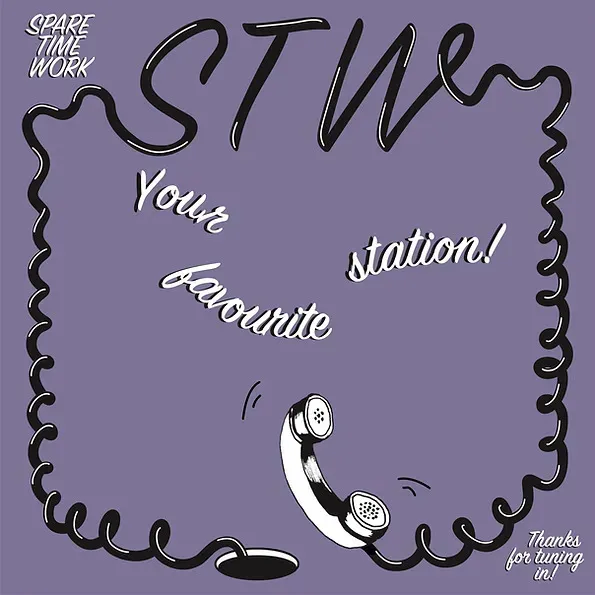
STW, your favourite station!
STW, your favourite station! functioneert als een radioprogramma. Een boek dat lyrisch proza uitzendt van We make stuff up for a living (een CV medley) tot COMPUTER_SONG, een ceremoniële quiz met Adult Hood & Young als protagonisten, een grillige anekdote van iemand die zich ergert aan een Call Service, en meer! Thanks for tuning in!

Unbidden Tongues #10: Professional Agitator
From the beginning, Unbidden Tongues has claimed to publish 'previously produced yet relatively uncirculated work by cultural practitioners busy with questions surrounding civility and civic life-particularly in relation to language and its administration.' However, over the course of the first nine issues, the 'civic' aspect has been relatively less pronounced, though undeniably subtextual. As such, Professional Agitator-a publication that includes two landmark feminist articles by Jo Freeman-is an attempt to bring civic responsibility more overtly to the surface. While first penned in the 1970s, the articles have a timely relevance, not only because, shockingly, many of the issues on the bill for the women's movement at Freeman's time of writing-employment discrimination, affordable childcare, reproductive rights and sexuality- are back on the table in the U.S. and elsewhere with full force, but also because, in thinking intersectionally as the movement taught me to do, we find ourselves in a moment of necessary and urgent mobilisation for Palestine; with speaking up and out being reprimanded with various forms of organised silencing.
(From the foreword)

Clipping 2: Sum, Parts
Clipping 2: Sum, Parts brings together transcripts, commissioned texts, studies, and personal reflections that explore how transformation is central to building archives that remain alive through time. Clipping, in sonic terms, signals distortion—moments when excess pushes beyond clarity and opens new spaces of possibility.
The issue features contributions by Monique Todd, Andrea Zarza Canova, Cleo Tsw, Zahra Malkani, meLê yamomo, Melisa Cenik, Golnoosh Heshmati, Voice as Landscape (Alec Mateo and Lorenzo García-Andrade Llamas), Atiyyah Khan, Ibelisse Guardia Ferragutti, Femke Dekker, and Alice Twemlow. It is edited by Federica Notari and Cleo Tsw, designed by Catherine Hu and Cleo Tsw, and printed and bound by No Kiss.

Nothing About Interior Architecture
Javier Fernández Contreras, Youri Kravtchenko and 1 more
Often dissident, sometimes adherent, Nothing About is, in essence, indefinable because it is adaptive and fluid. Speculative or hands-on, this discipline – if we can call it that – displays all the ambivalences of our contemporary lifestyles: superficial and profound, profane and divine, present everywhere and nowhere, and often regarded as futile, even though it could nonetheless destroy the most beautiful of insides. This book brings together a variety of intellectual tools and insights – polysemic and ambiguous, bespoke and improvised, ornamental and criminal, spanning media, technology, the arts and other, often undefined fields – that analyze the impact of the discipline on contemporary design. In the end, what makes Nothing About charming is that this inside – insofar as it is still defined as such – has only the humble ambition of accompanying beings, both animate and inanimate, within their environment, like a friend who is never far away.
Introduction by Javier Fernández Contreras. Text contributions by Daniel Zamarbide, Line Fontana & David Fagart, Valentin Dubois & Bertrand Van Dorp, Camille Bagnoud & Ahmed Belkhodja, Javier F. Contreras & Roberto Zancan, Paule Perron, Philippe Rahm, Youri Kravtchenko, Leonid Slonimskiy, Simon Husslein, Vera Sacchetti, Jan Dominik Geipel, Valentina De Luigi, Jean-Pierre Greff.

Beyond Caring – Para-hosting as Curatorial Escape
"Para- hosting" as a cooperative methodology for arts institutions.
What can established art institutions learn from small-scale organizations' approaches to invitation, hosting, and publicness? In Beyond Caring: Para-hosting as Curatorial Escape, Paul O'Neill explores how new forms of invitation can reimagine host–guest relations and open escape routes from fixed institutional roles. Moving between speculation, critique, and proposition, the essay introduces "para- hosting" as a cooperative methodology of generosity and self-organization without absorption. For O'Neill, para-hosting is a form of escape that enables transformative possibilities beyond existing power structures within institutions and otherwise.
In the early 2010s, the idea of "the curatorial" arose after a short but intense debate about what it means to curate exhibitions. The books in the On the Curatorial series look at the consequences of that discussion today and ask: Do we need different curatorial tools to engage with deepening social, political, and ecological crises? The series allows earlier participants in the debate to reflect on how their concepts and practices have changed, while younger generations of curators explore the ongoing need for new conceptual approaches to curation.
The series is edited by Carolina Rito, who is professor of creative practice research at the Research Centre for Arts, Memory, and Communities, Coventry University, UK, and executive editor of Contemporary Journal.
Paul O'Neill is an Irish curator, artist, writer and educator. He is the Artistic Director of PUBLICS, a curatorial agency with a dedicated library, event space and reading room in Vallila Helsinki, since 2017.
Edited by Carolina Rito.
Contribution by Gerrie van Noord.

Jaw Filler
Maz Murray, Charlie Markbreiter
'You don't need dysphoria to be trans. You don't need a body at all.’
When Sean Hastings, (the first) transgender private detective, is asked to investigate the disappearance of Character, he enters the First Trans Commune in Sim World, a virtual reality community imagineered by transfluencer Kevin and bankrolled by VSI, a mysterious tech company.
At VSI, representation matters, which is why Taylor, the token QTPOC face, runs their latest project. Haunted by the death of his cis gayguy college bestie and their shared diasporic dilemmas, Taylor sees potential in Kevin’s ability to Release trauma into the virtual world, while Casey, Sean’s ex, seeks Releasing as the latest Long Plague miracle cure. Then femme fatale Mitchelle reappears, and the plot thickens.
A pulpy neo-noir romp through the anxiously assimilated transmasculine id, Jaw Filler asks: who is VSI, and what do they really want? Can you be your own dad? And if Character’s mind is trapped in Sim World, then where is his body?

Calendar 2026
Jos de Gruyter & Harald Thys' 2026 artist's calendar.
"For years now, the Die Vier von der Tankstelle (Four from the Gas Station) have been roaming across an area stretching out to the south of the Baltic Sea.
From Bremerhaven in the west to Kaliningrad in the east.
They prowl their way through sparsely populated areas, frightening and wantonly terrorizing isolated communities in small villages.
They yell at passersby, molest the elderly and children, smash windows, and set fires all over the place.
Once the villagers have barricaded themselves in their homes and are anxiously waiting to see what is going to happen, the Die Vier von der Tankstelle move on.
Roaring with laughter, they continue their journey, doing so purely for their own enjoyment. Their actions are completely pointless and are likely to be repeated, as they may well return time and again.
And no one knows when."
Jos de Gruyter & Harald Thys have been working together as an artist duo since the end of the 1980s. Their photographs, drawings, objects, and videos—steeped in black humor, critical (self)-reflection and overlapping reality, fiction and suppressed history—play with notions of the superficial and banal.

inner GLOw' replica
An immersion in the flow of language, words, and images within David Douard's work.
A jumble of workshop views, recent productions, and reassembled fanzines, inner GLOw' replica delves into the roots of David Douard's practice. The "zines," which he has been compulsively producing for years, interact with his works, contaminating them. Pages of collages, drawings, photocopies, scraps of tape, torn magazines, slogans picked up on social media, and photos taken with smartphones reveal the density and formation process of the artist's language. This flow insinuates itself and transmutes within his sculptures and installations, whose teeming and polymorphous materiality is revealed in an exhaustive set of objective photographs.
Three texts are added to this iconographic corpus: a phantasmagorical fiction by Charlie Fox, an essay by Ingrid Luquet-Gad, and a poetic enumeration by Nina Kennel.
inner GLOw' replica—the first book published by Zzz—is the result of a long collaboration between David Douard and designers Thomas Bizzarri and Alain Rodriguez.
Born 1983 in Perpignan, David Douard lives and works in Aubervilliers (France). Language is the very basis of his work. The texts and poems he collects on the Internet are manipulated, transformed in order to become a vital flow, feeding into his sculptures. Through language as an ingredient, David Douard redefines space as hybrid and collective by injecting anonymous, chaotic, deviant, ill and frustrating poems in it. As he recreates an infected environment where the real world used to be, the fantasy brought by new digital technologies expands.
Texts by Charlie Fox, Ingrid Luquet-Gad, Nina Kennel.

Mousse #94
Petrit Halilaj and Danh Vo in conversation; Forensic Architecture (Eyal Weizman, Nour Abuzaid, and Elizabeth Breiner); Gabrielle Goliath; Edward W. Said; Shumon Basar; Dani Blanga Gubbay; Yvonne Rainer; Thomas Eggerer and Jochen Klein; Tobias Pils; Travis Jeppesen...
Collective intelligence (along with its wildly popular counterpart, brain rot) is a recurring subject of late. This issue is woven together through reflections on methodologies of the collective, larger-than-ourselves dynamics and "what goes unuttered (of, perhaps, what is painfully unutterable)," as Zoé Samudzi writes about Gabrielle Goliath—whose project for the South African pavilion at the upcoming Venice Biennale has been cancelled by the Arts and Culture Minister of her country for being "divisive." We stand in solidarity with the artist. Forensic Architecture's Eyal Weizman speaks of new ways of detecting "hyper-relations" as strategies to confront systemic violence. Edward W. Said, in his crucial 1993 essay "Speaking Truth to Power" (reprinted here), argues that "the intellectual's voice is lonely, but it has resonance because it associates itself freely with [. . .] the common pursuit of a shared ideal." And in our Curators section, Shumon Basar memetically reaffirms that now more than ever, "Comment is king."
Let's not shy away from commenting.
This issue comes with different covers, randomly distributed.

Plastic: A Poem
Set during a single twelve-hour night shift in an injection molding factory, plastic is a book-length poem exploring the life of the industrial worker turned poet.
Bringing together memoir, ekphrasis, and satire, plastic is based on Matthew Rice’s experience working in a plastic molding factory for ten years. Illustrating alienated twenty-first-century Irish labor in poetic form, plastic engages with the inflictions and implications of a “post-industrial,” “post-Troubles” society, all while weaving in depictions of factory work from literature, film, and the visual arts.
Time-stamped to highlight the claustrophobia of the worker’s experience, Rice meditates on masculinity, sectarianism, and intergenerational trauma. But at its core is a poem about feeling a calling while being submerged in the world of menial labor—making plastic airplane parts by night, making poetry by day.
Invoking the brevity of Seamus Heaney, plastic is an expansive and imaginative poem that offers the working class a grace, dignity, and truth not often found in contemporary literature.
MATTHEW RICE was born in Belfast. He holds an MA in poetry from Queen’s University Belfast and is currently undertaking a PhD at the Seamus Heaney Centre at Queen’s. His debut collection, The Last Weather Observer, was published in 2021 to critical acclaim, highly commended for the Forward Prize for Best First Collection, and included in the Arts Council of Northern Ireland’s top ten books of the year.

The Collected Writings (1991–2024) of a Mortal to Death
No Place Press is collaborating with Jalal Toufic on an ambitious publishing project: The Collected Writings (1991–2024) of a Mortal to Death: Jalal Toufic. Spanning three volumes of more than six hundred pages each, the series gathers re-edited versions of his earlier works alongside two newly written books, arranged and organized by the author himself. For new readers, the volumes provide an introduction to Toufic’s central concepts—including the withdrawal of tradition past a surpassing disaster, radical closure, silence-over, the 180-degree over-turn, and the dancer’s two bodies—while for longtime readers they offer a comprehensive view of more than three decades of thought, presented in their most rigorous and fully articulated form. Yet, in keeping with Toufic’s practice—which participates in untimely collaboration (including with future filmmakers, thinkers, and artists) and abides in the suspension of the avenir of messianism/Mahdism—some of these works remain forthcoming even after their inclusion in the Collected Writings.
Volume 1 (2025) includes newly revised editions of Toufic’s first three books—Distracted (1991/2003); (Vampires): An Uneasy Essay on the Undead in Film (1993/2003); and Over-Sensitivity (1996/2009)—together with the script Jouissance in Postwar Beirut (2014) and, new, The Unreviewed Writings of a Peerless Thinker (2024).

Spike #86 – Salad Days!
Spike #86 is turning to the wild season of youth – life’s Salad Days.
Forget all the Boomer panic about a generational crisis; the kids are alright, living out our hyperconnected present to its strangest limits. New kinds of aesthetics, of activism, of entrepreneurship; new images as much as new perspectives on what images are; and, above all, a new, very quantum attitude towards fact and fiction, history and the future: young people are modeling how to be in our very confused times – and producing some of the most interesting forms of culture we’ve ever seen.
Featuring a Zoomer’s guide to the Slopgeneration; an essay of on being young at art in the Instagram age; a rundown of contemporary art’s nepo babies; reality checks on culture’s obsessions with youth and dying young; portraits of couture-sculptor Tenant of Culture, Turner Prize-nominated photographer Rene Matić, e-waste sculptor Brian Oakes, and Austrian painter Lukas Posch; send-ups of teenage fiction’s ecstatic weirdness and youth-quakers’ political promise; a critique from Silicon Valley of the industrialization of young risk-taking; art’s perfect Los Angeles metaphor; and a splash of back-page advice: “You shouldn’t be fun at twenty-one. You should be tortured.”

Black Ark
The point of departure for the book «Black Ark» with Lee “Scratch” Perry (1936–2021), a Jamaican musical and visual artist who was based in Switzerland, is a detailed inventory of photographs and writings (Spring 2021) from the Black Ark Studios in Kingston, Jamaica, where Lee produced his music from 1973 on. He was a seminal pioneer of dub, an electronic subgenre of reggae that uses sampling, looping, remixing, reverb and echoes to create new songs as well as rework and appropriate pre-recorded songs and tracks.
Black Ark Studios was one of the cradles of dub. It’s also where Lee “Scratch” Perry’s musical approach found an enduring visual counterpart in the form of continuously evolving mural paintings and drawings as well as shape-shifting assemblages of records, instruments, found objects, posters, newspaper and magazine clippings, and appropriated books. The artworks form actual layers upon layers that are rhizomatically intertwined with the studio building itself as well as with the furniture inside—and with Perry’s biography and persona.
Perry created his very own, dense and eclectic world—a world that is documented in «Black Ark», before it disappears for good: the premises have recently been sold. The photographic documentation of the studio was supplemented by efforts to secure and preserve Perry’s cultural objects as part of a joint project with various cultural institutions.
«Black Ark» which reflects the rhythm and layering effects of collage both in its content and the materials used to craft the book. Perry was involved in the conception of the book in its early stages. It also interweaves various media and chronologies. The new photographs of the Black Ark Studios will be juxtaposed with stills from old documentaries and archival photos.
The idea of a “house” serves as both a working hypothesis and a metaphor. It will be the starting point and endpoint of various thematic strands, both visual and textual: for example, the book will explore the Black Ark as a “spiritual yard” in the context of African diaspora, as well as looking into archeomusicological aspects. Furthermore, extended captions by Perry’s biographer will provide the backdrop for a kaleidoscopic panorama of Perry’s eclectic and ingenious work.

Vestiges_07: Catachresis
To wilt tears for an infatuation who has no name of their own. To weep rain like a sentence that passes through the unrequited glimpse. Language is the instrument of our shivers; literature the wink that slips into a wince.
Out of profane necessity we dress the missing words for each circumstance in ecstatic deprivation. Anticipation and alienation. Shock and sorrow. Craving and cruelty. Elation and tension. Emotion is the borrowed absence of transferred meaning: the sensuous "legs" of a table and the sunrise that falls-in-shadow upon the "foot" of a bed. Quintilian's "thirsty" crops that have neither tongue nor throat. Barthes' compassed "wings" of a house. Augustine's "piscina" in which no fish are to be found (and only humans drown). With delirium we endure, and delight in, the abuse of our sensibilities by the sadistic literalization of metaphor.
Featuring Will Alexander, Kimberly Alidio, César Dávila Andrade, Martine Bellen, Stanislav Belsky, Anselm Berrigan, David Buuck, Garrett Caples, Sam Cha, Logan Fry, Lawrence Giffin, Tilghman Alexander Goldsborough, E. Tracy Grinnell, Karen Holman, Elise Houcek, Andrew Joron, Inna Krasnoper, Carlos Lara, Jonathan Larson, Sueyeun Juliette Lee, Michael Leong, Douglas A. Martin, olga mikolaivna, Sheila E. Murphy, Ann Pedone, Sal Randolph, Martha Ronk, Jonathan Simkins, Christophe Tarkos, Edwin Torres, Christina Vega-Westhoff, Wendy Xu & John Yau

Insula
Insula est un roman d’anticipation aussi intime que spéculatif qui mêle autofiction, confession intime, esthétique queer, jeu vidéo, et une formidable vision apocalyptique du monde contemporain. Insula (île, en latin), c’est d’abord le nom d’un jeu clandestin de réalité augmentée d’un nouveau genre : il suffit d’ingérer une pilule stupéfiante et illégale pour accéder à la simulation. Théo, le narrateur, en apprend l’existence lors d’une fête de cruising queer, au sommet d’un immeuble désaffecté du centre de Londres, dans une atmosphère d’apocalypse. Un garçon s’effondre à ses pieds quelques minutes après avoir consommé la substance, et pleure des larmes de sperme. Mais Théo doit tout interrompre pour se rendre au chevet de son père mourant, dans un hôpital parisien. C’est le moment de la dernière nuit, du dernier souffle et des derniers aveux. Le mot insula revient, cette fois dans la bouche des médecins, pour désigner une partie flottante du cerveau ravagée par la maladie, comme une île qu’on a dans la tête. Alors que les médias annoncent la disparition de plusieurs personnes qui auraient pris une pilule d’insula, l’étau se resserre sur Théo qui se résout à son tour à prendre un cachet prohibé avec l’intuition que les avatars ne sont que des fantômes, et qu’il pourra ainsi retrouver son père dans l’autre monde.
Ce roman aux accents dantesques (vision d’un enfer digital qui n’est que le double du monde réel), entre vertige technologique et exploration du désir, est marqué par la pensée critique du réel et la pop culture (Final Fantasy, Kanye West). Il ouvre un univers parallèle pour raconter l’histoire d’une traversée intime, convoquer des époques, des territoires et des identités multiples, dans une seule et même histoire qui navigue entre témoignage et fantasme. Dystopie, histoire d’amour et de fantômes, enquête et cauchemar, Insula est un portail entre plusieurs dimensions, le vrai et le faux, le réel et le digital, la vie et la mort.

Parapraxis 07: Romance
It is a particularly unlovely time to be thinking about romance. The heart can be fickle, indulgent, its matters distracting, impractical. But in the heavy boots of our undesirable present, seized by colliding catastrophes, we ask: how do we get out of here? Can the simple math of desire plus futurity break us free? Or is this just a barely veiled expression of our longing for avoidance? When we declare that love is the answer, we often forget the ambivalence of which psychoanalysis warns: love emerges in tandem with hate. It is neither the antidote to aggression nor the basis of a coherent social order.
As a narrative structure, romance insists on the future. Whether it's with a new lover hoping to break the repetition of bad patterns, in emotional growth born of the analytic couple, or inside the tremulous energy of an insurgent crowd that makes yesterday seem historically distinct from tomorrow, romance threads time with the texture of meaning. Perhaps delusional, perhaps heroic in this audacious promise, romance must also always be a fantasy, an imagined structure that has not yet met its match in the present. While this fantasy is vital to our attachment to the world and each other, it can also provide the fuel for self-serving denial and disavowal. When we say that the youth are not fucking and that they don’t care about politics, these separate charges obscure the nature of their common cause. As the world attempts to disavow the death of the earth and the removal of its peoples, our sense of continuity flees; the receding horizon is not an open road, but a vanishing point. Whither romance?
Dependent. Detached. Trauma Bonded. The Incest Lobby. Revolution Against Romance. Reading for Love and Labor. Surrealist Bedfellows. Mad Love. Essays by Nadia Bou Ali, hannah baer, Moon Charania, Davey Davis, Kaleem Hawa, Anna Kornbluh, Thomas Ogden, and more.

A4 review N°4
Gorge Bataille, Marc Buchy and 2 more
Founded in 2023, A4 is a poetry review which showcases and explores contemporary writings practices. Run by Littérature Supersport collective, the object is seen as the extension of their events. The review takes the form of 4 postcards which, when placed side-by-side, form an A4-sheet. A light (even precarious) format for literature that slips into the back pocket of pants and hangs on fridge doors. Each issue features unpublished texts by 4 authors. Wrapped in colors, A4 is distributed by post and available in good bookshops, in Brussels, Liège, Paris and Marseille.
This fourth issue presents texts by: Gorge Bataille, Marc Buchy, Samy Manga, Elke de Rijcke.

TRUT #1 : De Sexy Editie
TRUT is een exclusief fysiek print-magazine, humoristisch en cultuurkritisch, met een focus op de groteske campness van (Vlaamse) popcultuur. Met bijdragen van meer dan 20 jonge makers trachten ze popcultuur-curiosa opnieuw tastbaar te maken.

Search & Destroy: The Complete Archive
V. Vale, Cecily Chen and 1 more
The collected run of the groundbreaking and iconoclastic zine.
From 1977 to 1979, Search & Destroy chronicled the birth of San Francisco's punk scene with an intensity and vision that transformed music journalism. Now, for the first time, every issue of this seminal publication has been collected and meticulously restored in one definitive volume.
Launched with a $100 loan from Allen Ginsberg and Lawrence Ferlinghetti, Search & Destroy was the nerve center of West Coast punk culture. V. Vale and his motley cast of contributors struck a new form of guerrilla journalism with an aesthetic and attitude that was as raw and uncompromising as the music itself.
Search & Destroy: The Complete Archive captures the texture and tension of a scene in flux through stark photography, radical design, and unfiltered interviews with legends such as William S. Burroughs, Throbbing Gristle, the Dead Kennedys, Suicide, and Negative Trend. This collected edition also features retrospective writing on the legacy of Search & Destroy, its influence on design and culture, and V. Vale's work as a publisher, researcher, and archivist.
V. Vale is an American editor, writer, interviewer, musician and SF Bay legend. He is the publisher and primary contributor to books and magazines published by his company, RE/Search Publications.
Cecily Chen is a writer and translator from Beijing, China. She is currently completing her PhD in English at the University of Chicago, where she writes about the “minor archive” of Asian American experimentalism, Marxist aesthetics, and gender and sexuality. You can find her writing at The Poetry Project, Entropy, and the tiny. She also edits poetry for Chicago Review.
Mitch Anzuoni is the founding editor of Inpatient Press and its translation imprint, Mercurial Editions. His writing has appeared in Harper's and Rhizome.

Swamp, City, Forest
This zine is the result of the research residency "Plotting with the archive" that took place at Komplot between September 2025 and January 2026. The publication contains a subjective timeline of Komplot — its strategies, relations and projects — with the aim of organising them and at the same time speculating on possible future developments. The material was produced during a collective workshop in which the archive was explored and activated.

we as water
“Water has the power to connect us, reflects the relationship between past and present and provides space for narratives that have previously been overlooked."
In her book we as water, Leila Orth explores water as a site of memory, weaving together the stories of eight people who tell of oceans, rivers, and lakes and their own memories. Building on her many years of artistic engagement with memorials, Leila Orth uses the book to search for places, far removed from national memorials, that lead to a possible transnational form of remembrance. Water becomes a transnational site of memory, where layered stories and perspectives intertwine. It holds the traces of travellers and the drowned, the sand at the bottom of the seas, the history of the islands and coastlines where we grew up. It recalls our families, our longings, the past, the fighters, the dead, and the living.

Afghanistan
Afghanistan is my father’s homeland. He was born in Kabul in 1945 and later moved first to France, then to Switzerland in the 1970s. In my mind, Afghanistan exists as a geography with blurred edges, something I feel the need to reconcile with. It’s a place I’ve only ever known through stories, a source of memories that, over time, have shifted and become distorted.
Contributors: Luca Cerizza, Farid Rahimi, Said Rahimi, Susanna Ravelli, Francesca Recchia, Zafar Sayan, and Dawood Tawana