Artists' Writing
Artists' Writing
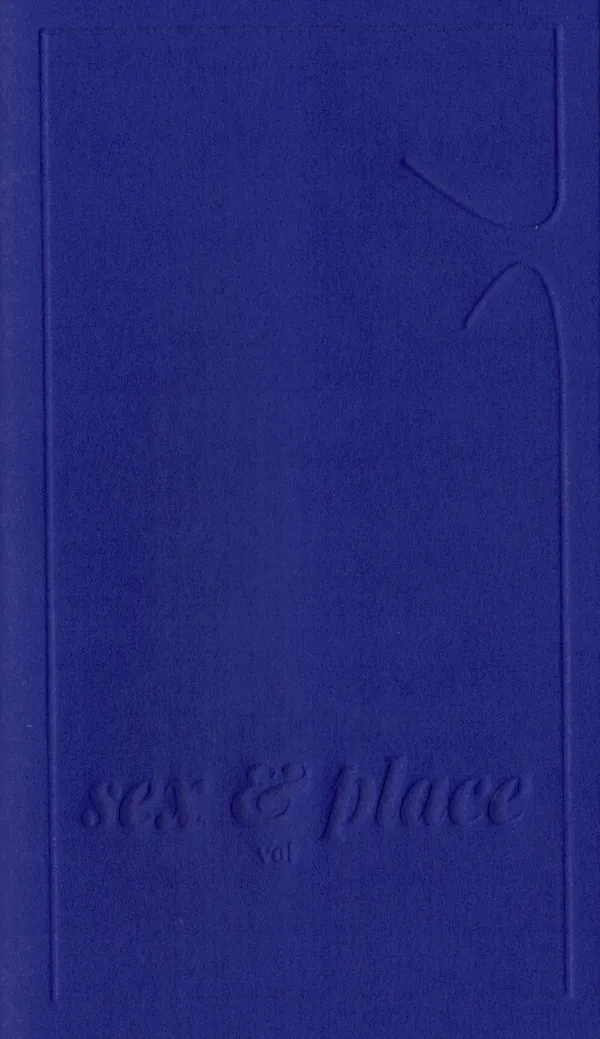
sex and place vol 1
Adriano Wilfert Jensen, Andrea Zavala Folache
sex and place is a series of workshops and publications exploring score-based and semi-anonymous writing as a tool for articulating shared concerns.
Vol. 1 ‘preliminiaries’ is written by Andrea Zavala Folache and Adriano Wilfert Jensen. In the midst of (learning) child care, (unlearning) performance and (experimenting with) sex, the publication interweaves three registers of writing as analogies and interruptions of each other.
The ‘sex and place’ series is part Domestic Anarchism, a project devoted to coalition-building beyond biological, chosen, or national conceptions of family. Dance serves as a set of tools and knowledge that can be applied beyond “the spectacle” to collectively study, write, and move.
Andrea Zavala Folache and Adriano Wilfert Jensen are choreographers and they co-parent three-year-old Penélope Cleo. Andrea and Adriano use dance and choreography to think about the distribution of care and solidarity beyond ‘the family’, and in turn consider how such a distribution could inform their dance practice. Inevitably themes like sex, economy, gender, and class get activated. But also notions such as prefiguration, anarchism, clitoridian* thinking, zones of non-domination and coalition building. They see dance as a knowledge that can be applied to different practices. Some of these include: co-habitations, score based writing and dancing, self-organised study groups and publications, workshops and dance performances.

Time has fallen asleep in the afternoon sunshine
Appendix #3: Orality
Victoria Pérez Royo, Léa Poiré and 1 more
Time has fallen asleep in the afternoon sunshine Appendix #3 Orality includes contributions by Simon Asencio, Bruno De Wachter, Peter Szendy, Clara Amaral, Itziar Okariz, Jude Joseph, Léa Poiré and Mette Edvardsen.
Time has The Appendixes #1–4 is an editorial series by Mette Edvardsen, Léa Poiré and Victoria Pérez Royo that developed out of the project Time has fallen asleep in the afternoon sunshine. For a two-year residency at Les Laboratoires d’Aubervilliers* (2022–23), they came together as a small work group, shaping the work process, hosting presentation formats and making this publication series on paper as four cahiers.
The cahiers comprise a collection of commissioned texts and contributions created for this context, selected documents and traces from work sessions and encounters organized during their residency, texts read together and republished for this occasion, a collection of references, notes in progress, unfinished thoughts and loose fragments – on paper, between pages.
The Appendixes are organized around four themes: (1) The gesture of writing, (2) How to organize a library, (3) Orality and (4) Translation. In addition to being published on paper, the editorial series also consisted of other formats of presentations, exchanges and meetings organized as workshops, fieldwork, performances, conferences, collective readings and oral publications, taking place during their residency at Les Laboratoires d’Aubervilliers and in the vicinity.
The Appendixes is the work that continues, material that adds on, some of it perhaps too long or too detailed, unfit or unfinished. The four themes that their research is formulated around originate in specific experiences and questions from the practices of Time has fallen asleep in the afternoon sunshine (2010 – ongoing), and also the large publication on the project ‘A book on reading, writing, memory and forgetting in a library of living books’ (2019). The research was both a means of exploring these themes in greater depth and also of bringing them into contact with other artists and researchers working on similar or related subjects. The Appendixes offered them both the contexts and the pretexts for things to happen (in time, in space, on paper).
The Appendixes #1–4, published in these cahiers, do not present an overview or a summary of all of the activities and presentations that took place during the two years at Les Laboratoires d’Aubervilliers. What these cahiers offer is a space in which to hold some thoughts together and to share them in this form. It is one more step along the way, extending the research and work already begun and that will now continue.

I will pay to make it bigger
You wake up in the footwell of a mid-sized hatchback somewhere on a highway in outer Bangkok. You compile neurotic spreadsheets of the best ‘party destinations’ in Europe, whilst your work emails pile up without ever being read. You quit your job. You launch a banal start-up. You grieve for a past relationship. You stare endlessly at the waves coming in from a beach in Koh Pha Ngan. You vape intensely. You spend money on feelings, on the performance of your own persona, whilst you observe yourself with a detached sense of horror.
i will pay to make it bigger is a novella, by poet and artist Ahren Warner, in which ‘you’ are the main character. Through text and image – autofiction, docufiction, and just plain fiction – you work your way through a tangle of preoccupations: from what it means to buy enjoyment, to the fragile construction of your own self as a cultural product.
i will pay to make it bigger is also a photobook, a collection of images produced whilst living in Thai ‘party hostels’. Although these photographs might seem to exist as the documentation of intimate or ecstatic moments, they are in fact quite painstakingly, and artificially, constructed: composited and manipulated from multiple still frames of film footage to produce images that advertise the calculated artifice of their own hedonism, emotion and seemingly raw experience.
With a Coda by Hana K. Ohnewehr, commissioned by Yu’an Huang

One Shape of the Language: Cyrillic Archives
‘One Shape of the Language: Cyrillic Archives’ is an artist’s book documenting Inna Kochkina’s research into the history, style, and politics of traditional Cyrillic.
This research was born from Kochkina’s self-reflective curiosity about the relationship between cultural heritage and typography and evolved into an examination of the socio-political role of traditional Cyrillic. An ancient script, Cyrillic has been used to express various forms of cultural and territorial domination and continues to serve as an imperialist tool, having long been deployed in support of Slavic nationalism both in Russia and in the former USSR territories.
This publication is the result of Kochkina’s own research into and engagement with archives of typography, as well as conversations with anti-colonial activists, artists, and historians who interrogate traditional Cyrillic and its relationship to colonial power.
Alongside conducting scholarly research, Kochkina also produced drawings in response to archives of traditional Cyrillic. Making these drawings constituted a form of “studying by making.” With these efforts she has sought to construct an anti-colonial feminist narrative, employing both typographic artifacts and ‘patriarchal’ letterforms.
To make her drawings, Kochkina took samples from these low quality typographic archives, enlarging and transforming them into unexpected graphic shapes that were then recorded in a series of experimental prints. The drawing, collating and contact printing process that she followed allowed her to document and reveal the qualities lent to historical artifacts by digital noise. Through this working method she sought to rethink both the subject of her work as well as traditional approaches to type design practice. This book presents the prints in a roughly chronological sequence, poetically portraying Kochkina’s complex relationship with her native script. Variously precise, messy, and destructive, these works ultimately convey a series of “imaginary” shapes through which to reinterpret traditional Cyrillic of the past and present.

A Faggot is a Unit
This publication brings together two original screenplays for yet-realized video works by Robinson along with a collection of research material presented as a retrograde calendar. The screenplays, / Imagine Prompt: Catfish Monogamy and The Jealousy of Sagittarius A*, both deal with contemporary life and creative labor as they intersect with digital culture and current anxieties regarding AI. In addition, the screenplays are followed by A Faggot is a Unit (Homage to Hanne Darboven), a collection of archival photographs, scanned objects and ephemera, as well as stock imagery and graphics from the internet collected by Robinson over the course of seven years (2015–2021). The imagery further splits the disorienting narratives presented in the two screenplays to offer a kaleidoscopic and unpredictable way of reading stories while functioning simultaneously as visual companion and counterpoint to the scripts.
Writing and editing is central to Robinson’s published and film work, inquiring into queer histories and the contemporary economy of the image, not as novelty subjects in themselves, but as forms of knowledge integral to questioning histories of perceived liberation. We are committed to representing diverse voices and perspectives that challenge and build upon our vision of bringing material from the fast-paced digital experience to the book form.
Padraig Robinson is a Berlin-based artist, filmmaker and writer.

N°3 Mirroring
Much in our life at this moment is often marked by an absence of clarity. Many have experienced a malaise and come to know its persistence. We seem to have become used to stasis and theoretical discussions, lingering in silence and hoping from time to time for something extraordinary to happen. Yet it might also have been a blessing; an opportunity to free ourselves from overarching narratives, to direct our attention to the individual, the local, and to subjects that have long been part of our own lives—a more agile, intuitive mindset.
The third issue of te magazine took shape in this context, and chose to confront experiences of “plight”—plight of the persecuted, of the artists, of the forgotten, and of those living with colonial legacies. How might we, as individuals, transmute plights in order to learn to live in this world? If each piece in this issue can be said to propose a mode of healing, the aim is not only about specific pathologies, but rather to recommend adjustments and defenses in moments of crisis. While writing on the plights of others, the authors also look inward for the roots of questions that they have long harbored about their own experiences. As introduced by Jacques Lacan, the theory of “the mirror stage” refers to children's initial awareness of their own existence. As adults, we continue to grapple with the process of self-discovery and understanding, at times feeling trapped deeply in the “mirror.”
This issue’s theme, Mirroring represents a continuous exploration of the self. On the one hand, these pieces document the processes of setbacks, negating, questioning and reconciling; on the other, delineate the self through the other, a process discernible in several jointly-authored pieces in this issue, where a special connection and sense of fellowship formed through dialogue, correspondence, and collaborative research. In Siddhartha, Hermann Hesse described how the protagonist's worldview was shaped through seeking and struggle, and we hear in it an echo of the inspiration behind this issue of te: “But now, his liberated eyes stayed on this side, he saw and became aware of the visible, sought to be at home in this world, did not search for the true essence, did not aim at a world beyond.” (Siddhartha by H. Hesse, translated by Hilda Rosner, Bantam Books,1971)
Contributors: Guadalupe Maravilla, Lucía Hinojosa Gaxiola, Kader Attia, Gantala Press, Peng Jen-Yu, An Mengzhu, Chang Yuchen, Chris Zhongtian Yuan, Chu Yun, Chen Zhe, Lieko Shiga

Sore 2
Sore is a serial anthology that brings together authors whose writing practices oscillate between the genres of diary keeping and fiction. For the second issue of Sore, ten contributors – both authors and visual artists – were invited to collectively develop their work through a series of informal critiques over the course of five months.
In the first issue of Sore, observations of everyday life intertwined with memories and cultural references to denote the significance of a certain soreness we each carry within us as we negotiate the various challenges of social existence. In this second ensemble, seven new authors widen our understanding of the term ‘sore’ by underlining a need to orient one’s gaze towards what’s hidden underneath, to enter the anatomy of all these necessary contortions and u-turns one performs in order to escape the grip of expected compliance.
With contributions from: Mathilde Heuliez, Lisa Lagova, Muyeong Kim, Nour Ben Saïd, Masha Ryabova, Adrienne Chung, Richard Dmitri Hees, Oscar Le Merle, Morra Kozlitina, Tindra Eliason, Helmer Stuyt, Ilya Stasevich, Kristina Stallvik.
Published by cover crop, Mathilde Heuliez & Lisa Lagova.

Siren (Some Poetics)
Through work by artists and poets of various generations and geographies, as well as additional contributors, SIREN (some poetics) considers the ways in which language is increasingly employed by artists in works that trouble the line between language as a literary practice and language as a visual one. Both human and nonhuman forms of language-making and poetics are insisted upon, from precolonial myth to scientific speculation, fungal networks to gut bacteria, text to textile, poem to algorithm. Published on the occasion of the exhibition of the same name at Amant, in Brooklyn, SIREN (some poetics) figures language in manifold forms: poem and essay, score and script, list and litany. All, though, emit and evidence a kind of parapoetics: poetry as opaque metabolic structuring or as some wild surfacing.
With texts by Hana Noorali & Lynton Talbot, Ruth Estevez, Quinn Latimer and excerpts by Don Mee Choi, Anais Duplan, Franz Kafka, Christa Wolf, a.o., and with artist contributions by Katja Aufleger, Patricia L. Boyd, Bia Davou, Sky Hopinka, Liliane Lijn, Bernadette Mayer, Rosemary Mayer, Nour Mobarak, Senga Nengudi, Rivane Neuenschwander, Mayra A. Rodríguez Castro, Aura Satz, Ser Serpas, Shanzhai Lyric, Jenna Sutela, Iris Touliatou, and Dena Yago

CONSTANT VIOLINS I & II
CONSTANT VIOLINS is a hybrid book consisting of two parts, each comprised of two texts of sci-fi auto-fiction: ‘FӔTAL ATRACTUS’ & ‘COQUETTES’, ‘RATS LIVE ON NO EVIL STAR’ & ‘SOPH MOB’. CONSTANT VIOLINS follows mutating characters & contexts that grapple & contort in half-step with the logics of a vast labyrinth of psycho para-social references, playing out across a tête-bêche (or head-to-tail) format book. The myriad ‘worlds’ occupied & embodied narratively riff on the act of world-making in itself.
As an only child, I used to climb up onto my grandmother’s vanity & collapse the 3 way mirror over my head so I could bask in the calm of the many me’s preening inside its reflective continuum. Sometimes I would just lean against the looking glass above her bureau or pretend the wall was my simultaneous lover. No one wants to be alone. Under covers, I initiate the same sequences of experiments that virtually anyone does.
We all imagine what our pillows witness annually would baffle sane onlookers. That’s why we practice kissing on our dorsal carpal arches, peaches in the dead of night, or remove condoms from bananas with our teeth. CONSTANT VIOLINS wants what any book wants; to become a formidable power couple with its author like a Pokemon & its precocious Trainer.
Jordan/Martin Hell (b. 1993, USA) is a Black trans(2s) writer, artist, & scholar who attended Städelschule (DE) & Cooper Union School of Art. He is currently a PhD candidate at Queen Mary’s University of London. Hell’s work is interdisciplinary & interlaced with his writing as the seedbed for his various explorations across painting, sculpture, pedagogy, music, dance, etc. In all of his work Hell is invested in the embedded associations which proliferate in the global collective subconscious & how that frames intimate (& often violent) realities in the lives of individuals whether historical, celebrity, or obscure. Closely linked with his work is a spiritualist psychoanalytic practice which spans hypnosis, theology, philosophy, Black fugitivity, & indigenous somatics.

Logorrhea
The fruit of a long-term project, this artist's book focuses on the written word and language in Jean-Michel Wicker's work.
Since the 1990s, the work of French artist Jean-Michel Wicker (born 1970 in Riedisheim, lives and works in Berlin) has focused on all forms of production, including publishing, typography, performance, and gardening. Wicker is the founder of the publishing houses Le edizioni della luna, Nice, Le edizioni della china, Berlin, and Ballabella papers, Berlin. His recent solo exhibitions include Edouard Montassut, Paris (2017), Bergen Kunsthall (2015), Sandy Brown, Berlin (2015), Künstlerhaus, Stuttgart (2015), Cubitt, London (2014), New Theater, Berlin (2014), Artists Space, New York (2013), Kunsthalle Bern (2012), and KW Institute for Contemporary Art, Berlin (2010). He has also exhibited in group shows, including the Institute of Contemporary Arts, London (2014), Kunsthal Charlottenborg, Copenhagen (2011), and Kunsthalle Zürich (2011).

Worms For Luncheon
Worms and Luncheon have come together to bring the tastiest of fertilisers, to accompany your lunch for one. Think of this publication as a wine pairing for bookworms. Each story has been tailored to your taste, with a serving suggestion accompanying each piece. Not to be read in the company of others, and only to be consumed with food.
Featuring contributions from Eileen Myles, Cecilia Pavón, Clem MacLeod, Kate Morgan, Pierce Eldridge, Juliet Jacques, Lynne Tillman, Estelle Hoy, Jodie Hill, Leone Ross, Slutty Cheff, Izdihar Afyouni, Gabriela Aquije and Stephanie LaCava. With photographs by Chieska Fortune Smith.
The 88 page thread bound publication consists of poetry, short stories, personal essays, illustrations and photographs of the cosiest spots to dine alone in.
Concept initiated by Clem MacLeod and France Armstrong Jones
Writing Commissioned by Clem MacLeod
Editors Clem MacLeod, Caitlin McLoughlin, Pierce Eldridge, Arcadia Molinas and Violet Conroy
Cover image by Annie Collinge
Art direction and design by Caitlin McLoughlin and Mariana Sameiro
Illustrations by Clemmie Bache

poussière de seum
“the following text was written in July 2024 in St Imier, Switzerland.
it's a fragment of Lettres à Bébé, a book I've been writing for some time in which I - Ethan - find myself helping and communicating by letter with a Marxist Baby whose political project is not to grow up so as not to become a tool of Capital. While he develops his project and tells it to me, I live my life and tell it too, observing and commenting on the ignoble state of the world, its language, its architecture, managing my heartbeat, meeting people, working, fucking, eating (...)”. - Ethan Assouline
Published by La Dépendance, St imier (2024)

Dolce Stil Criollo Issue 5: Extraordinarily Apotropaic
Dolce Stil Criollo’s fifth issue, "Extraordinarily Apotropaic," aims to rethink reality in its current ordinary form by discovering and creating charms and rituals for changing it into one where there is less harm. The issue features poems in multiple languages; a map of dreams; a video game-turned-manga; a section that functions as a kineograph; a collaboration with the Huni Kuin people; and more. We also curated a collective project, “Cinema of Hope,” which brings together 11 moving image artists in search of the apotropaic moment, caught on film.
The cover of our fifth issue features one of five “santinho” inserts. Designed like prayer cards, they contain a collaged portrait of a musical artist (Pivaratu, Pivete Nobre, Iya, Swatch, Devil Gremory) on the recto and the rap lyrics they wrote in response to our theme on the verso.
Contributors include Andrés-Monzón Aguirre, Aykan Safoğlu, Azul Caballero Adams, Belinda Zhawi, Daniel Machado, Daniel Moura, Devil Gremory, Enorê, Esvin Alarcón Lam, Gabriel Massan, Hick Duarte, Itamar Alves, Iya, Jennifer Pérez, Jesse Cohen, Johan Mijail, Juan Pablo Villegas, Kasra Jallilipour, Kent Chan, Keratuma (Mileidy Domicó), Laura Huertas Millán, Lucía Melií, Lucía Reissig & Bernardo Zabalaga, Maria Thereza Alves, Masha Godovannaya, Mayada Ibrahim, Najlaa Eltom, NIna Djekić, Ophelia S. Chan, Pivaratu, Pivete Nobre, Ricardo Pinheiro (Ganso), Roberto Tejada, Sofía Córdova, Sofía Gallisá Muriente, Swatch, Thales Pessoa, and Thiago Martins de Melo.
Languages: Spanish, Portuguese, English, Japanese and Arabic

Second Thoughts
‘Second Thoughts’, co-published by Kunstverein, Amsterdam, and Plug In ICA, Winnipeg, follows Kunstverein’s earlier publication, Paper Exhibition: Selected Writings by Raimundas Malašauskas, as the second in a series featuring the work of an author whose writing has never before been collected in a dedicated, single object. This collection of essays spans multiple research disciplines, including Angie Keefer’s own biography, and runs parallel to her artistic practice. All of the texts were commissioned and published previously, but many have been rewritten for this book. Keefer deftly brings together technological enquiry with artistic production and quotidian human experience.
I half hold that my life is a fine ride as long as I don’t attempt to navigate. The least critical way to describe this outlook is “bemused fatalism,” and as coping mechanisms go, there’s much to be said for keeping that faith, but so far it hasn’t proved compatible with ambitious ideas like writing a book, though this may turn out to be the first page of a first chapter, in which case I’ve changed my life and overruled fate with you as my witness.
—Angie Keefer
Edited by Maxine Kopsa and Yana Foqué (Managing Editor)
Designed by Scott Ponik

Alphabet Magazine #01
The first issue of the magazine made by artists, founded by Donatien Grau and Thomas Lenthal. Contributions by Mathias Augustyniak, Naomi Campbell, Théo Casciani, Michael Chow, Pan Daijing, Es Devlin, Claire Fontaine, Edwin Frank, Theaster Gates, Nicolas Godin, Alejandro Jodorowsky, Hedi El Kholti, Michèle Lamy, Paul McCarthy, Ian McEwan, Eileen Myles, Marc Newson, Hans Ulrich Obrist, Diana Widmaier Picasso, Ariana Reines, Barbara Chase-Riboud, Julian Schnabel & Jason Momoa, Hanna Schygulla, Juergen Teller, Iké Udé, McKenzie Wark, Robert Wilson, Yohji Yamamoto.
Alphabet is the artists' magazine. Here, they run the show. They write, they make images, they select their own works, they interview the figures they admire, they tell us what we did not know about them nor could have ever fathomed about life. This magazine is conceived entirely to put them in the driver's seat, and to enable readers to become part of the unique vision of some of today's greatest luminaries.
It is a manifestation of the creative community, coming together from all fields, from all generations and threads of culture. Writers, musicians, designers, painters, sculptors, poets—artistic figures of every kind converse all the time in their lives, but they did not have a shared space for their editorial projects. This is it.
Everyone who finds their way into Alphabet has made a mark on life, art, and culture, in a way that signals their importance to the present. Some of the contributors may be world famous, others well respected, others on the way to becoming the legends they already are. Their relevance to culture is the same, and that is why they all belong here, in the endeavor of the creative community. There is no hierarchy of status, or domain, or apparent impact. Some of the greatest revolutions happen undercover. Some of the most established voices are still breaking ground. The magazine's premise is simple: the old opposition between pop and underground does not make sense anymore. There are many creative communities, each following its own rules, each inventing its own space. Here, wherever they come from, whatever their community, artists can exist together, with the same intention of changing, and improving, what life is; with the same belief that art matters more than anything else.
None of the contributors is here randomly. They keep life thrilling and exhilarating, challenge the perception of everything and anything. Their role in shaping every aspect of life can hardly be overstated. That is why they needed a place to elaborate their own alphabet, their way of ordering and structuring language, the world, and the fabric of life—a place of freedom, where everything would be done to highlight their visions, where the very design would be a shrine to their magic. Even the distribution of the magazine was conceived with artists—each contributor suggesting sites of their liking.
Alphabet is also the magazine of magazines. Here, readers find essays, fictions, poetry, visual projects, DIY methods, recommendations from those who know, even games and astrology—and an artist's alphabet, articulating an entire universe. Anything that has ever formed a section of a magazine could find its way here. Even the cover is conceived by an artist: it was conceived especially by the legendary Robert Wilson. Artists will rejuvenate what magazines are, and magazines will be kept forever young by and with them.
Founded by Donatien Grau and Thomas Lenthal, Alphabet is a bi-yearly art magazine. Not a magazine about art. It's a magazine made by artists. Each contribution like an œuvre, making it the ultimate collector piece. Each cover is designed, with the word Alphabet, by a different artist, initiating a cult series.

First Drafts #2: Canonically Speaking
Canonically Speaking is the second title to appear on the First Drafts imprint, a zigzag in Kunstverein Publishing’s output that’s dedicated to publishing completed manuscripts that would otherwise, for an array of reasons, not see the light of day in this rough early form.
Central to Canonically Speaking is the idea that (female) life is an inherently surrealist experience. In this spirit, the ‘absurd’ is embraced as a means to speak out on themes such as self-image, spirituality, mental health and work. While slipping between poetry, comprehensive list-making, knock knock jokes and intertextual references, forms of recital and misinterpretation often take place, whereby characters quote and repeat sentences and words from a large variety of sources, jumping from the health benefits of whale blubber to court transcripts of Bill Clinton's impeachment to the plasma that is released when microwaving two grapes side by side.

The Wastes
After the death of her mother a woman decides to visit a familiar strip of rural upland, darkly identified on the South Pennines Ordnance Survey map as: The Waste. As she moves between trains, shunted by public encounters and haunted by past bar jobs, damp bedsits and a press shot of Vanessa Redgrave smoking in the bath, found slipped between the pages of her mother’s diary, the threshold between her past, present and future self dissolves. Fringe images she has neither designed nor authored begin to steer her toward grid reference 3499, where underfoot the semi-solid mud turns with worms and ants.
The Wastes is published as part of Arrhythmia, a series curated for Book Works by Katrina Palmer.
Roy Claire Potter works between performance and experimental art writing with recent work commissioned by Tate Britain and Tate Publishing, Reduced Listening for BBC Radio 3, Cafe OTO and Counterflows, and Primary. They are Senior Lecturer in Fine Art at Liverpool John Moores University.
Katrina Palmer is an artist and writer, living in London. She is the author of The Dark Object (2010), The Fabricators Tale (2014), End Matter (2015) and Black Slit (2023), all published by Book Works. She has exhibited extensively, including with an Artangel Open commission (2015), at Henry Moore Institute (2015-16), Yorkshire Sculpture Park (2018), and with Estuary and Waterfronts (2021). She received the Paul Hamlyn Foundation Award for Artists (2014).

The Medium
To read The Medium is to be submerged in a stream of consciousness populated by uninvited voices from the underworld. Animated, urgent, and brutally propulsive, this cacophony of competing narratives begins to upset the boundary between the living and the dead. The Medium is an alchemical novel, shimmering with insight from the depths of a black lake.
The Medium is published as part of Arrhythmia, a series curated for Book Works by Katrina Palmer.
Alice Walter is an artist, writer and medium – living and working in the UK. She has a BA in Fine Art, Film and Video from Central Saint Martins, UAL and a MFA from The Ruskin School of Art, Oxford University. Her practice combines collage, psychosexual sculpture, VHS and shamanism. Through these disciplines, Alice creates surreal and sensory spaces that open channels for the unseen.
Katrina Palmer is an artist and writer, living in London. She is the author of The Dark Object (2010), The Fabricators Tale (2014), End Matter (2015) and Black Slit (2023), all published by Book Works. She has exhibited extensively, including with an Artangel Open commission (2015), at Henry Moore Institute (2015-16), Yorkshire Sculpture Park (2018), and with Estuary and Waterfronts (2021). She received the Paul Hamlyn Foundation Award for Artists (2014).

Confidences / Oracle
Oracles don’t require belief—they now theatrically suspend disbelief. No longer advisors of world policy, they run Locus Solus, a town that has come to ramble around an eponymous theatre and chocolate factories. Theo, a centuries-old vampire intent on remaining contemporary through performance, visits Locus Solus, which is hosting Praise Estate, an international theatre festival. He uses the festival as an opportunity to stay with Gean, his oracle boyfriend, who is there visiting family. Theo has a fetish for the future, fixated on the one thing he is in no shortage of.
Confidences / Oracle is a lover’s trip to a weeklong theatre festival. A vehicle for recontextualising recent performance scripts and texts, Oracle is the third instalment in Ivan Cheng’s Confidences series, which intertwines vampires and performance as sites for circulation and recognition.

to enter the forest
to enter the forest is an invitation to suspend the acquired systems of knowledge, to look for other ways of “world making.” The book includes a revised and extended version of to err together with the unpublished correspondances.
to err gathers walking exercises and notes, created as instruments for choreographic composition, but practicable by anyone, to put one’s perspective about self and what is other to self, as well as the relations between things, even beyond the human, into question.
correspondances is an ensemble of writing exercises through which to investigate the system of consciousness around verbal language, asking ourselves what words mean from a slightly shifted perspective.
The publication is coproduced by a.pass, nadine, Buda Art Centre, Indisciplinarte, Flanders State of the Art.
lucia palladino is a transdisciplinary artist and researcher in the fields of performance, choreography, and dance. Her practices consist in the elaboration of forms of resistance to notions of identity and ownership naturalized by history and by culture, that define our knowledge and expectations and that need to be undone in order to make space for meeting.

Dead Minutes
Dead Minutes is a storytelling game about systemic change in an undesirable afterlife. You, the players, will decide what this hell, underworld or land of the dead is like, what its problems are, how change happens there, and what the complications might be when altering something so big, involving so many dead people, over so much time. It’s a game about impossible seeming actions at impossible seeming scales, making difficult choices, and dealing with unexpected outcomes.
The first half of this book gives you everything you need to play a session of Dead Minutes, which takes 2-5 hours with 3-6 people.
The second half features an essay by Patricia Reed that expands on the concepts of heuristic fictions and vital zombies in relation to the afterlife, and a series of afterlife generating 'seeds' contributed by different types of writers - a demonic boardroom presentation by writer and art critic Habib William Kherbek, a ritual from horror game designer Samuel Clarice Mui Shen Ern, a premise by Arthur C Clarke award winning author Chris Beckett, and a letter from Selma Selman.

The Clip-On Method
The Clip-On Method is THE book on the work of Cady Noland everybody was waiting for but nobody expected. Two volumes, almost 600 pgs, that gather a minute, specific, documentation of the artist’s works (“often shown within their first installations,” from 1984 onwards) and further unfold the issues and questions that form the core of her practice and structure her engagement in art – without imposing any interpretation, critical perspective, other than the one proposed (suggested) by the artist’s own approach to the book form.
Book 1 gathers documents, essays, sholarly texts and articles regarding capitalism, violence, aircraft industry, racial discrimination in US universities, amongst various issues, interspersed with pictures of the artist’s works.
In Book 2 there are more photographs along with an exciting, impressive collection of writings by Noland (including, of course, “Towards a Metalanguage of Evil”). Most of the texts, and several of the pictures as well, are presented as facsimiles, laying out the work process, and the origins of what forms that sum.
Design by Cady Noland, Will Holder

Dispersed Events. Selected Writings
Dispersed Events brings together for the first time Nick Mauss’ essays from the last fifteen years. Shimmering with the urgency of a new generation of queer thinkers, Mauss’ writing refracts contemporary art through histories of decorative art, film, theater, and dance.
An artist renowned for critically and poetically reconfiguring inherited genealogies and hierarchies of visual culture and art history, Mauss engages writing as a space for relentlessly activating counter-histories, repositioning the voice of the artist and the readers along the way. Whether he considers the practice of artist Lorraine O’Grady, the radical fashion of Susan Cianciolo, the anarcho-vaudevillian theater of Reza Abdoh, or the potential for textiles to disclose a different way of thinking, Mauss insists on the intense power of forms and feelings in their actual rather than enforced prehistories. Reevaluating experiments in fashion, dance, and the decorative arts on the same plane as painting, sculpture and cinema, he locates art as taking shape in the middle of conversations—“between art history and any afternoon.”
“Among what might initially appear, following Mauss, ‘a wildly inscrutable web of lineages,’ the reader quickly perceives unexpected, unheralded, conjunctions: affiliations, alignments, and affinities. . . . It generates a conviction that, in the best sense, is partisan. Singular, independent, illuminating.” — from the foreword by Lynne Cooke

Sore
Sore is a publication that brings together seven texts by authors whose writing practice oscillates between the genres of diary and fiction. Observations of every- day life, memories and cultural references intertwine to form an ensemble of texts that highlight the significance of the soreness we carry within us.
With contributions from : Niklas Büscher, Tindra Eliason, Céline Mathieu, Jonathan Lubasch, E. Eriskat, Emma Bombail and Bryony Dawson + an introduction by Mathilde Heuliez.
Graphic design: Lisa Lagova