Books
Books
in random order

Emil Lime
Emil Lime collects various materials that nurture and give shape to Esther Gatón’s artistic practice, including collages made with her phone pics, sketches, sporadic notes and drawings, together with the writing of authors that have been influential on the work: Fredy Massad, María Fernanda Ampuero, Darya Diamond and Cory John.

Unable To Achieve Broad Recognition In My Lifetime, I Laboured In Obscurity Until My Death Last Year
For nearly two years the author collected phrases from the exhibition press releases she received through email, posting certain of them on Facebook in a rather unsystematic way (that is to say, when she felt like it), with only one change, that of the personal pronoun, so each statement appeared vainglorious, absurd, even tragic. She supposes the measure was if they made her laugh or gasp or used words she deplores when thinking or writing about art. The posts gathered quite a following. Some people still mention them to her, and others have asked her to look at their own press releases before circulation.
These extracts have provoked laughter, disbelief (especially when performed as public readings, when she has been obliged to swear to their veracity), self-recognition, and yes, shame.
She had only three rules: 1) She would not quote the press release of anyone she knows (certainly she could have done—she must admit that both a friend and someone she dislikes intensely have slipped in, and she fervently hopes neither ever reads this book); 2) She would not alter anything except the pronoun (this is largely true; however, for this book, she corrected some errors of punctuation and spelling, changed spellings to their English form, and employed her beloved Oxford comma); and 3) She would not use anything the artist had written (this, too, is true, save for one exception that was too wonderful not to include).
Finally, she gathered a collection of endorsements, some along the way, others when she indicated this work was done. She is still alive and she continues to labour in obscurity.

Marlie Mul
Marlie Mul (b. 1980 in Utrecht, the Netherlands; lives and works in Brussels) is characterized by a strong material awareness, spatial thinking, and an ongoing engagement with conditions of labor, systems of value, and forms of collectivity. Her practice foregrounds a sustained interest in sculptural concerns, direct engagement with materials, and processes of layering, transformation, meaning and re-meaning across multiple levels of articulation. Central to this is a continuous process of familiarizing herself and working with new materials and practices, which are repeatedly extracted from their conventional contexts and expanded into new bodies of work. These are, in turn, accompanied and reframed by other materials as well as by more social formats of production and presentation.
The first comprehensive monograph on Marlie Mul’s work is published on the occasion of her solo exhibition Das Budget (2025) at Kunsthaus Glarus. It offers a comprehensive chronological overview of key bodies of work from the early 2000s to the present and, through a richly illustrated index, unfolds a complex structure of contexts, collaborations, and modes of production. The publication includes new contributions by Annie Goodner, Lili Reynaud-Dewar and Frank Wasser, a dialogue between the artist and the editor, as well as numerous reprints of texts that have accompanied Mul’s work over the years, including writings by the artist herself.

Maa Ka Maaya Ka Ca A Yere Kono – 13th Edition of the Rencontres de Bamako - African Biennale of Photography
Bonaventure Soh Bejeng Ndikung
The catalogue of the 13th edition of the Rencontres de Bamako - African Biennale of Photography, focusing on multiplicity, difference, becoming, and heritage.
The dominant narrative in this "globalized world" is, incidentally, that of singularity—of universalism, of single identities, of singular cultures, of insular political systems. With this narrative, however, comes an illusory sense of stability and stasis; identities seem inalterable, cultures are immutable, political systems prove uneasy in the face of change. Thus, in sustaining this pervasive discourse, there has been a great loss of multiplicity, of fragmentation, of process and change, and not least of complex notions of humanity and equally complex narratives.
In decentering this year's biennale On Multiplicity, Difference, Becoming, and Heritage, General Director Cheick Diallo, Artistic Director Bonaventure Soh Bejeng Ndikung, and the curatorial team—Akinbode Akinbiyi (artist and independent curator), Meriem Berrada (Artistic Director, MACAAL, Marrakech), Tandazani Dhlakama (Assistant Curator, Zeitz MOCAA, Cape Town, South Africa), and Liz Ikiriko (artist and Assistant Curator, Art Gallery of York University, Toronto)—of the Bamako Encounters pay a powerful tribute to the spaces in between, to that which defies definition, to phases of transition, to being this and that or neither and both, to becoming, and to difference and divergence in all their shades. Accordingly, Amadou Hampâté Bâ's statement (Aspects de la civilisation africaine, Éditions Présence Africaine, 1972) presiding over the manifestation, Maa ka Maaya ka ca a yere kono,translates to, "the persons of the person are multiple in the person."
A key tool for negotiating the processual and shifting nature of multiplicity lies in storytelling. It is the central medium through which humanity points the lens on itself and launches an attempt at self-understanding and reflection, and the breadth of answers given throughout history testifies to the congenial nature of storytelling and multiplicity. Moreover, the stories we tell not only negotiate who we are but also expose underlying currents of who we will become in the future. This is the concern lying at the heart of the 13th edition of the Bamako Encounters—the stories we tell, the multiple facets of humanity we accommodate, notions of processuality, becoming in being, embracing identities that are layered, fragmented, and divergent, and the multifarious ways of being in the world, whether enacted or imagined. It should be emphasized that this does not apply only to questions of personal identity. On the contrary, it is a bold affirmation of transformation and transition, of becoming in an emphatic sense, and is thus equally significant for state politics. It also rings true for questions of heritage/patrimony. Embracing the kaleidoscopic legacy of our multiple heritages means to open them up and liberate the term "patrimony" from its etymological roots (the Latin patrimonium means "the heritage of the father"), imagining in its place an inclusive concept of matrimony.
Thus, in this 13th edition of the Bamako Encounters with the title Maa ka Maaya ka ca a yere kono, artists, curators, scholars, activists, and people of all walks of life are invited to reflect collectively on these multiplicities of being and differences, on expanding beyond the notion of a single being, and on embracing compound, layered and fragmented identities as much as layered, complex, non-linear understandings of space(s) and time(s).
Published following the 13th edition of the Rencontres de Bamako - African Biennale of Photography, in Bamako, Mali, in 2022.
With Saïd Afifi, Ixmucané Aguilar, Baff Akoto, Annie-Marie Akussah, Américo Hunguana, Daoud Aoulad-Syad, Leo Asemota, Myriam Omar Awadi, Salih Basheer, Shiraz Bayjoo, Amina Benbouchta, Hakim Benchekroun, Maria Magdalena Campos Pons, Rehema Chachage, Ulier Costa-Santos, Adama Delphine Fawundu, Fatoumata Diabaté, Aicha Diallo, Amsatou Diallo, Anna Binta Diallo, Mélissa Oummou Diallo, Nene Aïssatou Diallo, Binta Diaw, Adji Dieye, Imane Djamil, Sènami Donoumassou, Abdessamad El Montassir, Fairouz El Tom, Luvuyo Equiano Nyawose, Raisa Galofre, Raisa Galofre, Joy Gregory, Gherdai Hassell, Thembinkosi Hlatshwayo, Letitia Huckaby, Anique Jordan, Gladys Kalechini, Hamedine Kane, Atiyyah Khan, Gulshan Khan, Seif Kousmate, Mohammed Laouli, Maya Louhichi, Mallory Lowe Mpoka, Nourhan Maayouf, Marie-Claire Messouma Manlanbien, Botembe Moseka Maïté, Louisa Marajo, Clarita Maria, Billie McTernan, Mónica de Miranda, Arsène Mpiana Monkwe, Sethembile Msezane, Ebti Nabag, Elijah Ndoumbe, Lucia Nhamo, Samuel Nja Kwa, Nyancho NwaNri, Jo Ractcliffe, Adee Roberson, Fethi Sahraoui, Muhammad Salah, Neville Starling, Eve Tagny, René Tavares, Sackitey Tesa, Helena Uambembe, David Uzochukwu, Sofia Yala, Timothy Yanick Hunter.

The Faggots and Their Friends Between Revolutions
The Faggots and Their Friends Between Revolutions is a beloved queer utopian text written by Larry Mitchell with lush illustrations by Ned Asta, published by Calamus Press in 1977. Part-fable, part-manifesto, the book takes place in Ramrod, an empire in decline, and introduces us to the communities of the faggots, the women, the queens, the queer men, and the women who love women who are surviving the ways and world of men.
This new edition will feature essays from performance artist Morgan Bassichis, who adapted the book to music with TM Davy in 2017 for a performance at the New Museum, and activist filmmaker Tourmaline.

The Feminist Bookstore Movement
From the 1970s through the 1990s more than one hundred feminist bookstores built a transnational network that helped shape some of feminism's most complex conversations. Kristen Hogan traces the feminist bookstore movement's rise and eventual fall, restoring its radical work to public feminist memory. The bookwomen at the heart of this story—mostly lesbians and including women of color—measured their success not by profit, but by developing theories and practices of lesbian antiracism and feminist accountability.
At bookstores like BookWoman in Austin, the Toronto Women's Bookstore, and Old Wives' Tales in San Francisco, and in the essential Feminist Bookstore News, bookwomen changed people's lives and the world. In retelling their stories, Hogan not only shares the movement's tools with contemporary queer antiracist feminist activists and theorists, she gives us a vocabulary, strategy, and legacy for thinking through today's feminisms.

Minibieb
Infrastructural systems define our ways of seeing and responding to the world around us. Today, our everyday lives and visual cultures have become saturated by digital communications systems whose physical footprint has been rendered largely invisible from the public sphere.
In an age of ever-expanding computation and a foolish believe in AI’s utopian potential, resistance can seem futile. But if we detach our gaze from increasingly narrow realm of digital imaginaries, a new world of radically different infrastructural opportunities opens up in front of our eyes.
Street libraries, or Minibiebs, as they are called in Dutch, are an under-appreciated piece of urban technology. Part manifesto, part research note, this mini publication dives into the radical potential of public book sharing structures and what they might tell us about our broken information ecosystem.
Printing: Risograph, Grafische Werkplaats Den Haag; Research and Photography: Livio Liechti; Design: Apsara Flury.
First print run – May 2025: 35 copies.

Islands After Tourism
Tourism does more than transforming spaces and forcing emotions: its geographies also conceal a persisting power that captures the imagination. In their operational sturdiness, tourismscapes appear intractable and inert, making their alternative renderings almost unthinkable. It feels uncanny to picture islands and their coasts freed from programs of leisure. But in recent years, the exhaustion of people and landscapes has brought forth a renewed imperative to think outside this ubiquitous extractive industry. Through essays, pieces of fiction, and visual references, this book discusses both the difficulty and the necessity of disrupting the monocultural imaginations of tourism. To escape the devouring vortex of its sticky nature and messianic promises, the cultural and political work necessary is not only this of negation and resistance, but also that of bold re-conceptualizations and re-imaginings.

The Performative Word
First monograph dedicated to the American artist, poet, and activist John Giorno, this publication introduces some of the many ways Giorno wove poetry into all aspects of daily life—by putting words on the wall, on the performance stage, on LP vinyl records, or on the telephone, in the context of the iconic Dial-A-Poem, one of his most celebrated works. A wide range of archival documents, images, and ephemera also form an intimate portrait of Giorno as an activist, performer, Buddhist practitioner, collaborator, and friend.
Published on the occasion of the eponymous retrospective exhibition at the MAMbo - Museo d'Arte Moderna di Bologna, in 2026.
Emerging from the New York downtown scene of the 1960s, John Giorno (1936–2019) developed a singular artistic voice at the crossroads of poetry, performance, painting, and political activism over the course of more than six decades. By bringing the written word off the page and into performance, technology, and visual art, Giorno consistently challenged disciplinary boundaries and advanced a radical vision of language as central to human expression. Though often positioned at the margins of multiple downtown scenes—the Beats, Andy Warhol's Factory, punk music, queer counterculture, anti-war activism—he was in fact an influential presence within all of them, operating as a conduit between coexisting cultural communities. His collaborators included Robert Rauschenberg, William S. Burroughs, Laurie Anderson, Anne Waldman, Allen Ginsberg, and Ugo Rondinone, among many others.

Seeing for Ourselves
Why do we yearn to be seen when we are already far too visible? How do we want to be perceived, and how are we exposed? Could we ever really see for ourselves?
In memoir, vignettes, poetry and essays, Suhaiymah Manzoor-Khan records her observations from the stands at the dizzying circus of being seen and unseen. She surveys the criminalising stadium of civic life, the open-air arenas of family, friendship and grief, the performative pageantry of the public eye and the unclad secrets of the self in solitude, paying attention to what’s on show and what goes undetected.
Perhaps the strangest, most exciting possibilities are opened when we surrender to another kind of sight. Submitting to the gaze of the Unseen and the All-Seeing, Manzoor-Khan invites us to close our eyes and discover what it would mean to look with our souls instead.
Suhaiymah Manzoor-Khan is a poet and writer whose work disrupts assumptions about history, race, violence and knowledge. She is the author of Tangled in Terror and the poetry collection Postcolonial Banter; a co-author of A FLY Girl’s Guide to University; and a contributor to the anthologies Cut from the Same Cloth? and I Refuse to Condemn. She is based in Leeds and is currently writing for theatre.

Between the Teeth
Produced on the occasion of the exhibition Unbidden Tongues #5: Theresa Hak Kyung Cha: Between the Teeth at Manifold Books, Amsterdam, November 28, 2021 – January 22, 2022.
Drawing on artist, poet and filmmaker Theresa Hak Kyung Cha’s extensive and largely unexhibited archive of ‘work on paper’, Unbidden Tongues #5: Between the Teeth is a publication-turned-exhibition and the fifth title in the series. From never-realised film scripts to concrete poetry and artists statements written intimately in the first person, the collection of material selected for this occasion presents the varying ways with which Cha drew on her personal and familial experience as an immigrant to conceptually grapple with language and its mediation and suppression, particularly, in this case, in its written form.

Éclairages : 12 entretiens et analyses sur les violences d’État
Filippo Ortona, Francesco Sebregondi
Depuis 2020, l’ONG d’investigation Index mène des contre-enquêtes sur les violences policières en France. De la mort d’Adama Traoré à celle de Nahel Merzouk, ses rapports ont pour objectof d’établir les faits dans des affaires où le déni est la norme.
Ce livre rassemble des entretiens et analyses publiés par Index entre 2024 et 2025, pour exposer l’arrière-plan des affaires qu’elle documente. En donnant la parole à des sociologues, juristes, chercheur·euses, journalistes et militant·es, l’ensemble explore différentes fomes de violences institutionnelles, les logiques discriminatoires qui les traversent, ainsi que les espaces où elles s’intensifient : des quartiers populaires aux outre-mer ou encore aux zones de frontières de territoire.
Éclairages se veut une ressource pour comprendre les conditions s’exercice des violences d’État aujourd’hui.
Contributions de Nour Abuzaid (Forensic Architecture), Matteo Bonaglia, Magda Boutros & Aline Daillère, Rémi Garayol, Thomas Chambon (Utopia 56), Groupe Retrace, Gwenola Ricordeau, Mathieu Rigouste, Sebastian Roché.

Intermediary Spaces (2nd edition)
Julia Eckhardt, Éliane Radigue
In the long interview that forms the body of this publication, Éliane Radigue talks about her work, her reflections and underlying research, as well as her historical context. The publication also contains a commented list of works and Radigue's programmatic text on The Mysterious Power of the Infinitesimal.
New expanded edition of the book first published in 2019.
Éliane Radigue (born 1932 in Paris) is considered one of the most innovative and influential contemporary composers, from her early electronic music through to her acoustic work of the last fifteen years. Influenced by musique concrète and shaped by regular sojourns in the United States, where she discovered analogue synthesisers, her work unfolds an intensity which is at once subtle and monumental. Through her deep reflections on sound and listening, not only her music but also her working methods have come to shape a widely resonating set of new parameters for working with sound as musical material.
Julia Eckhardt is a musician and curator in the field of the sound arts. She is a founding member and artistic director of Q-O2 workspace in Brussels, for which she conceptualized various thematic research projects. As a performer of composed and improvised music she has collaborated with numerous artists, and extensively with Eliane Radigue. She has performed internationally, and released a number of recordings. She has been lecturing about topics such as sound, gender and public space, and is (co-)author of The Second Sound, Conversation on Gender and Music, Grounds for Possible Music, and The Middle Matter, Sound as Interstice.
Edited by Julia Eckhardt.
Texts by Éliane Radigue and Julia Eckhardt.

Beloved
Staring unflinchingly into the abyss of slavery, this spellbinding novel transforms history into a story as powerful as Exodus and as intimate as a lullaby.
Sethe, its protagonist, was born a slave and escaped to Ohio, but eighteen years later she is still not free. She has too many memories of Sweet Home, the beautiful farm where so many hideous things happened. And Sethe's new home is haunted by the ghost of her baby, who died nameless and whose tombstone is engraved with a single word: Beloved. Filled with bitter poetry and suspense as taut as a rope, Beloved is a towering achievement by Nobel Prize laureate Toni Morrison.
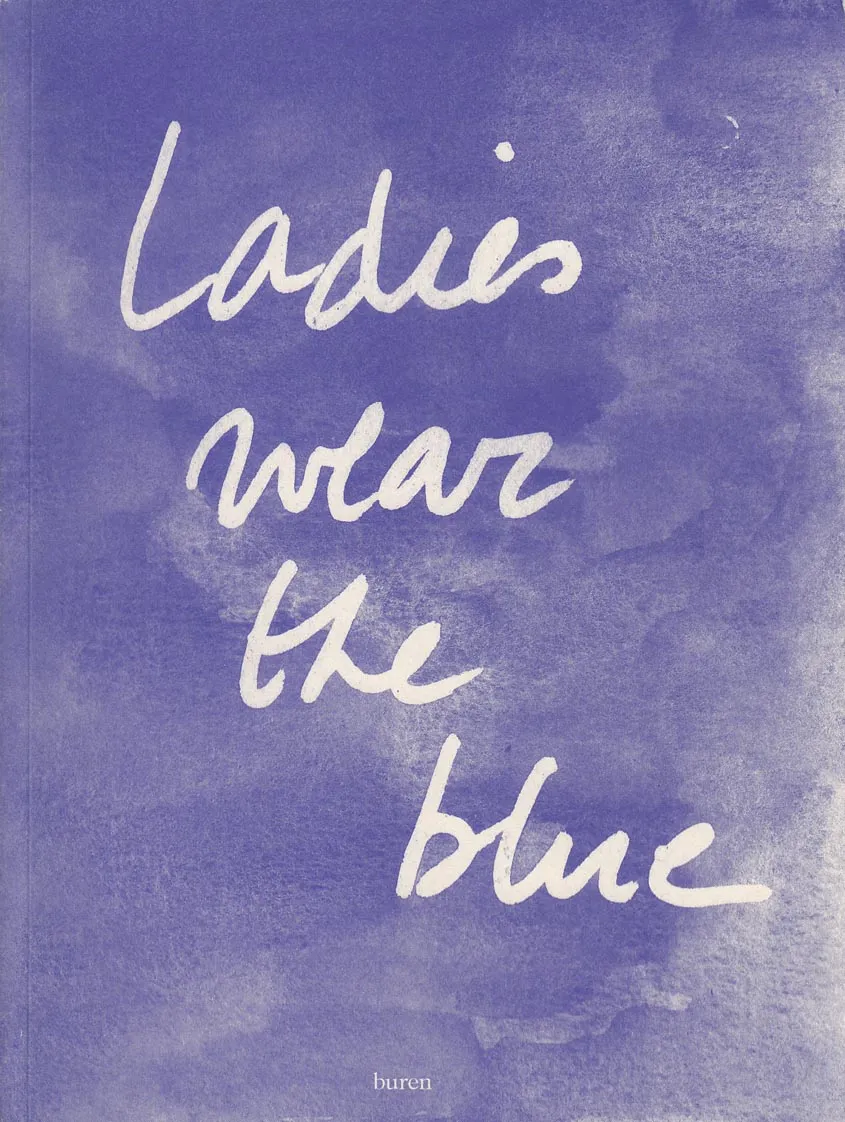
Ladies Wear the Blue
Ladies wear the blue is a collection of watercolour drawings by the hand of Melissa Mabesoone and Oshin Albrecht. The blue watercolours portray women from different moments in time. The adjacent texts describe these women's existence, roles, desires or ideosyncrasies deriving from the 'blue' in their lives. From the first female police officers and Alices all around, to Courtney Love's blue baby dolls and the girl with the blue tattoo Olive Oatman, this publication is an ode to women venturing into the world, and a way to continue telling their herstories.

Efemmera Reissue #7: Cassandra Radical Feminist Nurses Newsletter
A reissue of the 1982 inaugural Cassandra Radical Feminist Nurses Newsletter: founding members explain their interests, intentions, and goals, and invite other nurses to join them.
Introductory text by Peggy Chinn, founding member, and also co-author of Peace & Power: A Handbook of Feminist Process.
The Alder & Frankia Efemmera Reissue series amplifies, graphically reinterprets, and shares historic feminist ephemera. What ideas, strategies, and tactics from the past can we inherit to bring forth a feminist future?

Country Lesbians
A bootleg of the first edition of Country Lesbians, published by WomanShare Books in 1976. It was printed in the context of a 2024 exhibition at Shmorévaz, a Paris-based independent art space, dedicated to the WomanShare collective, taking the book as its starting point, and borrowing its title.
WomanShare Collective is Sue Deevy, Billie Miracle, Nelly Kaufer, Carol Newhouse and Dian Wagner.
Co-published by Ness Books and Shmooks
Graphic design: Espace Ness

desespiegles
This publication is presented as an object-book-manifesto of a ‘desespiegles’ way of thinking. It “translates” the trains of thought that architect-artists Anne Philippe and Jolien Naeyaert exchanged via videoletters. The videoletters mainly occurred during the covid period. Questioning the scope of the addressed images, these exchanges revealed a play of symmetries. It shows a series of interrogations, linking the intimate with the collective. The move towards a publication was obvious after conversations with Loes, Phyllis, An and Teresa of nadine. The desire to activate reading in a performative way, mirrors the exchange of videoletters. It continues the process-based methodology that inventively gave birth to a publication through the physical manipulation of the work. The riso-technique proved particularly suitable for this project, as the hands, the gaze and the exchange all played a role during the object-making process.
Dannie.n is an art-zine, published by nadine, about the artistic research, themes, and topics of discussion of the artists involved in nadine. nadine invites an artist or collective to create each new edition.
Dannie.p is a limited-edition artist's book by desespiegles (57 copies). nadine is supported by Vlaamse Gemeenschap, VGC, Brussels Hoofdstedelijk Gewest.

À perte de mère – Sur les routes atlantiques de l'esclavage
Saidiya Hartman traces the history of the Atlantic slave trade by recounting a journey she took along a slave route in Ghana. Following the trail of captives from the hinterland to the Atlantic coast, she reckons with the blank slate of her own genealogy and vividly dramatizes the effects of slavery on three centuries of African and African American history.
Saidiya Hartman, professor of English and comparative literature at Columbia University, is a scholar of African American literature and cultural history.
Preface by Maboula Soumahoro.
Translated from the English (American) by Maboula Soumahoro (original title: Lose Your Mother. A Journey Along The Atlantic Slave Route, Farrar, Straus and Giroux, 2007).

Par-delà étrange et familier
Dans cet ouvrage, malheureusement son dernier, Mark Fisher revisite des artefacts culturels familiers afin de cartographier les variétés de l’étrange dont ils sont porteurs. Longtemps sensible aux dimensions bizarre et omineuse qu’il devinait, sans les nommer, entre autres dans les œuvres de Lovecraft, les films de David Lynch ou les albums de The Fall, M. Fisher tente ici la synthèse essentielle d’un questionnement qui l’avait hanté, jusqu’à ce livre.
Avec son regard si particulier, celui du critique culturel tout à la fois pop et moderniste, puisant aux sources de la psychanalyse et du marxisme, Fisher se penche sur des objets sensibles pour y saisir les rapports entre présence et absence, entre ce qui devrait être mais n’est pas, ce qui ne devrait pas se présenter mais survient. C’est en compagnie de ces spectres — du titre d’un autre ouvrage — que nous sommes invités à voyager, pour questionner les formes mêmes de nos existences sociales, jusqu’aux frontières de l’étrange.

Touching Feeling
A pioneer in queer theory and literary studies, Eve Kosofsky Sedgwick brings together for the first time in Touching Feeling her most powerful explorations of emotion and expression. In essays that show how her groundbreaking work in queer theory has developed into a deep interest in affect, Sedgwick offers what she calls "tools and techniques for nondualistic thought," in the process touching and transforming such theoretical discourses as psychoanalysis, speech-act theory, Western Buddhism, and the Foucauldian "hermeneutics of suspicion."

The Sunflower
Jackie Wang's magnetic and spellbinding debut collection of poetry that attempts to speak in the language of dreams.
The poems in The Sunflower Cast A Spell To Save Us From The Void read like dispatches from the dream world, with Jackie Wang acting as our trusted comrade reporting across time and space. By sharing her personal index of dreams with its scenes of solidarity and resilience, interpersonal conflict and outlaw jouissance, Wang embodies historical trauma and communal memory. Here, the all-too-familiar interplay between crisis and resistance becomes first distorted, then clarified and refreshed. With a light touch and invigorating sense of humor, Wang illustrates the social dimension of dreams and their ability to inform and reshape the dreamer's waking world with renewed energy and insight.
Jackie Wang is a student of the dream state, black studies scholar, prison abolitionist, poet, performer, library rat, trauma monster and PhD candidate in the Department of African and African American Studies at Harvard University, specializing in race and the political economy of prisons and police in the United States. She is the author of a number of punk zines including On Being Hard Femme, as well as a collection of dream poems titled Tiny Spelunker of the Oneiro-Womb. In 2018 she published a book, titled Carceral Capitalism on the racial, economic, political, legal, and technological dimensions of the US carceral state. She is currently an Arleen Carlson and Edna Nelson Graduate Fellow at the Radcliffe Institute for Advanced Study.

My Earliest Person
Lyrical drifts warped by syntax into blizzarding softness; odes to beauty, meaning, and inexperience splintered by history and grammar. An aqueous surface marbled with the lightest possible touch, lost footings arrested by change’s near-griplessness.
None of this matters. It’s only supposed
to save you from yourself. None of this
matters, when I try to take it out of me into
the world, which to find I can praise
I go out to
Composed across two winters between late 2022 and early 2024. Contains 43 poems.
“This luscious and needle sharp collection is a real feat of the textual imagination, wow.” —Adam Piette, Blackbox Manifold, no. 34

Piero Heliczer. Poems & Documents / Poèmes & Documents
Sophie Vinet, Benjamin Thorel and 1 more
Poet, editor, filmmaker, actor, child star in Mussolini’s Italy, founder of The Dead Language Press and of the Paris Filmmakers Cooperative, Piero Heliczer (1937–1993) was an essential yet secret agent of the 1960s and ’70s counterculture. In the course of his nomadic existence in Rome, New York, London, Amsterdam, Paris, and Préaux-du-Perche, where he spent the last few years of his life, he met and worked with a constellation of avant-garde writers, forged friendships with figures from the Beat Generation and the British Poetry Revival as well as the New York art scene. At the crossroads of many underground experiences, Heliczer’s name appears in books dedicated to the artists and poets he collaborated with during his lifetime—names by the likes of Gregory Corso, Barbara Rubin, Andy Warhol, Jack Smith, Ira Cohen, or The Velvet Underground, a band he participated in creating with his friend Angus MacLise.
This myth obscures the fact that Piero Heliczer was first and foremost a poet. Today, this part of his work is overlooked; it is all the more difficult to encounter because Heliczer himself never collected it. So it was scattered, or lost, in the course of his wanderings. Heliczer favored the circulation of his works rather than their archiving: he was committed to the production of mobile forms—flyers, broadsides, and other ephemera—disseminated his verses in magazines, and preferred public readings and performances to the finished form of the book.
The present volume gathers a significant number of Heliczer’s poetic works through facsimile reproduction of his contributions to more than thirty periodicals—mostly stemming from poets’ presses or universities—published between 1958 and 1979. This collection isn’t “complete”—but it makes available again poems that, in some cases, never circulated after their initial publication.
Un recueil de poèmes de Piero Heliczer (1937–1993), auteur, éditeur et cinéaste, figure de l’underground et de la contre-culture, proche de Andy Warhol, Gerard Malanga, et Jack Smith. Sa poésie, héritière de la Beat Generation, restitue en métaphores et images saisissantes des expériences et des visions personnelles, tout en s’appuyant sur des formes héritées de la tradition anglaise et des partis-pris typographiques originaux. Ce recueil rassemble des facsimilés des publications originales de poèmes de Heliczer – périodiques d’artistes, revues miméographiées, petits magazines… – accompagnées de leurs traductions en français, ainsi que de plusieurs documents, parmi lesquels une reproduction intégrale d’une publication rare de 1961, Wednesday Paper, et, en insert, un facsimilé d’un placard de 1975, The Handsome Policeman.
Traduction des poèmes: Rachel Valinsky
Publié avec l’aide du CNAP