Books
Books
in random order

Par-delà étrange et familier
Dans cet ouvrage, malheureusement son dernier, Mark Fisher revisite des artefacts culturels familiers afin de cartographier les variétés de l’étrange dont ils sont porteurs. Longtemps sensible aux dimensions bizarre et omineuse qu’il devinait, sans les nommer, entre autres dans les œuvres de Lovecraft, les films de David Lynch ou les albums de The Fall, M. Fisher tente ici la synthèse essentielle d’un questionnement qui l’avait hanté, jusqu’à ce livre.
Avec son regard si particulier, celui du critique culturel tout à la fois pop et moderniste, puisant aux sources de la psychanalyse et du marxisme, Fisher se penche sur des objets sensibles pour y saisir les rapports entre présence et absence, entre ce qui devrait être mais n’est pas, ce qui ne devrait pas se présenter mais survient. C’est en compagnie de ces spectres — du titre d’un autre ouvrage — que nous sommes invités à voyager, pour questionner les formes mêmes de nos existences sociales, jusqu’aux frontières de l’étrange.

Lilacs
In Lilacs, syringa vulgaris gives its name to a form of long poem that promotes sense memory. Here, we have one lilac for each of the senses, and a sixth for love, which synthesizes them all.
Rainer Diana Hamilton is the author of God Was Right and The Awful Truth. They write, broadly, about the forms that dreams and art have taken.
“I wanna ____ all my friends at once”: how would you complete the lyric Arthur Russell wrote for “Go Bang”? In Rainer Diana Hamilton’s hands, “smell” or “touch”—or “talk to,” for Hamilton a near-synonym for “love”—might be more appropriate than Russell’s “see.” Or maybe they’ll have argued us into believing that yet a different faculty counts among the senses, in these poem-essays that swerve from memory to love letter to argument. A narrative of lost and developed capacities, a felt history of class antagonism, a treatise masquerading as a flower, a flower in every organ—Lilacs is rude with ambition, underneath its abundant charm.” —Kay Gabriel
“Every new poem by Rainer Diana Hamilton is a gift in which poetry is made new again.” —Andrew Durbin

Tripwire 16 - Performance/Writing
A special issue focused on performance writing, with work by Tanya Lukin Linklater (with Michael Nardone), Jibade-Khalil Huffman & Simone White, Jean-Thomas Tremblay, Claudina Domingo (trans. Ryan Greene), Kim Rosenfield, Nathan Walker, Liz Knox, Rona Lorimer, Léo Richard, & Hector Uniacke, Mohamed A. Gawad & Dalia Neis, Mei-mei Berssenbrugge & Teddy Yoshikami, interviewed by Michelle N. Huang, Kyoo Lee and Jocelyn Saidenberg, Adriana Garriga-López, Gabrielle Civil, plus a Kevin Killian Tribute, with Eileen Myles * Scott Hewicker * Cliff Hengst * Karla Milosevich * Craig Goodman * Michelle Rollman * Anne McGuire * Wayne Smith * Tanya Hollis * Steve Orth * Lindsey Boldt * Maxe Crandall * Arnold J. Kemp * Carla Harryman, Lee Ann Brown & Tony Torn * Susan Gevirtz * Laynie Browne * Patrick Durgin * Norma Cole * Jo Giardini. & reviews: Jessica Lopez Lyman & Jocelyn E. Marshall on Gabrielle Civil, alex cruse on Merce Cunningham, Rob Stanton on Anne Boyer, Jack Chelgren on Miyó Vestrini, David Grundy on Stephen Jonas, Virginia Konchan on Sarah Vap.

Letterpress Revolution
While the stock image of the anarchist as a masked bomber or brick thrower prevails in the public eye, a more representative figure should be a printer at a printing press. In Letterpress Revolution, Kathy E. Ferguson explores the importance of printers, whose materials galvanized anarchist movements across the United States and Great Britain from the late nineteenth century to the 1940s. Ferguson shows how printers—whether working at presses in homes, offices, or community centers—arranged text, ink, images, graphic markers, and blank space within the architecture of the page. Printers' extensive correspondence with fellow anarchists and the radical ideas they published created dynamic and entangled networks that brought the decentralized anarchist movements together. Printers and presses did more than report on the movement; they were constitutive of it, and their vitality in anarchist communities helps explain anarchism’s remarkable persistence in the face of continuous harassment, arrest, assault, deportation, and exile. By inquiring into the political, material, and aesthetic practices of anarchist print culture, Ferguson points to possible methods for cultivating contemporary political resistance.

Fia Backström: COOP: A-Script
COOP documents Swedish artist Fia Backström's (born 1970) performances of two recent scripts, continuing her exploration of language, marketing, disorders and performance. The first script operates according to two distinct logics: a four-part linear base structure and text material that was chosen and read during the performance through chance movement of the performer's body across a grid.
This publication was especially designed to reflect this type of unpredictable and spontaneous movement. Mathematical symbols have been embedded into the text and these symbols link to ones on the upper corner of pages with nonlinear material. These indicate where the text could be inserted during a performance, thus incorporating the form of performance into the book. The second script serves as an epilogue to the first and was performed by four voices, reading from beginning to end without assigned lines, sometimes simultaneously.

A Textbook for the Ecocene
A Textbook for the Ecocene is a how-to guide for connecting to self, community and planet. The Ecocene is an emergent and imagined geologic era where all humyns are living in reciprocity with their ecosystems again. Each textbook chapter shares practical exercises to try at home, Earth-centered theory and spirituality, and interviews with Black and Indigenous Earth warriors—cultural workers generating planetary liberation in their everyday lives. These testimonios from Johanna Iraheta, Bruje Fuego, Raquel Lemus, Patty Denisse, Jasmine Nyende, Queen Hollins and Olivia Chumacero shine with wisdom and advice for new and seasoned Earth stewards alike. Created originally as Sarita Dougherty's DIY PhD Dissertation, A Textbook for the Ecocene is a curricula for eco-feminista educations, DIY degrees and planetary destinies. We are activating the Ecocene right now, one step at a time. What we pay attention to grows.
Self-published by Co—Conspirator Press with the support of Women's Center for Creative Work. Edited by Simone Krug, copy edited by Gowri Chandra and Demi Corso. Designed by MJ Balvanera, Riso-printed by Neko Natalia.
SARITA DOUGHERTY (she/her, they/them) is a painter, parent, collaborator and educator of Cajun, Irish and Andean descent. Sarita is a cocreator of The School for the Ecocene Cooperative, offering a DIY PhD and more programs for planetary liberation. She currently lives and cultivates habitat on Ohlone Land. Sarita’s book, A Textbook for the Ecocene, is a continuation of her Artist Residency at The Feminist Center for Creative Work in Fall 2018.

ONE THOUSAND GHOSTS IN THIS FEAST
Sahar Khraibani’s ONE THOUSAND GHOSTS IN THIS FEAST contends with desire, grief, and language as sites of injury and release. Written over a period of three days—amid ongoing genocide, land seizure, and displacement—the long poem counters logics of possession with those of relation. Khraibani’s all-caps, first-person address impels the poem forward, centering intertextuality as a force through which spectral presences shine.
Sahar Khraibani is a writer and artist whose work has been presented with Montez Press, The Brooklyn Rail, Magnum Foundation, the Poetry Foundation, the Poetry Project, and Hyperallergic among others. Sahar is a recipient of the Creative Capital / Arts Writers Grant, a fellowship at The Poetry Project, a MacDowell Fellowship, a 2024 residency at Mass MoCA, and is an alumni of the Whitney Independent Study Program. Sahar teaches at Pratt Institute and is the author of Anatomy of A Refusal (1080PRESS, 2025).
ONE THOUSAND GHOSTS IN THIS FEAST lays bare the “SENSELESS DECAY” potentiated by empire’s relentless categorization, containment, and calculated death delivery. Khraibani’s debut chapbook collapses the imposed and perceived distance written by borders, disrupts anticipated colonial language logics, and bursts “INTO THE MADNESS OF THE ORGY” with queer interference reverberating in all directions. From the soil, from the graveyard, from the dancefloor, from their favorite spot on the eroding waterfront, Sahar broadcasts, IN ALL CAPS, “THE UNNAMEABLE TRUTH.”
— Andrea Abi-Karam

Foundlings
Foundlings, a video film, was shot near Wexford, in the south east of Ireland where she grew up. This visual poem without a particular narrative and full of autobiographical elements is set at a very slowed down pace. Floating images and heavy voices are central to the associative strategy that is at work here. The images allow one to listen to a hypnotic voice, while at the same time allowing the eyes to wander... to daydream... to travel over drawn out time. The images are country images, images of repetitive calm, the kind of calm one finds between awake and asleep. The speed of the sea sets the pace, regular yet irregular. The images are inhabited by people who cannot speak. Who are busy doing nothing, except passing time. Silent brothers and sisters of the sea.
The soundsculpture Unsaid, a joint work by Orla Barry and Portuguese artist Rui Chafes (1964), is very opposite to the film. The film is full of open spaces and bright colours. The sculpture is black, closed and claustrophobic and on top of that it is housed in a narrow tower five meters tall. The visitor has to take place on a rather unconventional chair and put his head in a closed off sphere, surrounding himself by darkness and leaving him with his own heartbeat. A voice addresses the visitor directly on highly intimate terms. The seating is hard and uncomfortable. One has to be strong to experience this piece that is a perpetual struggle between body and mind.
At the occassion of Barry’s show argos editions published Foundlings, a combined artist book and catalogue that can be ordered through argos. The book includes a DVD.
Orla Barry (1969) is an artist who centres her practice on language, written and spoken. Her work is strongly poetic and lyrical, crossing a wide variety of media. Barry was born in Ireland, and the rhythm of her phraseology, the pictorial and narrative vernacular on which she draws, somehow evokes her homeland’s topography, climate and literary heritage. At argos the artist presented two new works.

À perte de mère – Sur les routes atlantiques de l'esclavage
Saidiya Hartman traces the history of the Atlantic slave trade by recounting a journey she took along a slave route in Ghana. Following the trail of captives from the hinterland to the Atlantic coast, she reckons with the blank slate of her own genealogy and vividly dramatizes the effects of slavery on three centuries of African and African American history.
Saidiya Hartman, professor of English and comparative literature at Columbia University, is a scholar of African American literature and cultural history.
Preface by Maboula Soumahoro.
Translated from the English (American) by Maboula Soumahoro (original title: Lose Your Mother. A Journey Along The Atlantic Slave Route, Farrar, Straus and Giroux, 2007).

BRAIDS
Natalia Irena Nikoniuk, Gabriela Galeao Batres
BRAIDS is a 130 pages-long publication that features both visual and written works of 20 young creatives. The desire of BRAIDS is to expand the idea of queerness beyond the borders of identity. The journal exists to host bodies that deny framing and dare to expose the vulnerability of their difference. The publication is thus a woven story of the contemporary globalised queer, insecure but daring, honey-glazed yet continuously aching.

Good Looking Pomes
"Joseph Matick is a former poet, now bird. He flies over pastures and eats chemtrails as his karmic sentence for spending so many years without flying. (You still have time, kids). Remarkably, he wrote this book in Paris with Jack before his transformation into Frank 0' Hara for the front cover. This book is dedicated to his father and his son. And to all the gum chewing geniuses of the lower canal. He wrote this in the 9éme and was inspired by baseball, flowers, and getting money so as not to die. These are his simplest and most penetrating words."
KATE FOR AVEC JACK VERA INTL
Joseph Matick is an American poet and filmmaker based in Paris. He grew up on a farm in small-town America, moved to Chicago, and eventually to Paris, where he stayed. He studied at the Jack Kerouac School of Disembodied Poetics at Naropa University — of which he has said: “that place ripped the rug from under my feet” — and has been writing ever since. He is the author of four books: three published by Far West Press — The Baba Books (New American Babble, Post Meridiem Seasick Fuzz, Animal My Soul), Cherry Wagon, and Good Looking Pomes (March 31, 2026). His work appears in King Kong Magazine and is held in the collection of the American Library in Paris.
Translated to English for the first time.
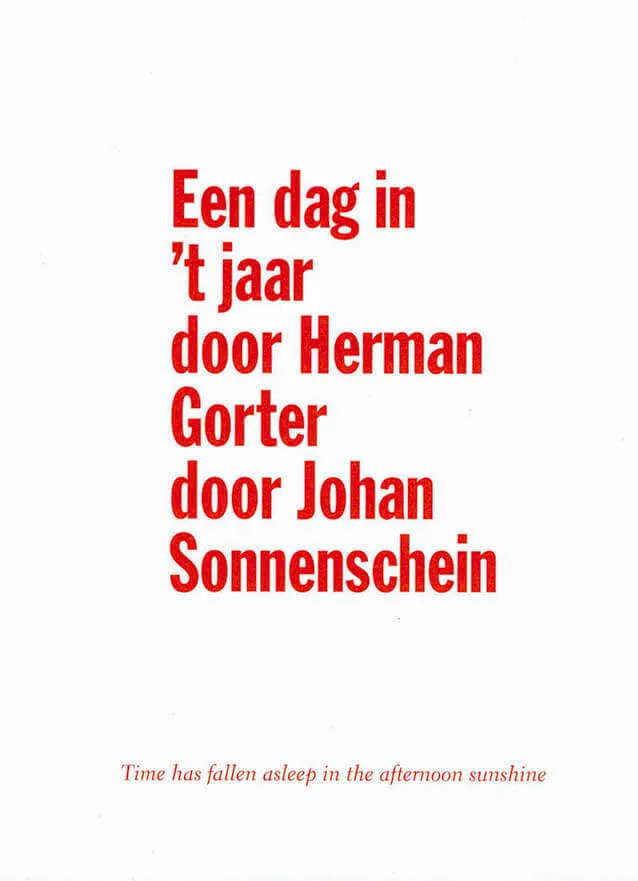
Time has fallen asleep in the afternoon sunshine
Een dag in 't jaar door Herman Gorter
For the project Time has fallen asleep in the afternoon sunshine a group of people/ performers memorize a book of their choice. Together they form a library collection consisting of living books. After years of learning by heart and reciting for readers, some of the books have now been written down from memory to create new editions, versions resulting from this process. This book is one of those books, chosen by one person, learned by heart and recited many times, and now written down again from memory. This edition is not a re-edition of the original text. It is a re-writing of the text after the process of reading, memorizing and reciting, with all the alterations that might have occured in the course of this process.

Coeur de Lion
A reissue of the instant cult-classic love poem, an investigation of poetic address.
Now that I am not addressing you
But the "you" of poetry
I am probably doing something horrible and destructive.
But this "I" is the I of poetry
And it should be able to do more than I can do.

Listen to the Golden Boomerang Return
Following their book AMANDA PARADISE: Resurrect Extinct Vibration (winner of the PEN and the Ruth Lilly Prize for Poetry), CAConrad's Listen to the Golden Boomerang Return shifts its attention from the previous book’s focus on communing with animals who are extinct toward communicating and caring for animals still living among us.
Recalling the historical and symbolic significance of the boomerang as an instrument of return, these poems emerged from a (soma)tic poetry ritual in which the author wrote with animals who have found ways to thrive in the Anthropocene, resulting in sculptural poems that are uninhibited and mysterious as they emerge organically from the bottom of each page. Guided by the urge “to/desire/the world/as it is/not as/it was,” CAConrad writes from an ecopoetics that is generous and galvanizing, reminding us of how our present attentions collectively shape a future humanity.

All Ah We is One: Caribbean Carnival Costume
Caribbean Carnivals have been taking place around the UK since 1959. These joyous celebrations of culture and community began as acts of resistance in the face of enslavement — a defiant stand from communities who refused to lose who they were and where they came from.
Drawing from this rich and radical history, Aisling Serrant explores Carnival through one of its most vibrant and unmissable features: costume. First turned to by former slaves in the Caribbean as an act of reclamation and quiet resistance, with roots in West African and European masquerade alike, the colourful costumes of Carnival weekend remain a vital mode of self-expression, protest, and camaraderie. From Canboulay to Leeds and Notting Hill, the costume makers, wearers, and the communities they attract, embody Carnival in the spirit of an expression used across the Caribbean to signify unity among nations and peoples: all ah we is one.

You Who Suffer, Because You Love, Love Still More
In You Who Suffer, Because You Love, Love Still More, Serubiri Moses offers an intimate and personal study of the lives and loves of pop star Freddy Mercury, combining a detailed epigraphy on the duplicitous nature of Mercury's origins, sexuality, and artistic talent with his own delicate memoir as a poet. Through this series of interlocked poems, yet again Moses lures us into an atmosphere both sensual and scholarly that echoes well past its last verse.
With ardor and grace, Serubiri Moses traverses a catalogue of pop music, visual art, and cultural history to bring his readers to a state of openness — to love, to art, and the freewill of ecstatic experience. Moses’s writing forefronts pleasure as a gateway for deeper critical inquiry, braiding personal memory and epigraphic excursions into sex, stardom, and poetry, reminding us in this journey that "pleasure almost happens without us knowing."
— Tausif Noor
Serubiri Moses, Ugandan curator and author, lives in New York City. He serves as a part-time faculty member at Hunter CUNY, and visiting faculty at the Center for Curatorial Studies, Bard College. He previously held faculty positions at New York University, and the New Centre for Research and Practice, and delivered lectures at Chazen Museum of Art, Art Institute of Chicago, Williams College, Yale University, University of Pittsburgh, The New School, Zeitz Museum of Contemporary Art Africa, and basis voor aktuelle kunst (NL), and University of the Arts Helsinki (FL). As a curator, he has organized exhibitions at museums including MoMA PS1, Long Island City; Kunst-Werke Institute for Contemporary Art, Berlin; the Hessel Museum, Bard College, NY; and the Smithsonian National Museum of African Art. He has curated solo presentations of Carl E. Hazlewood, Reza Aramesh, and is working on a retrospective of Taryn Simon. He previously held a research fellowship at the University of Bayreuth, and received his MA in Curatorial Studies at Bard College, and is an alumni of the Àsìkò International Art Programme. He serves on the editorial team of e-flux journal and his short stories have appeared in print in Ursula, and online in Lolwe. He has published poetry in the online journals Jalada and Badilisha Poetry Exchange, as well as in print journals Kwani? 7, Kwani? 8, and READ: A Journal of Inter-Translation (2022). He is the author of the poetry collection THE MOON IS READING US A BOOK (2023; Pântano Books).

BFTK #6: Tentative — Incomplete — Inconsistent
Andrew Walsh‐Lister, Matthew Stuart
This instalment of Bricks from the Kiln doubles as issue #6 of the journal and as an exhibition catalogue for the thematic show ‘BFTK#6: Tentative — Incomplete — Inconsistent: A Catalogue of the Disappeared, Destroyed, Lost or Otherwise Inaccessible’. Presenting objects, artworks, artefacts, models, events and animals that no-longer — or never did — exist in physical form, the exhibition explores themes of death, destruction and reincarnation, examining persisting interests in notions of ephemerality and permanence, memory and record, preservation and erasure, creation and reconstruction.
How do we remember and memorialise? How is space given to the unrecorded? How do we experience the out of reach, concealed, unseen, undiscovered? How can the dematerialised be materialised again, through the mediation of writing, image and sound?
THE ALMOST HORSE
Helen Marten
(inside front / back cover)
‘STILL IN ALL HEARTS, IN ALL BELLIES, IN ALL TOES’:
A BELATED REVIEW OF FESTIVAL DE FORT BOYARD
Matthew Stuart & Andrew Walsh-Lister
(pp.6–8)
EDDYSTONE
Rachael Allen
(pp.11–18)
TO MAKE THE STONE STONY
Emily LaBarge
(pp.21–26)
WHEREFORE AM I NOW?
Lucy Mercer
(pp.29–40)
WESTON: THE TOWN THAT WAS, AND THEN WASN’T
Crystal Bennes
(pp.43–52)
NOTES TO ACCOMPANY VIOLENT INNOCENCE (2019)
Will Harris
(pp.55–64)
GHOST, POCKETS, TRACES, NECESSARY CLOUDS
Matthew Stuart
(pp.66–69)
CONNECTIVITY OF TOUCHING
Ali Na & Mindy Seu in conversation
(pp.71–76)
PEARL
Rose Higham-Stainton
(pp.79–84)
NOTES FROM NEW MEXICO
Jennifer Hodgson
(pp.87–98)
THE MOOG OF AHMEDABAD
Paul Purgas
(pp.101–108)
IN WHICH DECIBELLA ESCAPES AUDITION
Sarah Hayden
(pp.111–122)
D.C.B.: A PARTIAL RETROSPECTIVE
Juliet Jacques
(pp.125–136)
PINBALL REMAINS: ON THE PINBALL ISSUE OF THE SITUATIONIST TIMES
Ellef Prestsæter
(pp.139–150)
TOMB III – CADMIUM (2021)
Gilbert Again
(pp.152–154)
NON-DESCRIPT ANIMAL
David Hering
(pp.157–161)
Cover & Bookmark artwork by Helen Marten

Luna
"Luna" (2021) is a graphic novel by Artist and illustrator Anat Martkovich, developed in collaboration with artist and illustrator Haithem Haddad. It was self published, with support by the Pais Foundation for the Arts.
The novel follows two days in the life of a family, and at its center is a dramatic event which drastically affects the lives of the family members.
The story develops in an a-linear and fantastic fashion, and attempts to present the impossible reality of violence within and outside the home.
The book is comprised of detailed black and white illustrations, with very little text accompanying them.
The little text alternated between different languages: Russian, Hebrew, Arabic, English and Hebrew sign language, depicting a complex and multi layer urban existence. The story is open to the reader's interpretation, though it is firmly set in a mundane everyday reality it opens up and presents us with fantastic possibilities of existence.
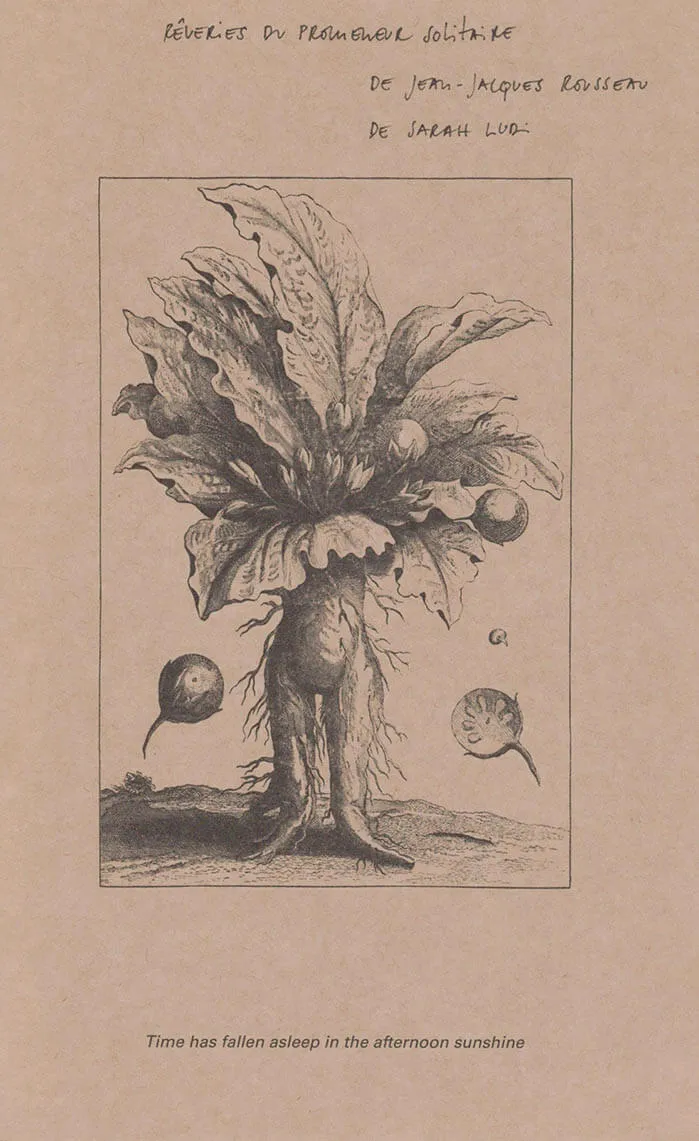
Time has fallen asleep in the afternoon sunshine
Rêveries du promeneur solitaire
For the project Time has fallen asleep in the afternoon sunshine a group of people/ performers memorize a book of their choice. Together they form a library collection consisting of living books. After years of learning by heart and reciting for readers, some of the books have now been written down from memory to create new editions, versions resulting from this process. This book is one of those books, chosen by one person, learned by heart and recited many times, and now written down again from memory. This edition is not a re-edition of the original text. It is a re-writing of the text after the process of reading, memorizing and reciting, with all the alterations that might have occured in the course of this process.

Slips of the Mind: Poetry as Forgetting
An audacious account of what happens when forgetting becomes a way of writing and writing becomes a way of forgetting.
In Slips of the Mind, poet and critic Jennifer Soong turns away from forgetting’s long-standing associations with suppression, privation, and error to argue that the absence or failure of memory has often functioned as a generative creative principle. Exploring forgetting not as the mere rejection of a literary past or a form of negative poetics, Soong puts to the test its very aesthetic meaning. What new structures, forms of desires, styles, and long and short feelings do lapses in time allow? What is oblivion’s relationship to composition? And how does the twentieth-century poet come to figure as the quintessential embodiment of such questions?
Soong uncovers forgetting’s influence on Gertrude Stein, Lyn Hejinian, Tan Lin, Harryette Mullen, Lissa Wolsak, and New York School poets John Ashbery, James Schuyler, Bernadette Mayer, and Ted Berrigan, among others. She reveals that forgetting’s shapeshifting produces differences in poetic genre, interest, and degrees of intentionality—and that such malleability is part of forgetting’s nature. Most provocatively, Soong shows how losing track of things, leaving them behind, or finding them already gone resists overdetermination and causality in the name of surprise, as poets leverage forgetting in order to replace identity with style. Slips of the Mind is the kind of literary criticism that will reward all readers of modern and contemporary poetry.

Malibongwe: Poems from the Struggle by ANC Women
In the late 1970s, Lindiwe Mabuza, a.k.a. Sono Molefe, sent out a call for poems written by women in anc camps and offices throughout Africa and the world. The book that resulted, published and distributed in Europe in the early 1980s, was banned by the apartheid regime.
Authorised by the editor, this re-issue of Malibongwe re-establishes a place for women artists in the history of South Africa's liberation. These are the struggles within the Struggle: a book that records the hopes and fears, the drives and disappointments, and the motivation and resilience of women at the front lines of the battle against apartheid. Here we see the evidence, too often airbrushed out of the narratives of national liberation, of a deep and unrelenting radicalism within women; of a dream of a South Africa in which not only freedom reigned, but justice too.

Image RIP: After Printing, Work & Planet Earth
Image RIP, the first publication from Source Type, is centered around New York graphic designer Geoff Han’s investigation into the Shenzen-based printer Artron and explores subjects ranging from design, production, work, and the environment in the post-industrial economy. The book gathers essays by Danielle Aubert, David Bennewith, Geoff Han, Ming Lin, Shanzhai Lyric, David Reinfurt, Mindy Seu, and Dena Yago, and features images by Ann Woo. Image RIP reflects a consistent theme in Han’s practice of the manipulation of image reproduction, printing, production, code, and other techniques to affect the process of viewing and reading.

My Kevin, My Paris
In the fall of 2017, Obe Alkema got acquainted with the American poet Kevin Killian, first at the New Narrative conference at UC Berkeley, then at the Poets & Critics Symposium in Paris that was all about his poetry. A year and a half later, Alkema traveled back to Paris, this time as a participant of a writing residency. He was there to research the landscape of memory, but more than he expected and initially realized, Kevin’s death the previous month (June 2019) affected his return. Besides inevitable, mourning and remembering became obsessions for Alkema, as he shows in ‘My Kevin, Our Paris’, a memoir about Kevin Killian (1952–2019), but especially about his Kevin and their Paris.

Afterimages 3: Lis Rhodes Volume 1
This DVD contains:
Light Reading, 1978, 20 min.
Pictures on Pink Paper, 1982, 35 min.
Cold Draft, 1988, 28 min.
Lis Rhodes has been at the forefront of British experimental filmmaking since the early 1970s. She studied at the North East London Polytechnic and the Royal College of Art. A strong formal aesthetic has been developed in her films, reflecting her involvement with the debates and practice which emerged from the London Filmmakers' Co-operative, where she was Cinema Curator 1975-6. Early 'expanded' works such as Light Music (1975) fused performance and multi-screen projection with an exploration of the visual qualities of sound. Her analysis of broader political and social questions can be traced to her later films, which combine formal rigour with a passionate critique of issues from nuclear power to domestic violence. As an active campaigner for women's rights, Rhodes was a founder member of Circles, the first women's artist film and video (1979) and was an Arts Advisor to the Greater London Council between 1982 and 1985. She lives and works in London and teaches at Slade School of Fine Art, University College, London.