Books
Books
in random order

From The Prop To The Inside
FROM THE PROP TO THE INSIDE gathers texts on the concept of the prop—as object, requisite and support—on stage and in the exhibition space. The starting points of this book are objects and installations of the artist Michaela Schweighofer, which deal with the stage as a platform and the sculpture as a prop.
The authors are friends: artists, critics and curators whom she has invited to write a text at the interface of their and her practice. The contributions within take on multiple forms; letters, essays and interviews—they are intended to create a theoretical-subjective anthology that makes visible the phenomena of the private as symptoms of the structural, as well as to provide a direct insight into contemporary artistic creation.
Text: Juliane Bischoff, Veronika Eberhart, Cornelia Lein, Cathrin Mayer, Gianna Virgina Prein, Agnieszka Roguski, Juliane Saupe, Michaela Schweighofer & Chloe Stead

The Letters of Mina Harker
In Dodie Bellamy's imagined "sequel" to Bram Stoker's fin de siècle masterpiece Dracula, Van Helsing's plain Jane secretarial adjunct, Mina Harker, is recast as a sexual, independent woman living in San Francisco in the 1980s. The vampire Mina Harker, who possesses the body of author Dodie Bellamy, confesses the most intimate details of her relationships with four vastly different men through past letters. Simultaneously, a plague is let loose in San Francisco-the plague of AIDS.
Bigger-than-life, half goddess, half Bette Davis, Mina sends letter after letter to friends and co-conspirators, holding her reader captive through a display of illusion and longing. Juggling quivering vulnerability on one hand and gossip on the other, Mina spoofs and consumes and spews back up demented reembodiments of trash media and high theory alike. It's all fodder for her ravenous libido and "a messy ambiguous place where pathology meets pleasure." Sensuous and captivating, The Letters of Mina Harker describes one woman's struggles finding the right words to explain her desires and fears without confining herself to one identity.

Better Living Catalog
Pippa Garner’s Better Living Catalog, originally published in 1982, takes the form of a mail order catalog featuring clever and whimsical inventions that parody consumer goods while simultaneously critiquing America’s obsession with ingenuity, efficiency, leisure, and comfort. These works, which were made as prototypes and photographed for the publication, take the form of improbable accessories, clothing, footwear, home appliances, and office gadgets.
For example, the “Reactiononometer,” a portable wristband, instantly measures social success, while the “Digital Diet Loafers” display the wearer’s weight with every step. If the “Munch-o-Matic” reduces deskwork interruptions by flinging a snack right into the user’s mouth, other items promise financial solvency (the controlled cash flow “Autowallet”), sustainable waste management, or mess-free companionship (the “Pet-a-Vision” TV console). The artist asserts that all of the products in the book are “absolute necessities for contemporary survival.”
The Better Living Catalog was a pop hit when it was published, earning Garner spots on nighttime TV talk shows and attention from magazines like Vogue and Rolling Stone. In a meme-filled culture, the works still resonate today, finding their analog in widely-circulating consumer products, and—in the case of the “High Heel Skates”—even appearing unattributed in the runway collection of a major luxury fashion brand.
A few years after the Better Living Catalog was published, Garner began her gender transition, which she has characterized as an artistic project that draws conceptual parallels to the altered consumer goods she has continued to create since the 1970s. The artist’s practice has always been about hacking—gender hacking, she stated, was “an excellent premise for maverick conceptual art and diametrically opposed to anything I’d ever done.”
Many of the prototypes Garner created for the publication were repurposed or recycled, making this previously rare gem of an artist book one of the artist’s few works to now be widely available.
Born in 1942 in Evanston, Illinois, Pippa Garner (formerly known as Philip Garner) began her practice in the late sixties as a member of the highly regarded Transportation Design department at ArtCenter, California, with plans to become a car stylist, and was drafted to Vietnam to serve as a combat illustrator. In the mid-80s, Garner began her gender transition, which she considers a conceptual artwork, marking an extension of her practice from twenty years of altering cars, garments, and consumer products to using her own body as raw material. Garner appeared on the Tonight Show Starring Johnny Carson and other talk shows, showcasing her satirical consumer product inventions, and her artwork has been featured in Car & Driver, Rolling Stone, Arts & Architecture, and Vogue, among other publications. In the 1980s, her performance, design, and video work was exhibited in institutions including the Los Angeles Institute of Contemporary Art; Whitney Museum of American Art; and Museum of Contemporary Art, Los Angeles; since 2015, she has had exhibitions at STARS, O-Town House, Redling Fine Art, and Parker gallery in Los Angeles; Jeffrey Stark in New York; JOAN, Los Angeles; Kunstverein München; 49 Nord 6 Est – Frac Lorraine, Metz; Kunsthalle Zurich; and Art Omi, Ghent, New York. She is the author of three other books: Utopia… or Bust! Products for the Perfect World (1984), Garner’s Gizmos & Gadgets (1987), and the zine Beauty 2000 (1992/2021).

Sonia's Book
I acquired Sonia’s copy of Fraser Darlingʼs book in 2010 when my cousins, sister, and I were going through Soniaʼs house following her death. From one of her glassed-in bookshelves, the spineʼs distinctive artwork caught my eye. When I put my hand in to grab it, it was immediately apparent there was something odd. Turning it over, I realised the book contained enclosures. It had been used as a flower press. Between its pages were eleven sheets of specimens, each sheet masked off with two pieces of neatly arranged blotting paper. All the sheets were titled in pencil: ‘Aviemore—May 1961’.
Sonia Campbell Penney was a professional gardener, keen botanist, and the author’s aunt. Her ‘book’ is a copy of Natural History in the Highlands and Islands by F. Fraser Darling, interleaved with eleven sheets of plant specimens, guarded by blotting paper, which Sonia collected around Aviemore in the Scottish Highlands in May 1961. Functionally, if sporadically, annotated with plant names and, occasionally, places of finding, these sheets might be interpreted as a form of nature writing or a holiday diary almost without words. Sixty years on, Bridget Penney asks what a close, though thoroughly unscientific, consideration of these unmediated traces might reveal.

Timothée Trouche, Marteau piqueur
Timothée Trouche, Marteau piqueur
Encre verte pour tableaux noirs. Vingt-sept poèmes de Timothée Trouche (maître d’hôtel et instituteur) compilés avec la complicité de Teddy Coste (groom et solitaire).

In Thrall
Dear Miss Maxfeld . . . What I’m really afraid of is that I am a homosexual human being. I wish you were one too but I don’t think it’s possible there could be so many in one school, do you? Probably there is only one person who is homosexual in one place at one time and that one person (I am afraid) is me . . .
After sixteen-year-old Lynn writes her thirty-seven-year-old English teacher a letter they embark on one of the funniest and saddest love affairs in fiction, shrouded in secrecy and guilt. Set in the year Kennedy was shot, all Lynn knows about “lezbos” is that they wear their hair in crew cuts, buy suits like her father’s, and sprout mustaches over their upper lips. Trying to pass, Lynn continues to neck with her boyfriend and make bigoted jokes with her friends. Feigning innocence with her parents, each night she checks the mirror for tell-tale signs of perversion. Profound, witty, poignant, and highly charged, In Thrall is the first in Jane DeLynn’s trilogy of novels on sexuality and authority. It is as believable in its depiction of a closeted teen as it is heartbreaking.
With an introduction by Colm Tóibín
Flawless comic timing. —Colm Tóibín, from the Introduction
All Lynn’s phobias, aversions and hang-ups make her exaggerated but real . . . The great triumph of this novel is that DeLynn has captured the way adolescents felt, talked, and behaved during the early 1960s. —San Francisco Chronicle
A dazzlingly gritty exposure of a girlhood experience usually neglected by both private and public consciousness. —Reba Maybury

Flet
Set in a spaced-out future in which all cities have been evacuated after an "Emergency," FLET is named for its female protagonist, an Administration flunky who begins to suspect that the Emergency may be a tool of sociopolitical oppression. An elegant entry in speculative fiction, Flet finds McSweeney slowing her distinctively hyperactive imagination down to the speed of narrative.

Vostok
The theme was built around the idiom “VOSTOK”, the title given by Stéphanie Pécourt to her cycle dedicated to performative semantics, in which carte-blanches signed by guest curators at the Centre Wallonie-Bruxelles are deployed. Buried beneath several kilometers of ice, Lake Vostok acts as an invitation that both fascinates and refuses us. This sub-glacial lake on the edge of Antarctica, the largest identified, becomes the mirror-object of our desires and fears for the abyssal depths. The title of the program, Now I am a Lake, is taken from Sylvia Plath's poem Mirror (1961).
This booklet includes the scripts and texts of the performances, translated exclusively into French for the occasion, as well as images from the videos presented at the eponymous event. The compilation focuses on Sylvia Plath's poem Mirror, and includes an introductory text by curator Pauline Hatzigeorgiou.
edited by SB34
graphic design by Raphaëlle Serres / Solid Éditons
Contributions by Signe Frederiksen, Pauline Hatzigeorgiou, Margaux Schwarz, Hagar Tenenbaum, Sylvia Plath & Eleanor Ivory Weber

Silicone God
Shae wants to stop shagging other women's husbands and be a proper queer. Plus, she's bored of only ever getting to use her new strap on a pile of cushions. The answer seems simple enough: come out, go out, and finally get it on with the fit bird at Dyke Night. Or it would be if Evaline, a wayward silicone mistress from the future, wasn't jealous...
A surreal, dirty little book that falls somewhere between Derek McCormack, David Cronenberg, and the tentacle porn you 'accidentally downloaded', Silicone God is for those who like it very, very weird.

Recto verso – An Anthology of Works and Writings by Asier Mendizabal
A comprehensive retrospective of the Spanish artist's work, covering his major exhibitions (Manifesta, Reina Sofia, MACBA, Raven Row, etc.) and including all of his texts published as fanzines over a period of twenty years, a new critical essay by Kim West, and a wide-ranging conversation.
Conceived as a compilation of works and writings of the last two decades, this book is structured as an alternating succession of four different registers: four recurrent modes. A long-form interview, a series of questions from different collaborators, documentation of a selection of projects, and a compilation of the facsimilia of the brochures published by the author since 2008. The aim of this concatenation of recurring sections is to delay the linear progression suggested by the narrative of a compilation, by the apparent causal string of decisions, ideas, references and works displayed as an accumulative "biography" of the artist's practice. However, this being a bound book, the suggestion of an interwoven relation between all the works, regardless of when, where or how they were made, must submit to the order locked by the sewn spine of its signatures, the folder of bound pages that forms each section of a book.
Designed by Filiep Tacq, the book includes an essay by Kim West and a long-form interview by Beatriz Herráez, punctuated by questions from Filiep Tacq, Lisa Tan, Jon Mikel Euba, Antonio Menchen, Alex Valijani, Johanna Gustafsson Fürst, Itziar Okariz, Olatz Otalora, Antonia Majaca, Pablo Lafuente and Koenraad Dedobbeleer.

Nothing at All
An atmospheric rumination on gendered violence, cosmic collapse, and colonialism.
From deep inside a black hole, comes Nothing at All—the space where everything collapses: form, genre, gender, and being. Olivia Tapiero’s poetic and essayistic fragments overflow with lyric beauty as they explore how colonialism, illness, and desire intertwine amidst personal and collective suffering. Generations, geographies, and desires mingle, contaminating one another in these anarchic, insubordinate texts. Here, the written word disrupts foundations and nations, claiming its own survival.
Olivia Tapiero is a writer, translator and musician. She is the author Les murs (Robert-Cliche Award, Prix Senghor finalist), Espaces (2012), Chairs (2019), Phototaxie / Phototaxis (Nightboat Books, 2017 / 2021, Lambda Literary Awards finalist), and Rien du tout (2021, Grand Prix du livre de Montréal Finalist, Governor General’s Literary Awards finalist). She is editor-in-chief for the literary magazine Moebius, and has contributed poems and essays to various publications in Canada, France, and Korea. She has also translated works of contemporary authors such as Roxane Gay, Anne Boyer and Billy-Ray Belcourt. She lives between Marseille and Montréal.
Foreword by Anne Boyer.

Dance as Moving Pictures
The first monograph dedicated to the pivotal work of African American postmodern dancer, choreographer and video artist Blondell Cummings.
A foundational figure in dance, Blondell Cummings bridged postmodern dance experimentation and Black cultural traditions. Through her unique movement vocabulary, which she called "moving pictures," Cummings combined the visual imagery of photography and the kinetic energy of movement in order to explore the emotional details of daily rituals and the intimacy of Black home life. In her most well-known work Chicken Soup, Cummings remembered the family kitchen as a basis for her choreography.
This book draws from Cummings's personal archive and includes performance ephemera and numerous images from digitized recordings of Cummings's performances and dance films; newly commissioned essays by Sampada Aranke, Thomas F. DeFrantz, and Tara Aisha Willis; remembrances by Marjani Forté-Saunders, Ishmael Houston-Jones, Meredith Monk, Elizabeth Streb, Edisa Weeks, and Jawole Willa Jo Zollar; a 1995 interview with Cummings by Veta Goler; and transcripts from Cummings's appearances at Jacob's Pillow and the Wexner Center for the Arts. Bringing together reprints, an extended biography, a chronology of her work, rarely seen documentation, and new research, this book begins to contextualize Cummings's practice at the intersection of dance, moving image, and art histories.
Blondell Cummings (1944-2015) was a choreographer and video artist who mined everyday experiences like washing, cooking and building to create works celebrated for their rich characterizations and dramatic momentum. According to Wendy Perron, Cummings crossed over from modern to postmodern, from the Black dance community to the avant-garde community. Cummings referred to her stop-motion movement vocabulary as "moving pictures," which combined her interests in the visual imagery of photography and the kinetic energy of movement. Her dances drew from an accumulation of character studies that often began with photography and workshops, and included poetry, oral histories, and projection. Her interest in moving pictures is also evidenced in her commitment to dance films. She both supported the documentation of dance, and created many experimental dance films.
Edited by Kristin Juarez, Rebecca Peabody, Glenn Phillips.
Texts by Sampada Aranke, Thomas F. DeFrantz, Tara Aisha Willis, Marjani Forté-Saunders, Ishmael Houston-Jones, Meredith Monk, Elizabeth Streb, Edisa Weeks, Jawole Willa Jo Zollar, Blondell Cummings, Veta Goler.

Iliazda at the Birthday Party – Autobiographical Lecture, 1922
The English translation of Zdanevich's Dadaist autobiographical lecture in Paris in 1922, where he adopts the name Iliazda. In this entertaining lecture, the achievements of the avant-garde is presented as a combination of zaum, polymorphous sexuality, aleatory forms and scatological interpretation of culture.
The second volume of the bie bao series presents a eulogy entitled Iliazda at the Birthday Party, a pseudo-autobiographical lecture delivered by Ilya Zdanevich in Paris in 1922. It reports on Zdanevich's artistic and political adventures up until then. Along with an autobiography full of self-admiration, in this lecture Zdanevich gives an interpretation of his zaum dramas inspired by Freudianism, and humorously describes a colourful image of the Russian microcosm in Montparnasse.
Additionally, this second volume also includes Iliazd's letter to Ardengo Soffici from 1964, where one can read, in the most unambiguous terms, about Zdanevich's positions against war, imperialism, and all forms of nationalism. Subtitled 50 Years of Russian Futurism, the letter to Soffici presents us with an altogether new Zdanevich—a "fellow traveller" in both leftist and avant-garde circles. As well as the extended introduction and extensive annotations, the texts are further contextualised with Johanna Drucker's visual presentation of the birth of the Iliazd cult.
The bie bao series will include eight publications, covering many layers of Zdanevich's rich theoretical and artistic output. Each volume consists of a bio-bibliographical introduction, a commentary, a translation with annotations, and artistic intervention.
Iliazd (Ilya Zdanevich, 1894-1975) was a Russian poet, designer, typographer, theoretician, art critic, and publisher, close to the avant-garde circles and one of the promoters of Futurism in Russia, author of a poetic work, drama written in zaum abstract poetic trans-sense or "transrational" language, and novels.

In the forest of grief I grew into a shrub of gold
For British artist Delaine Le Bas, dress is divine. Clothes appear as both mask a nd memorial within an expansive body of work exploring mythologies of Le Bas’s Romani ancestry. Embroidered and hand-painted textile is central to the artist’s lyrically activist practice, alongside costume, writing and performance. In a new series of portraits by the British photographer Tara Darby, directed by Jane Howard, gold leaf dances across the planes of Le Bas’s face in repose, it wraps and jangles around her wrists, glimmers across her clothes. In a notebook she has inscribed: “In the forest of grief I grew into a shrub of gold.” The grief is alchemical.
As Stephen Ellcock writes:
‘The maxim ‘Know Thyself’ was inscribed in gold on a column on the threshold of Pythia’s temple, serving as a warning that wisdom, understanding, empathy and anything remotely resembling peace of mind are unachievable without selfawareness, reflection and ruthless self-criticism.’
The fragments of hope, anger, magic and curiosity redolent in Le Bas’s work form a call to action. A reminder of the racism, exclusion and subjugation that abound. Photographs of Le Bas, which Darby has been making for more than a decade, present the artist as truth sayer, inquisitive goddess and modern-day Sibyl.
Through the incorporation of texts—a conversation between gallerists John Marchant and Keiko Yamamoto with curator Claire Jackson—drawings from Le Bas’s journals, archival images taken at her home and the restyling—and reflection—of her own personal wardrobe, In the forest of grief I grew into a shrub of gold radiates psychological, social and political wisdom. Fashion is revealed as both tyrannical disguise and liberating regalia.

COOP. A Novelette
On work and words, and how they contort the world.
Lena is a part-time bookseller in a bougie design studio in Oxford Circus. In between minimum-wage work under a politically hostile boss and strained communications with her parents, her days are shaped by a fraught relationship with food, ambiguous experiments in creative writing, and mounting pressure to find a ‘proper’ postgraduate job.
In taut, pocket-sized vignettes, COOP reveals a suffocating lattice of language that makes up a precarious London life. But as each word of her story unravels, Lena discovers interstices between them—to find autonomy and escape.
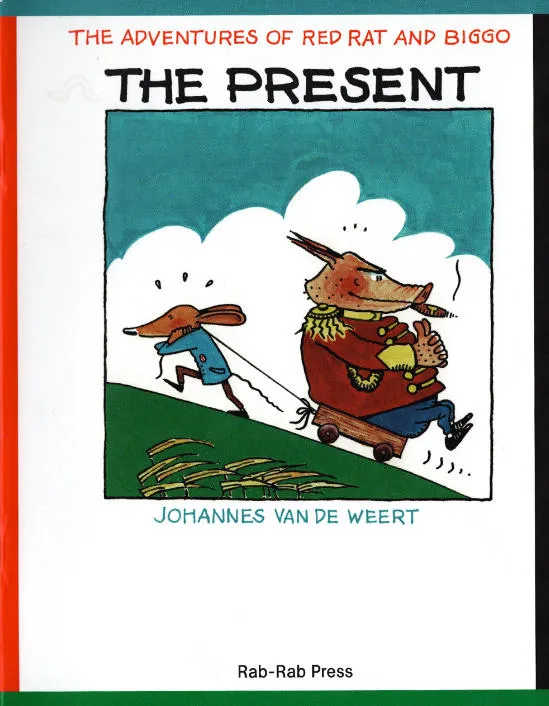
The Adventures of Red Rat and BIGGO – The Present
A children's book by Johannes van de Weert, a veteran of the punk underground (Rondos, The Ex, Red Rat, Raket).
The Adventures of Red Rat and BIGGO – The Present is a remake of Bram konijn en Piet de muis [Bram the Rabbit and Piet the Mouse], a 1982 children's book by Johannes van de Weert, a veteran of the Dutch punk underground who played with Rondos and The Ex, and who was the force behind Red Rat and Raket editions.
The Present is a 2010 remake telling the story of a bully pig who terrifies a poor rat on a daily basis. After a while, the rat falls ill with fear and has to stay in bed. The lonely, evil pig has no one to play with and becomes depressed. The pig gives the rat a present—a bunch of beautiful flowers—and all is well. Now the two can play together.
The 2010 remake, featuring different characters and intended for a North Korean audience, was never published. The 2025 English version opens with an introduction by Van de Weert, telling a bizarre story of a failed political career and an absurd vaudeville class struggle behind the seemingly harmless educational children's book.
Johannes van de Weert was a cartoonist active in the Rotterdam punk and squatter's movements of the 1980s. He was a singer with the punk band De Rondos and he started self-publishing small comic booklets in the late 1970s. He created his character "Redrat" for the fanzine Raket in 1980. The character soon became an icon for the squatter's movement.

Mud … and the Earth System
Mud … and the Earth System explores groundbreaking research in Earth system sciences and highlights the challenges of communicating these findings to the public.
As once-stable “mudscapes” transform, they become both symptoms and symbols of a rapidly warming planet. This book delves into humanity’s connection to these changes through the study of ancient organic and inorganic compounds that have come alive after millennia. It poses essential questions about what these evolving ‘mud’ compounds reveal about Earth’s deep past and our imminent future.
Born from collaborative research led by artist Rikke Luther at the Interdisciplinary Research of Ocean, Climate and Society (ROCS) at the University of Copenhagen in collaboration with Earth scientist, Professor Katherine Richardson, this publication showcases how artistic practices – such as image-making, conceptual mapping, and filmmaking – enhance scientific representation.
Mud… and the Earth System features commissioned essays from experts in Earth Science, Political Aesthetics, and Molecular Geobiology. The book pairs their insights with compelling artwork, including large-scale maps of emerging ‘mudscapes’ in Svalbard, Iceland, Greenland, and Gotland.
The essays give perspectives on the DNA that is collected and stored in mud, which connects life across timescales as an evolutionary resource framing the interactions of human societies with the extreme complexities of the Earth system. Esther Leslie’s “Mud Crystal and Polar Thinking” sets the scene, followed by Karina K. Sand’s “Death and Life: in Mud: Two Million Years in a Split Second,” and Earth scientist Katherine Richardson’s contribution “A Muddy Diary.”
As Richardson sums up, “Mud is an important medium for storing the archives that describe the history of both life and climate on Earth, and we are only just beginning to understand the fantastic stories that mud can tell.”
Contributions by Esther Leslie, Rikke Luther, Katherine Richardson, Karina Sand

University of California Press
This Connection of Everyone with Lungs
Part planetary love poem, part 24/7 news flash, the hypnotic poems of This Connection of Everyone with Lungs wrap with equal, angular grace around lovers and battleships. These poems hear the tracer fire in a bird's song and capture cell division and troop deployments in the same expansive thought. They move through concentric levels of association and embrace —from the space between the hands to the mesosphere and back again—touching everything in between. The book's focus shifts between local and global, public and private, individual and social. Everything gets in: through all five senses, through windows, between your sheets, under your skin.

Up Your Ass
Valerie Solanas's rarely published, legendary play, Up Your Ass, explodes social and sexual mores and the hypocritical, patriarchal culture that produces them through her signature irreverence and wit, incisiveness and camp.
The play, whose full title is Up Your Ass Or From the Cradle to the Boat Or The Big Suck Or Up from the Slime, marches out a cast of screwy stereotypes: the unknowing john, the frothy career girl, the boring male narcissist, two catty drag queens, the sex-depraved housewife, and a pair of racialized pickup artists, among others. At the center is protagonist Bongi Perez—a thinly veiled Solanas—a sardonic, gender-bending hustler who escorts us through the back alleys of her street life. The fictionalized predecessor to SCUM Manifesto, the play shares the same grand, subversive, implicative language, equally spitting and winking, embracing the margins, the scum, and selling a trick along the way.
Valerie Solanas (1936-1988) is an American radical feminist intellectual, known for her SCUM Manifesto—a pamphlet with which she declares the power of women and imagines a political future through the margin—, and for having tried to assassinate Andy Warhol.
Edited by Leah Whitman-Salkin.
With a contribution by Paul B. Preciado.
Graphic design: Roxanne Maillet.

Sonic Faction: Audio Essay as Medium and Method
Maya B. Kronic, Steve Goodman and 1 more
Explorations of the audio essay as medium and method.
With contributors including Justin Barton, Angus Carlyle, Kodwo Eshun, Steve Goodman, Robin Mackay, Paul Nataraj, and Iain Sinclair, Sonic Faction presents extended lines of thought prompted by two Urbanomic events which explored the ways in which sound and voice can produce new sensory terrains and provoke speculative thought.
Three recent pieces provide the catalyst for a discussion of the potential of the "audio essay" as medium and method, a machine for intensifying listening and unsettling the boundaries between existing forms: documentary, music, ambient sound, audiobook, field recording, radio play….
Kode9's Astro-Darien (2022) is a sonic fiction about simulation, presenting an alternative history of the Scottish Space Programme, haunted by the ghosts of the British Empire. Justin Barton and Mark Fisher's On Vanishing Land (2006) is a dreamlike account of a coastal walk that expands into questions of modernity, capitalism, fiction, and the micropolitics of escape. Robin Mackay's By the North Sea (2021) is a meditation on time, disappearance, and loss as heard through the fictions of Lovecraft, Ccru, and the spectre of Dunwich, the city that vanished beneath the waves.
Alongside photographic documentation of the events and edited transcripts of the artists' discussions, Sonic Faction brings together contributors with diverse perspectives to address the question of the audio essay and to imagine its future.
Contributors
Lawrence Abu Hamdan, Lendl Barcelos, Justin Barton, Ben Borthwick, Angus Carlyle, Matt Colquhoun, Jessica Edwards, Kodwo Eshun, Steve Goodman, Ayesha Hameed, Eleni Ikoniadou, Lawrence Lek, Robin Mackay, Paul Nataraj, Emily Pethick, Iain Sinclair, Shelley Trower

Thirty-Odd Functions of Voice in the Poetry of Alice Notley
Alice Notley has consistently peopled her poetry with the voices of those around her: kids, friends, husbands, strangers, and the dead. Thirty-Odd Functions of Voice in the Poetry of Alice Notley offers an array of interpretations of this technique. While not aspiring to completeness, and limiting its attention to one formal aspect of a single author's work, this poem-essay sketches relationships between intimate speech and literary language.

Grand Rapids
Installed alongside the Grand River in downtown Grand Rapids, Michigan, Alexander Calder’s public sculpture La Grande Vitesse has come to symbolize the city. Tess moves there from Ypsilanti, Michigan in 2001—the same year that her mother dies, when everything begins to move, for her, in slow motion. Thrust into adolescence nearly rudderless, fifteen-year-old Tess is intoxicated, angsty, and sexually awake. A decade later, inspired by diary entries and TV reruns, she remembers this summer in the suburbs as the one that redefined her. Its echoes of death are frozen in time like the waves represented in the Calder sculpture or the concrete steps leading down to the churning river. She comes to see Grand Rapids as a collection of architecture and emblems, another home to which she cannot return.
Natasha Stagg is the author of Sleeveless: Fashion, Image, Media, New York 2011–2019 and Surveys: A Novel, both published by Semiotext(e). Her work has appeared in Artforum, Bookforum, Texte Zur Kunst, n+1, Spike Art, Flash Art, Dazed, V, Vice, 032c, and other publications.

Anarcadia
An epic poem in miniature, Anarcadia attempts to navigate the stark disintegration of the very world from which it’s made, mapping a catastrophe that seems both on its way and already occurring. Offering a collage of collapsing fragments – whirling ‘like bitstreams / in a blizzard’ – this sequence freefalls through a landscape of freak storms and surveillance satellites, ‘bio- / metric insects’ and ‘full- / body scanner[s]’, ‘leaving nothing left / undamned’. Continuing the sleek work of the previous collections, Hand’s command of language generates a livable terrain, humming with echoes of the pastoral tradition – from Sidney to Shelley, from Geoffrey Hill to J.H. Prynne. Hand’s poetry renders ‘an animate / climate’, through which we are forced to face the debris of a system that has failed us and a planet we, in turn, have failed. Nevertheless, the poet shows us a glimpse of the future. At the heart of Anarcadia is something of a love poem, revealing beauty in the art of losing, a way to ‘Re-salvage / sylvan camouflage / out of obscure selvage’, attempting a recovery. ‘Rife with hybrid vigour’, this book confirms Dominic Hand to be a poet of singular, clear-sighted vision, unafraid to see things as they are, ‘risking / bewilderment’.
– Rowland Bagnall

Cadavres
Phœbe Hadjimarkos-Clarke, Rozenn Voyer
Cadavres rassemble 13 poèmes écrits par Phœbe Hadjimarkos - Clarke sur les errances dans les villes âpres, les campagnes humides et les maisons branlantes. Les poèmes sont accompagnés de 15 dessins de Rozenn Voyer.