rile*books

Search books

Search books by title, author, publisher, keywords...

Cover of Wrong Winds

Fonograf Editions

Wrong Winds

Ahmad Almallah

€18.00

Ahmad Almallah’s third poetry collection considers the impossible task of being a Palestinian in the world today.

When genocide is the question, can the answer be anything but wrong? In Wrong Winds, written during the first months of Israel’s genocidal assault on Gaza, Palestinian-American poet Ahmad Almallah converses with the screams echoing throughout the West. Traversing European cities, Almallah encounters the impossibility of being a Palestinian, left alone in a world full of sympathizers and enemies. Through a continuous unsettling of words and places, considering the broken voices of Western poetry (Eliot, Lorca, and Celan, among others), the poems in Wrong Winds discover the world again and form an impossible dialogue with the dead and dying.

Published in 2025 ┊ 70 pages ┊ Language: English

recommendations

Cover of The Grimace of Eden, Now

Fonograf Editions

The Grimace of Eden, Now

Cody-Rose Clevidence

Poetry €19.00

The playful, inventive, and lyrically quick poems comprising The Grimace of Eden, Now orbit the strange space halfway between Tennyson and the Metaverse, veering between the natural world and a sci-fi universe, between inner feelings and outward observations, with questions of divinity alongside domestic life, spiders, dishes, and spaceships. The roving eye of these poems wanders through spacetime carrying irreverent theologies and exploring what it could mean to be living, sensate, and awake in this weird moment in time, exposing a mixture half of awe and half of madness. 

Cody-Rose Clevidence is the author of Aux Arc / Trypt Ich (Nightboat Books, 2021), Listen My Friend, This is the Dream I Dreamed Last Night (The Song Cave, 2021), Flung/Throne (Ahsahta, 2018), and BEAST FEAST (Ahsahta Press, 2014), as well as several chapbooks (Fonograf Editions, flowers and cream, NION, garden door press, Auric). Occasionally a visiting poetry professor at the Iowa Writers Workshop, they live in the Arkansas Ozarks alongside three loyal, sentient pets, and the continuous void.

Cover of A Mouth Holds Many Things: A De-Canon Hybrid Literary Anthology

Fonograf Editions

A Mouth Holds Many Things: A De-Canon Hybrid Literary Anthology

Dao Strom, Jyothi Natarajan

Poetry €36.00

A Mouth Holds Many Things collects hybrid-literary works from 36 women and nonbinary BIPOC writer-artists. Spanning experimental poetry and prose, image-text, collage, performance text, AI-generated writing, and more, this ground-breaking full-color print volume illuminates and expands the interstitial spaces where text blends, blurs, and morphs with visual and other media.

At the restless heart of this collection is a challenge to some fundamental questions: What is reading? What is writing? Lifting language beyond the domain of the letter, the works collected here present language in other forms: visual, embodied, sonic, asemic, tactile. Language, after all, is multi-textu(r)al, interwoven, punctured, fragmented, grafted, possessing power to construct and deconstruct, fed into by many rivers of experience: marginalizations and migrations, diasporas and displacements, invisibilities and hyper-visibilities.

A project of the Portland-based literary-social art project, De-Canon, which creates unique spaces and experiments to center works by writers of color, this collection is edited by Dao Strom and Jyothi Natarajan.

A Mouth Holds Many Things was, in the short stories/poetry/anthologies category, the winner of a 2024 PubWest Book Design Award.

Full list of contributors

Stephanie Adams-Santos, Kimberly Alidio, Samiya Bashir, Aya Bram, Victoria Chang, Jennifer S. Cheng, Gabrielle Civil, desveladas (Macarena Hernández, Sheila Maldonado, Nelly Rosario), Carolina Ebeid, Nadia Haji Omar, Christine Shan Shan Hou, Imani Elizabeth Jackson, Vi Khi Nao, Diana Khoi Nguyen, Quyên Nguyễn-Hoàng, Cindy Juyoung Ok, Monica Ong, Shin Yu Pai, Jenne Hsien Patrick, Jennifer Perrine, Alley Pezanoski-Browne, Kelly Puig, Ayesha Raees, Jhani Randhawa, Paisley Rekdal, Daisuke Shen, Sasha Stiles, Sandy Tanaka, Arianne True, Addie Tsai, Vauhini Vara, Divya Victor, Anna Martine Whitehead, Kathy Wu

Cover of Bird Watching and Their First Three Books of Poetry

Fonograf Editions

Bird Watching and Their First Three Books of Poetry

Eileen Myles

Poetry €24.00

Any future film director planning to make a movie of Myles's iconic novel Chelsea Girls (it's always just about to happen) would be wise to read Bird Watching first. Written in 1978 and unpublished until now, the central character of the book is a twenty-something that is already filled with memories. Living in New York City, resplendent, full of both grandeur and awkwardness, they are about to embark on a life fully invested in art. Bliss happens, as does uncertainty. Everything is here and now.

The Irony of the Leash, A Fresh Young Voice from the Plains, and Sappho's Boat, the other collections contained in the volume, comprise the first three books that Myles published, when their promise as one of the most important writers of their generation was just coming into view. Immensely readable, raw, and slightly unhinged, the poetry that comprises these three texts is post young. Slight creaky but fully functional, all of these poems are beautiful and funky.Bird Watching and Their First Three Books of Poetry contains a critical foreword by poet and scholar Rosa Campbell, along with a preface by Eileen Myles contextualizing the book within our contemporary moment.

Eileen Myles (them/them, b. 1949) is a poet, novelist and art journalist whose practice of vernacular first-person writing has made them one of the most recognized writers around town (globally). They live in New York & in Marfa, TX.

Cover of Early Works

Fonograf Editions

Early Works

Alice Notley

Poetry €26.00

Early Works collects Alice Notley’s first four out of print poetry collections, along with 80 pages of previously uncollected material. A must have for any Notley fan. Includes original collection cover artwork by Philip Guston, Philip Whalen and George Schneeman, among others.

From editor Nick Sturm’s “Introduction” to Early Works:

In the author’s note that begins Grave of Light: New and Selected Poems 1970-2005, Alice Notley writes, “My publishing history is awkward and untidy, though colorful and even beautiful.” I have always been enamored of this sentence, which reminds us that an array of dispersed and varying publishing contexts are the original sites that give shape to such a book’s form. It is also something of an invitation into that color and untidiness, a prompt to become more curious about the awkwardness and beauty of Notley’s publishing history. This book, Early Works, accounts for a significant portion of that history by bringing back into print the complete versions of her first four books, a little-known 22-poem sonnet sequence, and a large selection of early uncollected poems gathered from little magazines. In doing so, Early Works joins an important set of recent volumes that put Notley’s earlier poetry back into circulation, including Manhattan Luck (Hearts Desire, 2014), which collects four long poems written between 1978 and 1984, and Songs for the Unborn Second Baby, originally published by United Artists in 1979 and reissued in a facsimile edition by London-based Distance No Object in 2021. Each in their own way, and especially taken together, these books continue to confirm that, as Ted Berrigan writes in The Poetry Project Newsletter in 1981, “Alice Notley is even better than anyone has yet said she is.”

Cover of Women in Concrete Poetry: 1959-1979

Primary Information

Women in Concrete Poetry: 1959-1979

Mónica de la Torre, Alex Balgiu

Poetry €30.00

An expansive anthology focused on concrete poetry written by women in the groundbreaking movement’s early history. It features 50 writers and artists from Europe, Japan, Latin America, and the United States selected by editors Alex Balgiu and Mónica de la Torre.

Women in Concrete Poetry: 1959-1979 takes as its point of departure Materializzazione del linguaggio—the groundbreaking exhibition of visual and concrete poetry by women curated by Italian feminist artist Mirella Bentivoglio for the Venice Biennale in 1978. Through this exhibition and others she curated, Bentivoglio traced constellations of women artists working at the intersection of the verbal and visual who sought to “reactivate the atrophied tools of communication” and liberate words from the conventions of genre, gender, and the strictures of the patriarchy and normative syntax.

The works in this volume evolved from previous manifestations of concrete poetry as defined in foundational manifestos by Öyvind Fahlström, Eugen Gomringer, and the Brazilian Noigandres Group. While some works are easily recognized as concrete poetry, as documented in canonical anthologies edited by Mary Ellen Solt and Emmett Williams in the late ’60s, it also features expansive, serial works that are overtly feminist and often trouble legibility. Women in Concrete Poetry: 1959-1979 revisits the figures in Bentivoglio’s orbit and includes works by women practicing in other milieus in the United States, Eastern Europe, and South America who were similarly concerned with activating the visual and sonic properties of language and experimenting with poetry’s spatial syntax.

Artists and writers include Lenora de Barros, Ana Bella Geiger, and Mira Schendel from Brazil; Mirella Bentivoglio, Tomaso Binga, Liliana Landi, Anna Oberto, and Giovanna Sandri from Italy; Amanda Berenguer from Uruguay; Suzanne Bernard and Ilse Garnier from France; Blanca Calparsoro from Spain; Paula Claire and Jennifer Pike from the UK; Betty Danon from Turkey; Mirtha Dermisache from Argentina; Bohumila Grögerová from the Czech Republic; Ana Hatherly and Salette Tavares from Portugal; Madeline Gins, Mary Ellen Solt, Susan Howe, Liliane Lijn, and Rosmarie Waldrop from the US; Irma Blank and Ruth Wolf-Rehfeldt from Germany; Chima Sunada from Japan; and Katalin Ladik and Bogdanka Poznanović from the former Yugoslavia.

Cover of SAPPHO TERROR

PRROBLEM

SAPPHO TERROR

Maura Modeya

Poetry €20.00

Maura Modeya’s SAPPHO TERROR is a book haunted—by empire, by sleeplessness, by Sappho herself. In it, queerness becomes both the agent of terror and its object. “I want to be consumed. I want to disappear twice.” Extending the experiments of Mayer, Lonidier, and Stein, Modeya’s poems are as much about desire as they are about violence. They let us in on a secret: “Logic sometimes is so disgusting.” At once delirious and hyperalert, performance and document of a performance, SAPPHO TERROR disrupts the routines of everyday life from within. “Tending to the eros of writing something down.”

A fist is something that blooms inside a lover, a hand held up in revolutionary camaraderie, and the weapon of bare-knuckle combat. In Maura Modeya’s SAPPHO TERROR, the poet probes, in a language that possesses an addictive deliquescence, the body as policy and the devotional as daily, where intimacy is all at once risked, tenderized, and disciplined. We begin in a space of betweenness—between street and bed, between conquest and abandon—and are then submerged into tidal pools of sleeplessness where the poet is overtaken, exquisitely, by forces beyond themselves. Sculpted into vigilant word-reliquaries, these poems exalt the femi-themme of the night while holding fast to danger. Inside this edge-space lives the chasm—the danger that lives in the distance from one edge to another—where sex, politics, and liminal states of consciousness collide, exposing how power is enforced, negotiated, and sometimes utterly undone through the body. —Valerie Hsiung

In SAPPHO TERROR Maura Modeya drifts with eros between the “war intestine,” and a restless dreamscape where desire demands disorientation and the rapture of invasion teeters in tension between queer love and the horrors of militaristic and domestic terrorism. Modeya offers us a vulnerable and familiar sorrow: “Why when I want to speak of love, violence surfaces?” In communion with Sappho’s fragments—those invocations of desire intensified by their historical devastation—Modeya’s poems project that eros is to want is to risk.

Leaning into the “deathless language” of queer love, Modeya allows herself to be haunted by the unreasonable logic of eros and finds herself caught between an insomnia that threatens the poet’s coherence of self, and a sleep that risks waking to the repulsive logics adorning our daily violences.In striking and visceral exhaustion, this book performs the desire of possession—by a lover, by language, by loss. SAPPHO TERROR brings us into the poet’s rapture, one that is profoundly balanced between the paradoxical and perilous forces of eros. —Serena Chopra

What arises out of sleeplessness? In SAPPHO TERROR, all boundaries fall away into ritual. There is a permeability, an eros, a freedom from all structures and institutions, even from our own self. Our human guardrails fall away to a place where we forget the boots on our necks, that our money buys weapons for the state, or even that we are separate unique beings. Is it wrong to forget, or is it a healing? Perhaps both. Modeya says that in sleeplessness, “to submit means to surrender into what is wanted so badly.” In the face of terror, our letting go is a kind of purity. It tells us we can travel beyond repression, not to escape, but to reach the most natural state of our being, even before survival. It is a reminder of life. —Samuel Ace

Maura Modeya’s SAPPHO TERROR takes back Plato’s Cave for the dykes. In these poems eros’ shadows reign sovereign: language is chained and casts haptic forms onto Modeya’s bedroom wall lit by Sappho’s famous fires. These poems join her chorus of “You Burn Me” with the desperate velocity only the insomniac knows. Modeya’s verse is exquisite and relentless, creaking out of the dead of night, bargaining for the possibility of touch. An assembly of aching towardness, SAPPHO TERROR is part elegy, part manifesto, part love letter that sabotages the war intestines we live in order to undivide us from our desire. —Rosie Stockton

Cover of If Only For a Moment (I’ll Never Be Young Again)

Fonograf Editions

If Only For a Moment (I’ll Never Be Young Again)

Jaime Gil de Biedma, James Nolan

Poetry €19.00

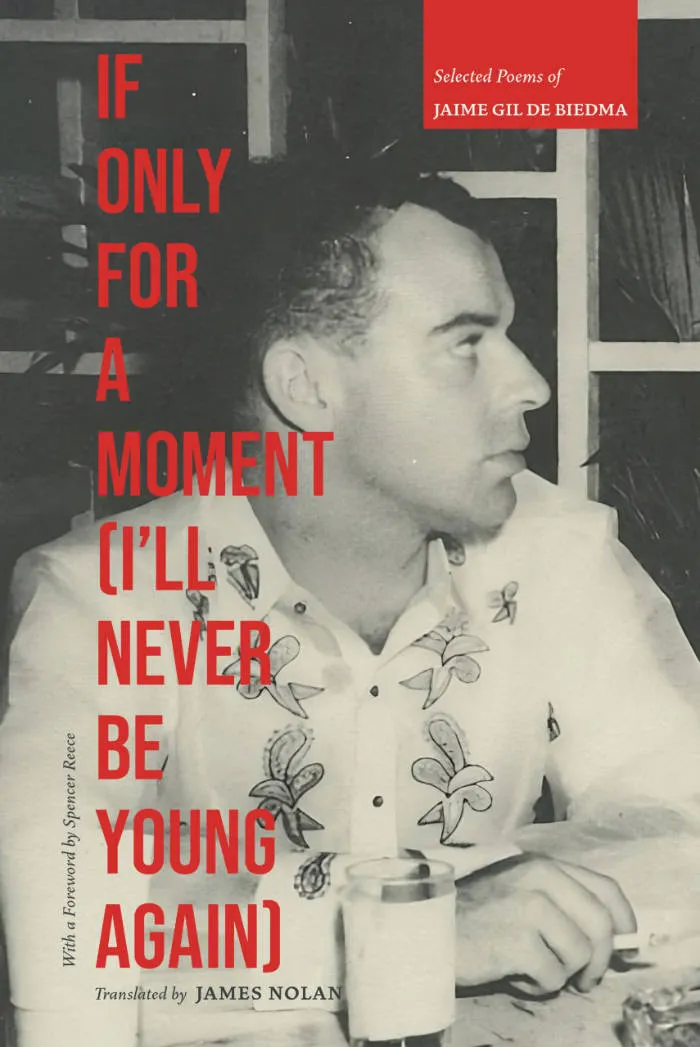
Jaime Gil de Biedma is the most original and influential among the poets known as the ‘50’s Generation in Spain, and is considered the greatest Spanish poet to emerge in the second half of the 20th century. His life and literary career were bracketed almost entirely by the rise and fall of Generalissimo Francisco Franco, notorious for the suppression of literature. Born in 1929, Gil de Biedma was six years old when García Lorca was murdered in Granada at the outbreak of the Civil War, and his collected poems, Las personas del verbo, first appeared in 1975, the year Franco died. What is surprising is that Gil de Biedma was a leftist, homosexual poet from the Catalan capitol, Barcelona – all of Franco’s favorite things – who not only published books of autobiographical poetry in Spain but was known as a poet of social conscience as well as erotic lyricism. Like other Spanish poets of his time, he chose his words carefully. Gil de Biedma died of AIDS in 1990.

If Only For a Moment (I’ll Never Be Young Again) consists of an extensive bilingual selection of Gil de Biedma’s poetry, including all of his most well-known work. The book additionally consists of a Foreword by Spencer Reece, Jaime Gil de Biedma’s short essay “I wanted to be the poem,” and two different essays on Gil de Biedma and the art of translation by James Nolan, the volume’s translator.

Cover of Telling the Truth as It Comes Up: Selected Talks & Essays 1991-2018

The Song Cave

Telling the Truth as It Comes Up: Selected Talks & Essays 1991-2018

Alice Notley

Essays €27.00

An Expert Array of Talks & Essays by One of Our Greatest Living Poets.

One of our greatest living poets, Alice Notley, the author of more than 40 books of poetry, has delivered an expert array of talks and essays over the last three decades.

The publication offers a significant contribution to literature, reimagining the possibilities of writing in our time and the complicated business of how and why writers devote their lives to their craft. Whether she is writing about other poets—Ed Dorn, Allen Ginsberg, Homer, bpNichol, Douglas Oliver, or William Carlos Williams—noir fiction, the First Gulf War, dreams and what they're for, or giving us insight into her own work, Notley's observations are original, sobering, and always memorable. This collection often eschews the typical style of essay or lecture, resisting any categorization, and is consciously disobedient to academic structures in form. The results are thrilling new modes of thinking that may change the ways we read and write.