rile*books

Search books

Search books by title, author, publisher, keywords...

Cover of Mucus in my Pineal Gland

Capricious

Mucus in my Pineal Gland

Juliana Huxtable

€30.00

Mucus in My Pineal Gland is the debut collection of New York-based artist and writer Juliana Huxtable (born 1987). Gathering poems, performance scripts and essays, this startling volume expands Huxtable's critique of gender, sexuality, politics, whiteness and history while establishing her as a singular poetic voice.

Juliana Huxtable is a New York City-based writer, performer, and artist. Her work has been featured in numerous publications, including Artforum, Candy, Tropical Cream, and Mousse. She was included in the 2015 New Museum Triennial, curated by Ryan Trecartin and Lauren Cornell.

Published in 2019 ┊ 185 pages ┊ Language: English

recommendations

Cover of Tuesday or September or the End

Capricious

Tuesday or September or the End

Hannah Black

During a residency on Fire Island, artist and writer Hannah Black decided to tackle a highly daunting project: the 2020 novel.

The result of her efforts, Tuesday of September or the End, is a slim, playful work of speculative fiction. Written in the aftermath of the early months of the pandemic and the uprisings of summer 2020, the novel explores the ruptures of the year with a satirical sci-fi bent. Black chronicles the lives of two characters, Bird and Dog, as they contend with rapidly changing political possibilities during the pandemic while the run of Moley Salamanders (i.e. Bernie Sanders) concludes and aliens finally invade earth. Through a galvanic vision of how the riots of 2020 might have turned revolutionary, Black offers a meditation on collective life. This crucial novel invites readers to consider who we are—and, by extension, what we are here for—when our normal referents are muted, deleted and upended.

Hannah Black (born 1981) is a New York-based visual artist, critic and writer from Manchester, England. Her work spans video, text and performance and draws from communist, feminist and Afro-pessimist theory. She is the author of Life (2017, with Juliana Huxtable) and Dark Pool Party (2016). Black is represented by the gallery Arcadia Missa in London and Isabella Bortolozzi in Berlin.

Cover of Untitled

Capricious

Untitled

Sasha Phyars-Burgess

Sasha Phyars-Burgess’ first monograph, Untitled. Spanning three bodies of work, this 200-plus page monograph includes poems by Ser Alida and Aurora Masum-Javed, a conversation between Sasha Phyars-Burgess, Juliana Huxtable and Carolyn Lazard, and essay by Bill Gaskins. Designed by Studio Lin.

As recipient of the second annual Capricious Photo Award, Sasha is a vital, emerging voice in contemporary photography, engaging the charged line between documentary and fine art. Her work ranges from affecting studies on diaspora, family and place to revolving social phenomenons in which energy, beauty and power meet.

The second annual jury panel was helmed by Capricious Founder and Publisher Sophie Mörner and Associate Publisher Anika Sabin alongside Lauren Cornell, Katherine Hubbard, JOFF, Matt Keegan, Guadalupe Rosales, Ka-Man Tse, and Lyndsy Welgos.

Cover of Se Te Subió El Santo (Are You In A Trance?)

Capricious

Se Te Subió El Santo (Are You In A Trance?)

Tiona Nekkia McClodden

Se Te Subió El Santo is a collection of self – portraits taken by the artist directly after she awoke every morning while away on a week-long residency in Iowa City, IA at the Center for Afrofuturist Studies in Spring 2016. This daily practice confronts notions of the artist’s interests in rendering a full self implicit of gender, race, sexuality, and spirituality while challenging and collapsing the intersections of each identity as well.

The title of the work is taken from Ana Mendieta, the Iowa Years: A critical study, 1969 through 1977 where Julia Ann Herzberg writes in the dissertation:

Ana and Raquelin Mendieta’s vocabulary contained many Afro-Cuban idiomatic expressions. For example, they would often respond to a friend who was acting in an unruly or hyperactive manner by asking” “Se te subió el santo? (“Are you in a trance?”) In the Afro-Cuban context, the expression “subirse el santo” is used in religious ceremony when the orisha/saint takes possession of the believer.

The monograph also includes an essay by author Akwaeke Emezi.

First edition, 94 page, black and white, leather bound hardcover with white foil embossment 

TIONA NEKKIA MCCLODDEN is an interdisciplinary research-based conceptual artist, filmmaker and curator whose work explores, and critiques issues at the intersections of race, gender, sexuality and social commentary. McClodden’s interdisciplinary approach traverses documentary film, experimental video, sculpture, and sound installations. Themes explored in McClodden’s films and works have been re-memory and more recently narrative biomythography.

Cover of == #2 (edition)

Capricious

== #2 (edition)

Matt Keegan

First launched in 2012, and published by mfc michèle didier (micheledidier.com), == is a small-run arts publication, edited by Matt Keegan. ==#2, 2015, is designed by Su Barber and published in an edition of 500 by Capricious Publishing. Barber and Keegan worked together on North Drive Press (northdrivepress.com) between 2005-2010, and this publication shares a variety of traits with NDP.

==#2 is a non-thematic arts publication contained in a box with a 96-page bound volume featuring artist-to-artist interviews, texts, and transcriptions. Six loose multiples are also included.

Contributors include: Sam Anderson, Uri Aran, Fia Backström, Darren Bader, Judith Barry, Stefania Bortolami, Daniel Bozhkov, Milano Chow, Anna Craycroft, Lucky DeBellevue, Cristina Delgado, Haytham El-Wardany, Jake Ewert, Vincent Fecteau, Corrine Fitzpatrick, Harrell Fletcher, Rachel Foullon, Aurélien Froment, Kenny Greenberg, Calla Henkel, Leslie Hewitt, Jaya Howey, Adelita Husni-Bey, Iman Issa, Ruba Katrib, Jill Magid, Jo Nigoghossian, Aaron Peck, Max Pitegoff, David Placek, Olivia Plender, Lisa Robertson, Andrew Russeth, Amy Sillman, Diane Simpson, Greg Parma Smith, Jessica Stockholder, Martine Syms, and Anicka Yi.

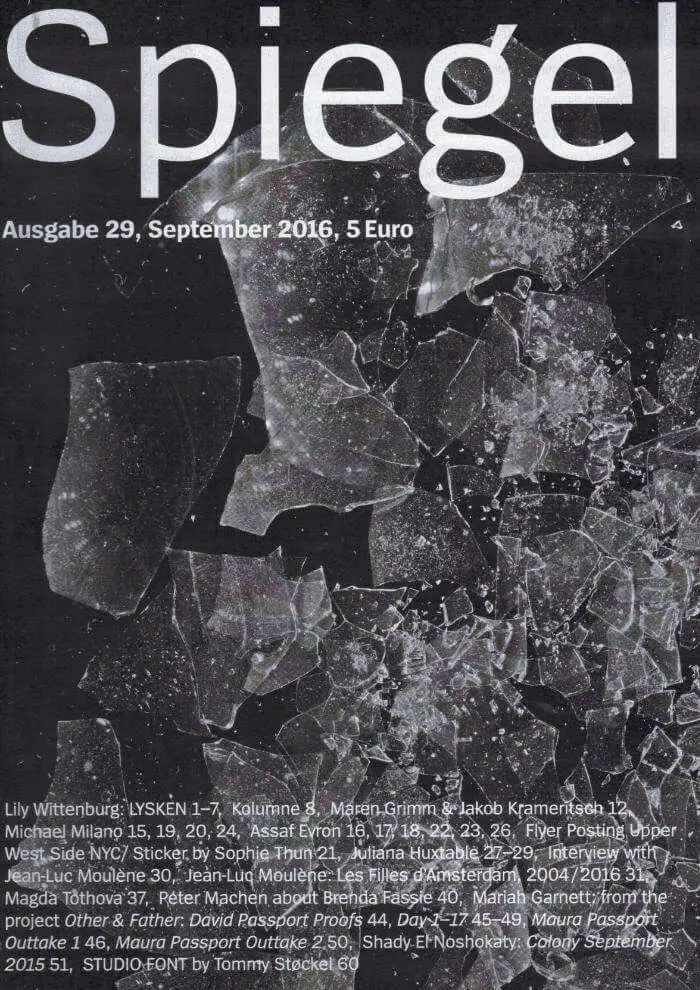
Cover of ztscript  29 : Spiegel

ztscript

ztscript 29 : Spiegel

ztscript

This issue uses the font designed for german news magazine Spiegel by amazing Lucas de Groot. The color poster is part of the full print of the series “Les Filles d’Amsterdam” by photographer Jean-Luc Moulène. It is the first time this series is printed in book form and in an exclusive interview the artist tells the story of that work.

Contributors: Lily Wittenburg, Maren Grimm & Jakob Krameritsch, Michael Milano, Assaf-Evron, Sophie Thun, Juliana Huxtable, Interview with Jean-Luc Moulène, poster by Jean-Luc Moulène, Magda Tóthová, Peter Machen on Brenda Fassie, Mariah Garnett, Shady El NoshokatyTommy Støckel

Cover of The Letters of Douglas Oliver and J. H. Prynne

The Last Books

The Letters of Douglas Oliver and J. H. Prynne

Joe Luna

Poetry €25.00

Douglas Oliver (1937–2000) and J. H. Prynne (b. 1936) are two of the most original and ambitious poets of the contemporary era. Eschewing the conservativism of mainstream postwar British verse and embracing influences from America and Europe, each developed their craft through continuous correspondence and exchange as part of the febrile scene of poetical community and contestation that emerged in Cambridge in the 1960s. Their works over the following decades exhibit frequent shifts in form and style, from Prynne’s radical transformation and dispersal of the lyric tradition to Oliver’s adaptation of dream visions and medieval-inspired verse satires.

Their letters are a record of both the high stakes and playful experiments that constitute the writing lives of two singular poets determined not just to engage with modern political and social life during decades of crisis and upheaval, but to contribute through the circulation and publication of poetry to what Oliver calls “a community of political ethic.” Over the course of more than thirty years of friendship and mutual appreciation, the motivations for, and consequences of, their poems are constantly worked through, tested out, evaluated, and contradicted, always with a view to what the poetry means for the other, for the poetical communities they inhabit, and for the life of poetry itself.

This volume collects for the first time the majority of Oliver and Prynne’s correspondence, allowing new insights into the literary, political, and historical contexts of their lives and writing. An introduction, notes, and appendices provide a scholarly apparatus to situate Oliver and Prynne among the poets and publishers with whom they worked and socialized, and to identify and expand upon their frequent references to an enormous range of source material and reading matter.

“The correspondence between J. H. Prynne and Douglas Oliver is gripping and illuminating, brilliantly edited and completely absorbing. Two great poetic intelligences respond to each other’s work and to the society around them, thinking through the issues at stake in their poetic practice, their differences in approach, the different worlds they inhabit, their shared commitment to writing poetry and their admiration of each other’s work. The letters, complex as their matter can be, repay repeated reading; taken together, over a period of 33 years, they chart the context and creation of some of the most significant work in late twentieth-century poetry. This is an utterly engaging volume, and should be read by anybody interested in poetry and its place in the contemporary world.”—Ian Patterson

“For writers who welcome each other as peers, the exchange of letters is the spontaneous moment of exposure, the drawing out of selves. It is thinking in mutuality. In this thoughtfully edited and carefully, even beautifully, presented correspondence between Douglas Oliver and J. H. Prynne, two of the preeminent poets of the ‘British Poetry Revival’ of the post-World War II generations, we witness two writers of immense gifts thinking with each other, coming alive to thought and, ultimately, a shared world or community of wish. There is life, there is death; there is grief, there is anger – and love – but always there is a seeking, an attempt to arrive at a language for our worlds. Henceforth, one cannot imagine reading the work of either Oliver or Prynne without this correspondence and all that it offers in openings onto what Oliver himself saw as ‘the poet’s full performance [which] is the whole life’s work.’ It is a glimpse into an athanor of poetic creation.”—Michael Stone-Richards

Cover of The Nancy Reagan Collection

Futurepoem

The Nancy Reagan Collection

Maxe Crandall

Poetry €18.00

THE NANCY REAGAN COLLECTION is a response to growing up queer and trans under the rise of HIV-AIDS. Crossing genres and generations, this performance novel remixes the AIDS archive through an ever-spiraling politics and aesthetics of mourning. Alternating chapters offer up a narrative throughline composed of hallucinogenic episodes from the perspective of a nameless, grieving protagonist in the midst of the global carnage of the Reagan dynasty. Part revenge, part fantasy, the book experiments with poetic practices that challenge conceptions of memory and morality, activism and escapism, grief and beauty.

Maxe Crandall is a poet, playwright, and director. He is the author of the chapbooks Emoji for Cher Heart (Belladonna*, 2015) and Together Men Make Paradigms (Portable Press @ Yo-Yo Labs, 2014), and is the founder of the theater company Beautiful Moments in Popular Culture, which produces a poets theater series at the Stud in San Francisco. He has received fellowships from the Poetry Project, Poets House, Lambda Literary, and the Millay Colony for the Arts. Maxe is a lecturer in the Feminist, Gender, and Sexuality Studies Program at Stanford University.