rile*books

Search books

Search books by title, author, publisher, keywords...

Cover of Tuesday or September or the End

Capricious

Tuesday or September or the End

Hannah Black

€25.00

During a residency on Fire Island, artist and writer Hannah Black decided to tackle a highly daunting project: the 2020 novel.

The result of her efforts, Tuesday of September or the End, is a slim, playful work of speculative fiction. Written in the aftermath of the early months of the pandemic and the uprisings of summer 2020, the novel explores the ruptures of the year with a satirical sci-fi bent. Black chronicles the lives of two characters, Bird and Dog, as they contend with rapidly changing political possibilities during the pandemic while the run of Moley Salamanders (i.e. Bernie Sanders) concludes and aliens finally invade earth. Through a galvanic vision of how the riots of 2020 might have turned revolutionary, Black offers a meditation on collective life. This crucial novel invites readers to consider who we are—and, by extension, what we are here for—when our normal referents are muted, deleted and upended.

Hannah Black (born 1981) is a New York-based visual artist, critic and writer from Manchester, England. Her work spans video, text and performance and draws from communist, feminist and Afro-pessimist theory. She is the author of Life (2017, with Juliana Huxtable) and Dark Pool Party (2016). Black is represented by the gallery Arcadia Missa in London and Isabella Bortolozzi in Berlin.

Published in 2022 ┊ 136 pages ┊ Language: English

recommendations

Cover of == #2 (edition)

Capricious

== #2 (edition)

Matt Keegan

First launched in 2012, and published by mfc michèle didier (micheledidier.com), == is a small-run arts publication, edited by Matt Keegan. ==#2, 2015, is designed by Su Barber and published in an edition of 500 by Capricious Publishing. Barber and Keegan worked together on North Drive Press (northdrivepress.com) between 2005-2010, and this publication shares a variety of traits with NDP.

==#2 is a non-thematic arts publication contained in a box with a 96-page bound volume featuring artist-to-artist interviews, texts, and transcriptions. Six loose multiples are also included.

Contributors include: Sam Anderson, Uri Aran, Fia Backström, Darren Bader, Judith Barry, Stefania Bortolami, Daniel Bozhkov, Milano Chow, Anna Craycroft, Lucky DeBellevue, Cristina Delgado, Haytham El-Wardany, Jake Ewert, Vincent Fecteau, Corrine Fitzpatrick, Harrell Fletcher, Rachel Foullon, Aurélien Froment, Kenny Greenberg, Calla Henkel, Leslie Hewitt, Jaya Howey, Adelita Husni-Bey, Iman Issa, Ruba Katrib, Jill Magid, Jo Nigoghossian, Aaron Peck, Max Pitegoff, David Placek, Olivia Plender, Lisa Robertson, Andrew Russeth, Amy Sillman, Diane Simpson, Greg Parma Smith, Jessica Stockholder, Martine Syms, and Anicka Yi.

Cover of Untitled

Capricious

Untitled

Sasha Phyars-Burgess

Sasha Phyars-Burgess’ first monograph, Untitled. Spanning three bodies of work, this 200-plus page monograph includes poems by Ser Alida and Aurora Masum-Javed, a conversation between Sasha Phyars-Burgess, Juliana Huxtable and Carolyn Lazard, and essay by Bill Gaskins. Designed by Studio Lin.

As recipient of the second annual Capricious Photo Award, Sasha is a vital, emerging voice in contemporary photography, engaging the charged line between documentary and fine art. Her work ranges from affecting studies on diaspora, family and place to revolving social phenomenons in which energy, beauty and power meet.

The second annual jury panel was helmed by Capricious Founder and Publisher Sophie Mörner and Associate Publisher Anika Sabin alongside Lauren Cornell, Katherine Hubbard, JOFF, Matt Keegan, Guadalupe Rosales, Ka-Man Tse, and Lyndsy Welgos.

Cover of Se Te Subió El Santo (Are You In A Trance?)

Capricious

Se Te Subió El Santo (Are You In A Trance?)

Tiona Nekkia McClodden

Se Te Subió El Santo is a collection of self – portraits taken by the artist directly after she awoke every morning while away on a week-long residency in Iowa City, IA at the Center for Afrofuturist Studies in Spring 2016. This daily practice confronts notions of the artist’s interests in rendering a full self implicit of gender, race, sexuality, and spirituality while challenging and collapsing the intersections of each identity as well.

The title of the work is taken from Ana Mendieta, the Iowa Years: A critical study, 1969 through 1977 where Julia Ann Herzberg writes in the dissertation:

Ana and Raquelin Mendieta’s vocabulary contained many Afro-Cuban idiomatic expressions. For example, they would often respond to a friend who was acting in an unruly or hyperactive manner by asking” “Se te subió el santo? (“Are you in a trance?”) In the Afro-Cuban context, the expression “subirse el santo” is used in religious ceremony when the orisha/saint takes possession of the believer.

The monograph also includes an essay by author Akwaeke Emezi.

First edition, 94 page, black and white, leather bound hardcover with white foil embossment 

TIONA NEKKIA MCCLODDEN is an interdisciplinary research-based conceptual artist, filmmaker and curator whose work explores, and critiques issues at the intersections of race, gender, sexuality and social commentary. McClodden’s interdisciplinary approach traverses documentary film, experimental video, sculpture, and sound installations. Themes explored in McClodden’s films and works have been re-memory and more recently narrative biomythography.

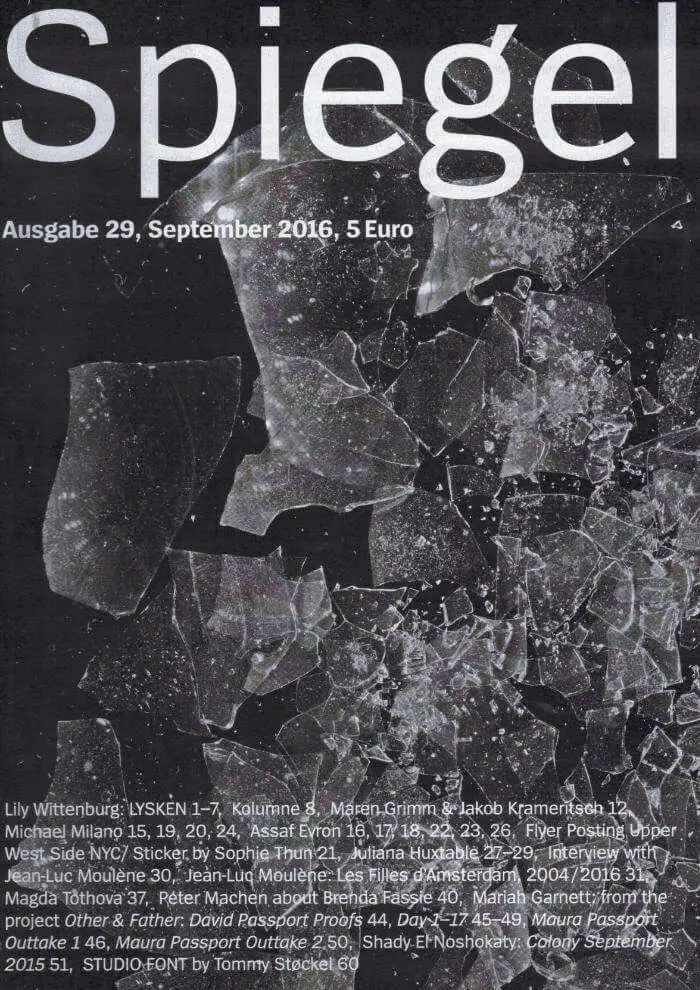
Cover of ztscript  29 : Spiegel

ztscript

ztscript 29 : Spiegel

ztscript

This issue uses the font designed for german news magazine Spiegel by amazing Lucas de Groot. The color poster is part of the full print of the series “Les Filles d’Amsterdam” by photographer Jean-Luc Moulène. It is the first time this series is printed in book form and in an exclusive interview the artist tells the story of that work.

Contributors: Lily Wittenburg, Maren Grimm & Jakob Krameritsch, Michael Milano, Assaf-Evron, Sophie Thun, Juliana Huxtable, Interview with Jean-Luc Moulène, poster by Jean-Luc Moulène, Magda Tóthová, Peter Machen on Brenda Fassie, Mariah Garnett, Shady El NoshokatyTommy Støckel

Cover of Mucus in my Pineal Gland

Capricious

Mucus in my Pineal Gland

Juliana Huxtable

Poetry €30.00

Mucus in My Pineal Gland is the debut collection of New York-based artist and writer Juliana Huxtable (born 1987). Gathering poems, performance scripts and essays, this startling volume expands Huxtable's critique of gender, sexuality, politics, whiteness and history while establishing her as a singular poetic voice.

Juliana Huxtable is a New York City-based writer, performer, and artist. Her work has been featured in numerous publications, including Artforum, Candy, Tropical Cream, and Mousse. She was included in the 2015 New Museum Triennial, curated by Ryan Trecartin and Lauren Cornell.

Cover of Tout geste est renversement – Every gesture is reversal

Gevaert Editions

Tout geste est renversement – Every gesture is reversal

Chloe Chignell, Laurianne Bixhain

Tout geste est renversement – Every gesture is reversal is a publication by artist Laurianne Bixhain comprising an imahe captured and silkscreen printed by Bixhain and a text written by Chloe Chignell. The work addresses the potential for mutual transformation between language and materials, whether human or non human. How does language traverse the body? What are its resonances? How does it shape physical presence, gestures or thoughts? 

A2 silkscreen printed poster
Designed by Morgane Le Ferec.
Printed in 300 Copies. 

Cover of Responses to Untitled (eye with comet) By Paul Thek

Pilot Press

Responses to Untitled (eye with comet) By Paul Thek

Richard Porter

Responses to Untitled (eye with comet) (c.1985) by Paul Thek is the sixth and final anthology in a series that gathered responses to works of art made during a period of the ongoing AIDS Crisis, from the identification of the virus in 1981 to the introduction of life-saving drugs in 1996.  

In this sixth iteration, responses were sought to the painting Untitled (eye with comet) by Paul Thek. The work was found in his storage after his death from AIDS in 1988. 

List of contributors in order of appearance:

E.R. De Siqueira
Ben Estes
João Motta Guedes
Lucy Swan
Jon Rainford
Louis Shankar
Amy Evans Bauer
Hattie Morrison
Sammy Paloma
AN Grace
James Horton
Nick Wood
Sophie Paul
Jae Vail
Elizabeth Zvonar
Lars Meijer
Clay AD
Michel Kessler
Pablo Miguel Martínez
Emma Harris
Dylan McNulty-Holmes
Kitya Mark
Katherine Franco
Ainslie Templeton
Alistair McCartney
John Brooks
Jesse Howarth
jimmy cooper
Felix Pilgrim
Nicholas Chittenden Morgan
Murphy O’Neir
Rachel Cattle
Isabel Nolan
Susan Finlay
Ted Simonds
Brooke Palmieri
Kate Morgan
Ashleigh A. Allen
Diogo Gama
JP Seabright
Hugo Hagger
Amanda Kraley
Brendan Cook
Matt Bailey
Charlotte Flint
Rodney Schreiner
Lucy Price
Morgan Melhuish
Jordan Weitzman
Jaakko Pallasvuo
Alex Fiorentino
Harald Smart
Marguerite Carson
loll jung
Richard Porter
Nicholas Kalinoski
Hedi El Kholti
Edmund Francis English
Ted Bonin

Cover of Great is the Power of the Name

Forlaget Emancipa(t/ss)ionsfrugten

Great is the Power of the Name

Signe Frederiksen, Anne-Mette Schultz

Great is the Power of the Name considers the works of authors Elena Ferrante, Pauline Reáge, Karl Ove Knausgård, Colette and artist Lee Lozano

In 2016, when Anne-Mette had invited Signe to take on the role as editor of her text The Institute of Applied Speech, they both began reading Elena Ferrante's The Neapolitan Novels. They were specifically fascinated by the author’s use of pseudonym. Anne-Mette's Institute of Applied Speech was a tale of a fictive place, a pseudo-topos, and Elena Ferrante’s ideas about the pseudonym as a space for the writing itself was useful in thinking about fictive authorship. In a number of written interviews, Elena Ferrante unfolds the feminist perspective of her use of pseudonym. They were attracted by the idea that the author could avoid the biographical question; that she could disappear behind her own writing. 

To them, the artist Lee Lozano is the ghostly presence of hard-core moralist and humorous fuck-off art from another decade. During the course of her life, Lozano continuously reconfigured and gradually dissolved her own name, starting from Leonore Knaster ending up with E. Her work Boycott Women, in which she decides not to have any contact with women, expands the notion of feminist critique. 

Great is the Power of the Name publishes a readership interested in the position of the artist, and how it conditions the way we make art.

Cover of Cancelled Confessions (or Disavowals)

Siglio Press

Cancelled Confessions (or Disavowals)

Claude Cahun

First published in 1930 by anti-fascist, avant-garde publisher Éditions du Carrefour in Paris as Aveux non Avenus, Cancelled Confessions (or Disavowals) is Claude Cahun’s wildly radical answer to an invitation to write a memoir. Shattering the very premise of the “memoir”—the singularity of identity—into sharp and prismatic fragments, Cahun assembles an ever-mutating inquiry into the instability of “self” and its many masks.

Masculine? Feminine? It depends on the situation. Neuter is the only gender that always suits me.

Using a multitude of forms (fables, jokes, aphorisms, letters, dialogues, dreams, hymns, pronouncements, etc.), to plumb the subjects of desire, love, gender, sex, fear, faith, religion, and vanity (among others), Cancelled Confessions (or Disavowals) is a tour-de-force work of resistance: it provokes the reader to enter the capacious, provocative, playful, and deeply imaginative space constructed by Cahun in defiance of all categorization, to repudiate a delimited, censured world and embrace, instead, the outcasts and cast-offs, the unknowable and the unknown.

I believe, but in the conditional: I would like to believe.

Thoughtfully redesigned to emulate the original artist’s book, this revised edition of the out-of-print English translation by Susan de Muth—originally published in the UK by the Tate in 2007 and in the U.S. by MIT Press in 2008—includes novelist and critic Pierre Mac Orlan’s original 1930 preface along with contemporary essays by scholar Amelia Groom and translator de Muth. Almost 100-years-old, it is not only prescient, but urgent, in.

It’s not enough to be vanquished, you also have to know how to turn defeat to your advantage.

Translated by Susan de Muth, preface by Pierre Mac Orlan, essay by Amelia Groom.

Cover of Art Notes, Art

CARA Center for Art, Research and Alliances

Art Notes, Art

Cynthia Hawkins

Since the 1970s, Cynthia Hawkins has investigated the potentials of abstract painting. While often beginning a work or series with a predetermined concept or strategy, Hawkins’s process-oriented practice simultaneously embraces the improvisational to create a systemized space for her continually evolving vocabulary. From 1979 to 1981, important early years in the elaboration of her work, Hawkins documented these developments in a journal. A record of routine and the everyday, the journal also gathers sketches, notes for new and in-progress works, and responses to contemporary art and criticism, bringing the artist’s process, experimentation, and reflections on materials, formalism, abstraction, and figuration into relief. 

Art Notes, Art also offers a picture of the burgeoning Black-owned gallery scene in 1970s and ‘80s New York that Hawkins was an important participant in—including Cinque Gallery, Kenkeleba Gallery, and Just Above Midtown, where she had her first solo exhibition in 1981–as well as the women artists’ circle she was an active member of, which hosted weekly shares, critiques, exchange, and amplification of each others’ work. An important glimpse into Hawkins’s creative process and artistic community, Art Notes, Art is richly illustrated with works by the artist produced during this key period–some of which are now lost–photographs and ephemera, and a visual archive of contemporaneous work by her peers.

Editor: Ananth Shastri
Managing Editor: Rachel Valinsky