rile*books

Search books

Search books by title, author, publisher, keywords...

Cover of There Is in the Kitchen

Self-Published

There Is in the Kitchen

Charlotte Koopman

€15.00

Charlotte Koopman has run a kitchen for the past 15 years and has always responded to both crises and festivities by cooking. ‘There Is in the Kitchen’ is a look at how to begin writing, which turns out to be not that different from preparing a meal. Both are prose bordering on poetry, both speak in a multitude of languages. 

‘There Is in the Kitchen’ is a series of essays, an inventory of what coexists in the kitchen, a larder stocked with particular interests. Ranging from the singular- Mandarino Tardivo di Ciaculli or Pistacia Terebinthus to the expansive- the cross- rhythm, close encounters, seasonality.

Published in 2025 ┊ 88 pages ┊ Language: English

recommendations

Cover of Hortus

Self-Published

Hortus

Lilia Luganskaia

Photography €35.00

The Hortus  project is an open investigation into the nature of seemingly common objects through 'Floriography', urban gardens, and the history of female rights. Hortus was inspired by urban gardens in West Amsterdam and created with its plants by Lilia Luganskaia. 

Joanna Cresswell about the 'Hortus':

History teaches us that a language of flowers can communicate endless things about the culture in which it emerged, and herein lies Lilia Luganskaia's interest. Taking inspiration from the world of 19th Century sentimental flower books, Hortus presents itself as a set of notes towards a modern handbook for contemporary floriography, considering what the discipline might look like today. By collecting common flora across one year in the urban gardens around her home in Amsterdam and cross-referencing their meanings with publications from the past, Luganskaia reflects on their natures, their roles, and the symbolic familiarity they might hold for the communities living with them. A female artist and reader of the twenty-first century, she seeks out the essence of modern life through her lens, and through flowers, just like the women who came before her. 

Lilia Luganskaia (1990) Russian - Dutch multidisciplinary artist and author, based in Amsterdam. In her artistic practice, Lilia uses her background in documentary techniques to focus on what she calls ‘investigating reality’.  Her practice is research-based, Lilia decodes abstract notions such as love, tourism, bureaucracy, politics, and feminism through the use of constructed images, sculptures, videos, and installations. One of the key elements of her work is to understand multiple aspects of the photographic image.

Cover of A Letter from a Tehran Prison

Self-Published

A Letter from a Tehran Prison

Wu Qin

Zines €24.00

This story was written by a Chinese activist/writer about her arrest and detention during the waves of resistance in China in late 2022. To evade censorship, she disguised it as a translation—told through the voice of an Iranian Kurdish woman amid the “Woman, Life, Freedom” uprising happening at the same time. 

After fleeing China, the author reclaimed the story through footnotes—uncovering hidden meanings and restoring its Chinese context. What first read as an Iranian story became, on re-reading, a coded Chinese narrative. Iran stood as both real and metaphorical—a displaced symbol, through which the interconnected struggles in different movements echoed.

The two waves of reading, months apart, became part of the story’s form. This “non-nonfiction” reveals a paradox: in China, truth must appear as fiction or elsewhere to be told—making the fiction more real than reality itself. 

Two years later, the piece was translated “back” into Persian by an Iranian Kurdish activist. And now, it arrives here, in this zine of tripped, layered languages. 

Author: Wu Qin
English Translation: Aaris WOO and Yixi
Farsi Translation: Somayeh Rostampour
Visual & Layout: Maoyi, If A, Hu Jiamin
Interior illustrations: Hu Jiamin
Published by Tofu Stand (Tofulogy 002)

Cover of Chile Chico et le quartier Versailles

Self-Published

Chile Chico et le quartier Versailles

Ema Tytgat

Chile Chico et le quartier Versailles, c'est une exploration qui inventorie, interroge et révèle les mémoires invisibles en listes et en collections. Une mémoire qui ne soffre pas en bloc, qui résiste, se fragmente, se transforme. A travers cette archive collaborative, nous avons voulu capter ces va-et-vient ď'un passé qui dialogue avec le présent, des images qui oscillent entre Vintime et le collectif. 

Le point de départ de cette fabrique visuelle, c'est lexil des Chilien.nes, débarqué.es dans les années 70, qui se tissent une nouvelle vie sur le sol de Neder-Over-Heembeek, dans le quartier Versailles à Bruxelles. Ces trajectoires, arrachées à un ailleurs, s'ancrent dans des espaces rêvés comme de transit pour devenir des lieux d 'appartenance, où lexil se mue et les racines finissent par se déployer. A ces récits se greffent d'autres histoires, d'autres trajectoires. Un quartier comme un carrefour, ou les individualités se rencontrent, où les vies se croisent et s'allient.

Cover of Civilization #7

Self-Published

Civilization #7

Richard Turley, Lucas Mascatello

Periodicals €15.00

The occasionally-published broadsheet Civilization was founded in New York in 2018 by Richard Turley,  Lucas Mascatello, and Mia Kerin. Its origin was as a response to New York City life, but has now transformed into an art project that gathers language, overheard conversations, secret recordings transcribed by rapid-capture software to produce a dense, rhythmic assemblage of texts from both public and private spaces alike. As a result, Civilization’s design texture has found fans in the fashion world, leading to collaborations with Calvin Klein and Junya Watanabe. 

The publication has also enjoyed contributions from a wide array of artists, writers and personalities including: Aaron Maine, Alis Atwell, Amos Poe, Amalia Ulman, Aria Dean, Alicia Novella Vasquez, Bill Drummond, Biz Sherbert, Babak Radboy, Carly Busta, Darcie Wilder, Echo Wu, Ella Plevin, Eric Johnson, Honor Levy, Iris Luz, Mel Ottenberg, Isabelle Rea, Joey LaBeija, Jordan Barse, Lovefoxx, Maddie Quinn, Patrick McMullan, Rachel Rabbit White, Sybil Prentice, Thom Bettridge, and Zans Brady Krohn.

Cover of I am Welton Santos.

Self-Published

I am Welton Santos.

Sofia Caesar

I am Welton Santos reenacts a dialogue between the Brazilian geo-bio-architect Welton Santos and an Interviewer. The book, which is always read collectively, is used in reading performances by groups of at least 3 people.

Printed on the occasion of an artist residency at PAV, Parco d’Arte Vivente, Turin, July 2016. Texts based on transcripts of interviews with Welton Santos.

Cover of Installation Views

Lenz Press

Installation Views

Charlotte Posenenske

Conceived as a visual résumé, Installation Views provides both a comprehensive overview of Charlotte Posenenske's solo exhibitions and a record of her numerous group shows.

In her Manifesto, Charlotte Posenenske stated: "I find it difficult to come to terms with the fact that art can contribute nothing to the solution of pressing social problems."
Developing her artistic practice throughout the 1960s, Posenenske produced a body of work that uniquely combined several strands of the art of the period: conceptualism, minimalism, and socially engaged participatory art. Her Manifesto, published in Art International in May 1968, lays out the social demands on art as well as the impossibility of fulfilling those demands. Shortly after its publication, Posenenske left the art world behind to pursue her studies in sociology, undertaking a new career in that field.

Conceived as a visual résumé, Installation Views provides both a comprehensive overview of Charlotte Posenenske's solo exhibitions and a record of her numerous group shows. The book features an essay written by curator Erlend Hammer on the role of documentary photographs in the circulation of works of art. 

The book was published in conjunction with the eponymous show at the Haugar Art Museum in Tønsberg, Norway—the first full-scale presentation of the artist's oeuvre in Scandinavia. The exhibition showcased works from all the artist's major series of modular sculpture. Consisting of works made over the course of less than 12 months, between 1967 and 1968, preceding the abrupt end to Posenenske's career as an artist, the exhibition had the character of a snapshot. We are left wondering whether her withdrawal from the art world was a logical or necessary consequence of the development of the series. What are we to do with Posenenske's assertion that art is powerless to effectively change society for the better?

Cover of Le Sacrifice comme acte poétique

Les Solitaires Intempestifs

Le Sacrifice comme acte poétique

Angélica Liddell, Christilla Vasserot

Essays €14.00

Mise en scène, écriture – pièces de théâtre, poésie, récits, journaux – et présence sur scène : tout est lié chez Angélica Liddell. L’art et la vie, la fiction et la biographie, la création poétique et la réflexion théorique entretiennent les uns avec les autres des liens évidents et complexes. Ce volume inclut une série de textes qui, depuis une perspective théorique, éclairent en partie la pratique théâtrale de leur auteur, contribuant à la construction d’une poétique toujours inachevée, basée sur une expérience vitale.

Dans cet essai recueillant douze conférences et entretiens, Angélica Liddell évoque la création artistique ainsi que son processus dramaturgique très organique et très violent car « la violence poétique est nécessaire pour combattre la violence réelle ». 

-

Direction, writing—plays, poetry, stories, journals—and stage presence: everything is interconnected in Angélica Liddell’s work. Art and life, fiction and biography, poetic creation and theoretical reflection maintain obvious yet complex connections with one another. This volume includes a series of texts that, from a theoretical perspective, shed light on the author’s theatrical practice, contributing to the construction of an ever-unfinished poetics rooted in lived experience. 

In this essay, which brings together twelve lectures and interviews, Angélica Liddell discusses artistic creation as well as her highly organic and violent dramaturgical process, for “poetic violence is necessary to combat real violence.” 

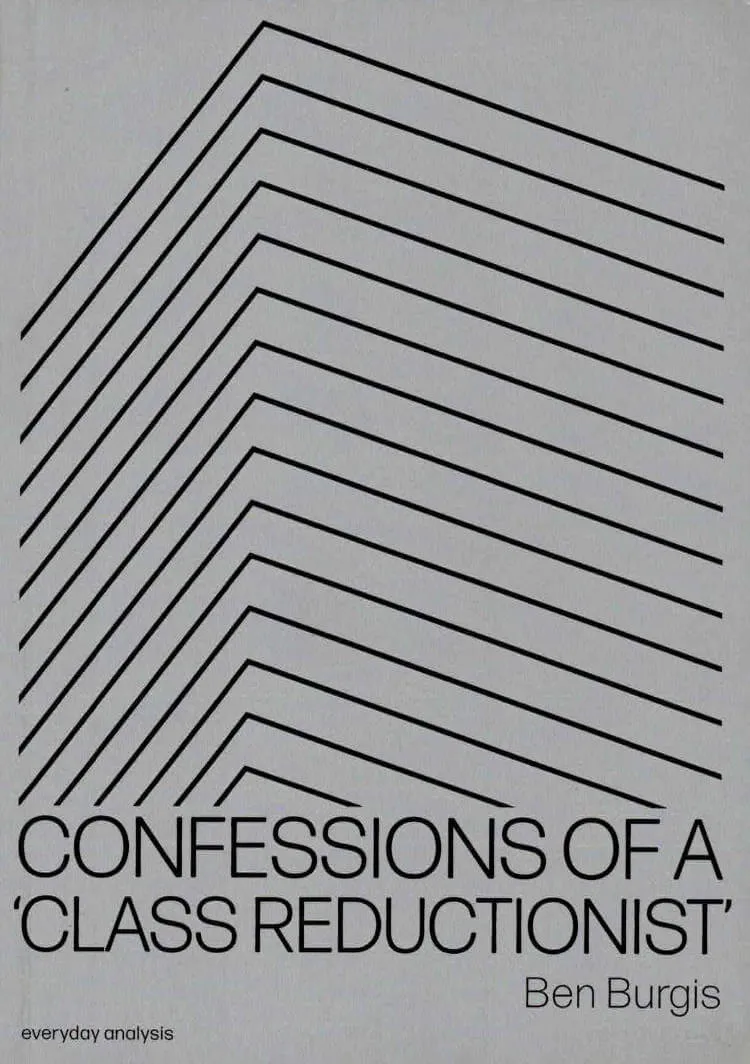
Cover of Confessions Of A Class Reductionist

Everyday Analysis

Confessions Of A Class Reductionist

Ben Burgis

Essays €11.00

In these essays, Ben Burgis criticizes fashionable radical-liberal identity politics and makes the case for universalism about rights and an unabashedly “class-first” approach to socialist political strategy. This may sound to some ears like a call for abandoning marginalized people. On the contrary, he argues, focusing on economic inequality empowers the victims of bigotry and retrograde social practices the resources and material security to stand up for themselves far more effectively than any diversity trainer or “anti-racism” consultant could represent their interests. As we face a rising tide of reactionary authoritarianism, it’s more important than ever to ditch the identitarian pieties of the recent past and think hard about how the Left can actually win.

Cover of Prairie, Dresses, Art, Other

Prototype Publishing

Prairie, Dresses, Art, Other

Danielle Dutton

Fiction €16.00

In Prairie, Dresses, Art, Other Danielle Dutton imagines new models for how literature might work in our fractured times. Dutton’s writing is as protean as it is beguiling, using the different styles and different spaces of experience to create a collage of the depths and strangeness of contemporary life.

This hybrid literary collection covers an inventive selection of subjects in four eponymous sections which contrast and echo one another, challenging our expectations and pushing the limits of the dream-like worlds and moods that language might create.

‘Danielle Dutton is a writer whose work I wait for. When a new book comes, I keep it very close… Her growing body of work is among the most formally inventive (and therefore essential) I can think of, and Prairie, Dresses, Art, Other is a vital, enlivening addition to it.’ – Kate Briggs

Danielle Dutton is the author of the novels Margaret the First and SPRAWL, the prose collection Attempts at a Life, the illustrated nonfiction chapbook A Picture Held Us Captive, and she wrote the text interpolations for Richard Kraft’s Here Comes Kitty: A Comic Opera. Her fiction has appeared in magazines and journals including The New Yorker, The Paris Review, The White Review, Harper’s, BOMB, and NOON. Dutton teaches at Washington University in St. Louis and is cofounder and editor of the award-winning feminist press Dorothy, a publishing project. Born and raised in California, she has lived on the (former) prairie now for roughly twenty years.

Cover of Amanda

Maria Editions

Amanda

Olga Micińska

The artist book Amanda is greatly inspired by “Tradeswomen” quarterly magazine for women in blue-collar work, published in the 1980’s and 1990’s in the United States. Amanda is similarly thought as a periodical dealing with the subjects of technology and industry from a feminist (not solely female) angle. The first issue contains fiction stories of an emancipatory character, citing trade associations, oil industry in Iran and ghosts of the printer feeders.

The publication is made in the framework of The Building Institute, an experimental organisation aiming to strengthen the position of femmes builders in the domain of technical construction work. Amanda brings together literary texts by Maria Toumazou, Samantha McCulloch, Sepideh Karami and Madeleine Morley, combining fiction stories with visual artwork. 

Olga Micińska is a visual artist currently living in Amsterdam. Graduated from the MA Art Praxis program at the Dutch Art Institute and holds an MFA in Sculpture from the Academy of Fine Arts in Warsaw. Also trained as a woodworker, collaborates with craft studios of various domains. Recently she has initiated The Building Institute.

The Building Institute (TBI) is an experimental platform aiming to emancipate the undermined knowledges dwelling in the craft domains, and to unpack diverse questions related to technology and the means of production. TBI combines art’s speculative competences with the grounded practice of manual labor, manifesting its objectives through educational activities, exhibitions, and publications.