rile*books

Search books

Search books by title, author, publisher, keywords...

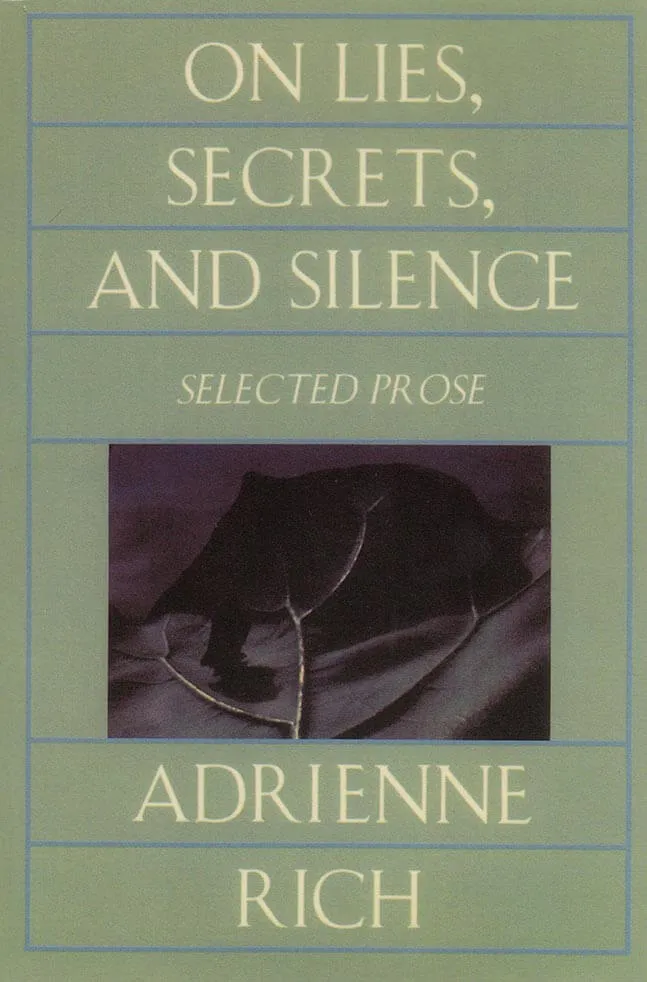
Cover of On Lies, Secrets And Silence

W. W. Norton & Company

On Lies, Secrets And Silence

Adrienne Rich

€20.00

Collection of early prose writings by Adrienne Rich. On Lies, Secrets, and Silence is a sort of travel diary, documenting Adrienne Rich's journeys to the frontier and into the interior. It traces the development of one individual consciousness, 'playing over such issues as motherhood, racism, history, poetry, the uses of scholarship, the politics of language.' Rich has written a headnote for each essay, briefly discussing the circumstances of its writing.

Adrienne Rich (1929–2012) was for decades among the most influential writers of the feminist movement and one of the best-known American public intellectuals. She wrote two dozen volumes of poetry and more than a half-dozen of prose. Her constellation of honors includes two National Book Awards, a MacArthur Foundation “genius” grant, and a Medal for Distinguished Contribution to American Letters by the National Book Foundation. Ms. Rich’s volumes of poetry include The Dream of a Common Language, A Wild Patience Has Taken Me This Far, An Atlas of the Difficult World, The School Among the Ruins, and Telephone Ringing in the Labyrinth. Her prose includes the essay collections On Lies, Secrets, and Silence; Blood, Bread, and Poetry; an influential essay, “Compulsory Heterosexuality and Lesbian Existence,” and the nonfiction book Of Woman Born, which examines the institution of motherhood as a socio-historic construct. In 2010, she was honored with The Griffin Trust for Excellence in Poetry's Lifetime Recognition Award.

Language: English
recommendations

Cover of Lost & Found: The CUNY Poetics Document Initiative, Series IV

CUNY Center for the Humanities

Lost & Found: The CUNY Poetics Document Initiative, Series IV

CUNY

From a never before seen manuscript of poems by Harlem Renaissance poet Helene Johnson to a treasure trove of Adrienne Rich's teaching materials from City College, this new series overturns all expectations. We have brought you facsimile reproductions and variorum editions, notes, storyboards, memos, screenplays, letters and of course, poetry from all around America. Building cultural history from the ground up, Series IV provides a completely different vantage point from which to further explore our literary heritage. LOST & FOUND: THE CUNY POETICS DOCUMENT INITIATIVE SERIES IV consists of eight beautifully printed chapbooks (600 pages in all), featuring rare and unpublished texts, including late work by Harlem Renaissance poet Helene Johnson, Adrienne Rich's teaching materials, a newly discovered film script by Edward Dorn, the formative correspondence of Pauline Kael & Robert Duncan, and a facsimile reproduction of Vincent Ferrini's 1946 Tidal Wave: Poems of the Great Strikes.

SERIES IV includes:

Edward Dorn: Abilene! Abilene! (Parts I & II) (ed. Kyle Waugh)

Vincent Ferrini: Before Gloucester (eds. Ammiel Alcalay & Kate Tarlow Morgan)

Helene Johnson: After the Harlem Renaissance (ed. Emily Rosamond Claman)

Pauline Kael & Robert Duncan: Selected Letters 1945-1946 (PARTS I & II) (ed. Bradley Lubin)

Adrienne Rich: Teaching at CUNY, 1968-1974 (Parts I & II) (eds. Iemanjá Brown, Stefania Heim, erica kaufman, Kristin Moriah, Conor Tomás Reed, Talia Shalev & Wendy Tronrud)

Cover of After Sex

Silver Press

After Sex

Alice Spawls, Edna Bonhomme

Essays €18.00

Who decides what happens after sex? The last decade has seen many significant changes to the laws governing women’s reproductive rights around the world, from liberalisation in Ireland to new restrictions in the USA. After Sex offers personal and political perspectives from the mid-20th century to the present day, setting feminist classics alongside contemporary accounts. These essays, short stories and poems trace the debates and tell the stories; together, they ask us to consider what reproductive justice might look like, and how it could reshape sex.

The writers pay special attention to people — both fictional and real — who have sought control over their sexual lives, and the joy, comedy, difficulties and disappointments that entails. But above all, After Sex testifies to the power of great writing to show us why that freedom is worth pursuing — without shame and without apology.

With contributions from: 
Lauren Berlant, Joanna Biggs, Edna Bonhomme, Gwendolyn Brooks, Beverley Bryan, Stella Dadzie and Suzanne Scafe, Storm Cecile, Lucille Clifton, Rachel Connolly, T.L. Cowan, ’Jane Does’, Maggie Doherty, Nell Dunn, Andrea Dworkin, Anne Enright, Deborah Friedell, Tracy Fuad, Kristen Ghodsee, Vivian Gornick, Donna Haraway, bell hooks, Barbara Johnson, Jayne Kavanagh, Lisa Hallgarten and Angela Poulter, Jamaica Kincaid, Patricia Knight, R.O. Kwon, Ursula K. Le Guin, Natasha Lennard, Sophie Lewis, Audre Lorde, Amelia Loulli, Erin Maglaque, Holly Pester, Adrienne Rich, Denise Riley, Sally Rooney, Loretta J. Ross, Madeleine Schwartz, SisterSong, Sophie Smith, Annabel Sowemimo, Amia Srinivasan, Keeanga-Yamahtta Taylor, Judith Jarvis Thomson, Alice Walker and Bernard Williams.

Cover of The Lesbian Body

Winter Editions

The Lesbian Body

Monique Wittig

Fiction €22.00

In this genre- and gender-breaking work of theory-fiction, legendary writer and cofounder of the 1970s French feminist movement Monique Wittig celebrates the body—lesbian, literary and defiantly political—and challenges the order of heterosexuality in literature. 

First published in French in 1973, The Lesbian Body mines the relationship between a lover and a beloved—also a writer and a text—to explore the ideological and historical constructions of the female subject. Organized according to the principle of montage, poetic passages are juxtaposed with anatomic lists that mark lesbian eros. Through expressions of joy, violence, and tenderness, the site of pleasure is celebrated. In her transfiguration of gender and its paradigms, Wittig transformed French vocabulary, feminizing grammar and lesbianizing myths. This edition brings the English translation of Wittig’s groundbreaking work back into circulation for the first time since the mid-1980s, revised according to the author's notes, and with an introduction by Paul B. Preciado.

The Lesbian Body is a fundamental work of lesbian existence. Wittig's applied vision is a state of natural delirium, a revolutionary excess of utopianism, refusal, and mutual self-creation. Revisiting it reveals how much passionate free thought has been lost, and simultaneously, how many of her tropes and discoveries have integrated into our collective consciousness.” — Sarah Schulman

“In this stunning new rendering of The Lesbian Body by the French author, theorist, activist and teacher, the late Monique Wittig, we are plunged into an imagined world of passionate violence and erotic lesbian mayhem intertwined in strikingly bold poetic images. Wittig, in the reach and volatility of her imagination, stands alongside such important American writers as Audre Lorde, Adrienne Rich, and Valerie Solanas, all of whose work deserves to be read again, or for the first time.” — Esther Newton

“To read the book is to be forced by Wittig into another grammar and happily contaminated by its strange forms. You will never think straight again.” — Jack Halberstam

“For me, Wittig opened up a sense of the world that had been, quite literally, unimaginable. She tore us apart.” — Judith Butler

“Together with Ursula Le Guin and Samuel R. Delany, Wittig is the first to design a nonbinary utopia, a world in which the binary categorization of sexes and genders will have ceased to exist.” — Paul B. Preciado

Introduction by Paul B. Preciado
Translated by David Le Vay

Cover of Cassell's Encyclopedia of Queer Myth, Symbol and Spirit

Cutt Press

Cassell's Encyclopedia of Queer Myth, Symbol and Spirit

Randy P. Conner, David Hatfield Sparks and 1 more

Bootleg edition by Cutt Press. 

Foreword by Gloria Anzaldua.

Drawing on religion, mythology, folklore, anthropology, history and the arts, this encyclopoedia is a collection of queer spirit. It contains articles on the world's spiritual traditions; entries on deities, symbols, spiritual teachers, spiritually focused artists; and related subjects.

Did you know that in medieval French folklore a person might change sex by passing under a rainbow? Or that same-sex unions have been celebrated by peoples of the ancient Mediterranean, Africa, China, and indigenous America? Or that Sappho, da Vinci, Emily Dickinson, Nijinsky, Benjamin Britten, Mishima, Adrienne Rich, Audre Lorde, Keith Haring, Boy George, and Derek Jarman number among those who have explored the spiritual dimension of gender and sexuality in their works? While the terms many of us employ today to identify ourselves – ‘queer’, ‘lesbian’, ‘gay’, ‘bisexual’, ‘transgendered’ – differ markedly from those of peoples of other times and places, we are nevertheless the bearers of a rich spiritual history that has been ignored or suppressed, a history encoded in sacred texts as well as in works of art, music, dance and other media. Drawing upon religion, mythology, folklore, anthropology, history and the arts, the Encyclopedia is a cornucopia of queer spirituality, containing over 1,500 alphabetically arranged entries from Aakulujjuusi to Zeus.

Cover of The Power of Adrienne Rich: A Biography

Nan A. Talese

The Power of Adrienne Rich: A Biography

Hillary Holladay

Poetry €30.00

The first comprehensive biography of Adrienne Rich, feminist and queer icon and internationally revered National Book Award winning poet.

Adrienne Rich was the female face of American poetry for decades. Her forceful, uncompromising writing has more than stood the test of time, and the life of the woman behind the words is equally impressive. Motivated by personal revelations, Rich transformed herself from a traditional, Radcliffe-educated lyric poet and married mother of three sons into a path-breaking lesbian-feminist author of prose as well as poetry. In doing so, she emerged as both architect and exemplar of the modern feminist movement, breaking ranks to denounce the male-dominated literary establishment and paving the way for the many queer women of letters to take their places in the cultural mainstream. Drawing on a wealth of unpublished materials, including Rich's correspondence and in-depth interviews with numerous people who knew her, Hilary Holladay digs deep into never-before-accessed sources to portray Rich in full dimension and vivid, human detail.

Cover of Unfit

New Directions Publishing

Unfit

Ariana Harwicz, Jessie Mendez Sayer

Fiction €16.00

A bracing novel that asks how far we would go for the ones we love—and what we would do to destroy the ones we hate. 

Lisa has lost custody of her young twin boys. Caught between the French legal system’s sluggish bureaucracy and her sinister, scheming in-laws, she’s alone and lost, an Argentine migrant in rural France picking grapes for a pittance, only allowed to see her children in supervised visits once a month. Scapegoated and outcast, destitute and desperate, Lisa decides to take radical action: early one morning, she sneaks into her in-laws’ farmhouse, takes back her children, sets the barn ablaze, and makes her escape.

What follows is a white-knuckled road trip that explores human beings pushed to the edge. Clearly, Lisa is not in her right mind, and as Harwicz deftly mingles a chorus of contradictory voices into her very unreliable narration, the reader comes to regard the protagonist with an unsettling mixture of sympathy and suspicion. Written in savage, chiseled prose, Unfit shoots off, a gripping chase that questions all our assumptions—and points out our hypocrisies— about motherhood, custody rights, love, violence, anti-semitism, and migration. The latest novel by the acclaimed author of Die, My Love (soon to be adapted to a film starring Jennifer Lawrence), Unfit is addictively terrifying, savagely sophisticated, and shockingly brilliant.

Translated from Spanish by Jessie Mendez Sayer

Cover of The Time of the Novel

Wendy's Subway

The Time of the Novel

Lara Mimosa Montes

Fiction €18.00

A disaffected young woman seeking self-estrangement and withdrawal from the world decides to quit her day job as a bookseller to live out, or live in, an experiment: to become a full-time narrator. She moves through sentences, afternoons, a rented apartment, an artist’s studio, a party, the post office with the flowering focus of a realist novel, transposing physical and social life to the space of fiction. As she chronicles the process of becoming a subject in writing, the narrator confronts her fantasy of uninterrupted interiority—and its limits.

What is “fiction” and how does one “enter” into it? Composed in the tense of Literature, Lara Mimosa Montes’s The Time of the Novel is a book about detours, psychic swerves, and surprising encounters with the Real as it converges with the written.

Cover of les petites histoires

les petites histoires

les petites histoires

Sam Buouffandeau, S. M. Drogo and 2 more

Fiction €15.00

les petites histoires sont quatre courtes fictions contemporaines. Entre le lonely langoureux New York des années deux mille, le pont poétique et capricieux de Louis 2 de Bavière, l'histoire vraie de Sandy Stone dans les seventies et la satire cinglante et drôle d'une galerie d'art, ces livres sont de brefs univers vivants et curieux.

En 2025, quatre petites histoires sont racontées par quatre auteurices dans quatre livres : L'effondrement du pont de Sam Bouffandeau ; The Gallery de S. M. Drogo ; Exit de Juli Le Nahelec; «Que faire de Sandy Stone?» de Mia Trabalon.

L'édition des petites histoires a été imaginée par Élise Comte, Chloé Delchini, Perrine Estienne, Gabriel René Franjou, Justine Gensse, Bastien Hauser, et Cyprien Muth. Ce collectif d'éditeurices est né à Bruxelles, où les petites histoires ont été imprimées, chez Graphius. 
La maquette, réalisée par Chloé Delchini, à été composée avec Otto, une typographie dessinée par Sam de Groot et Laura Opsomer Mironov, chez Dinamo Typefaces.