rile*books

Search books

Search books by title, author, publisher, keywords...

Cover of New York Temps

Dépense Défensive

New York Temps

Aurelia Guo, Salomé Burstein trans.

€15.00

Composé à la fois de récits personnels, de citations et de collages provenant notamment du New York Times, New York Temps suggère une discontinuité des états intérieurs, accentuée par la multiplicité des orateur.ices : les voix se succèdent à elles-mêmes, sont à chaque moment ce qu’elles n’étaient pas celui d’avant, apprenantes et à l’écoute de tout ce qui n’est pas elles. À travers des questions d’intertextualité et de sampling en poésie, le texte porte en lui une violence immanente – rendue plus intérieure, faite sienne –, une gêne, non seulement ressentie, mais aussi imposée, comme une protestation.

Titre original : NYT. Publié pour la première fois chez Gauss PDF en 2018. Traduit de l’anglais par Salomé Burstein.

Aurelia Guo est écrivaine et chercheuse à Londres. Elle est également l’autrice de World of Interiors (Divided Publishing, 2022).

Published in 2025 ┊ 32 pages ┊ Language: French

recommendations

Cover of Crue

Dépense Défensive

Crue

Théo Robine-Langlois

Poetry €12.00

L’Île-de-France a été engloutie. Submergée par de l’eau liquide. C’est à peu près tout ce que l’on sait. Crue est un long poème construit sur un rythme ternaire, une suite de tercets libres entrecoupés de symboles typographiques étranges dont la signification exacte semble avoir été perdue dans l’inondation. Il y a dans le va-et-vient soutenu du texte comme dans celui de la mer, ses gestes répétés, toujours successifs, quelque chose de l’automation ; l’acceptation sans révolte d’une nouvelle nature sous-marine hybride, plus uniquement humaine, à la langue noyée, gorgée de néologismes, méthodique, néanmoins sentimentale. Car ici la cruauté sinistre de la nature fait écho aux émotions du narrateur. Le paysage-état d’âme est désolé, apocalyptique mais comme résigné, nu. Crue sonde les abysses de la civilisation et des comportements humains. Peut-être un des textes les plus personnels de Théo Robine-Langlois.

Cover of Secrèt

Dépense Défensive

Secrèt

Théo Robine-Langlois

Fiction €12.00

Mystique des rues vides et peu éclatantes des banlieues pavillonnaires, ce court poème en prose interpelle par sa langue sombre. Dans une parodie de messe noire – beigeasse comme le crépis des façades –, Théo Robine-Langlois dépeint le monde mystérieux des maisons individuelles, du repli sur soi démonique, et des vieilles qui marmonnent entre leurs gencives au retour du marché, le panier plein de gros sel et de radis noirs en guise d'hostie. Les mots occitans qui ponctuent le texte comme des conjurations en accroissent l’escur.

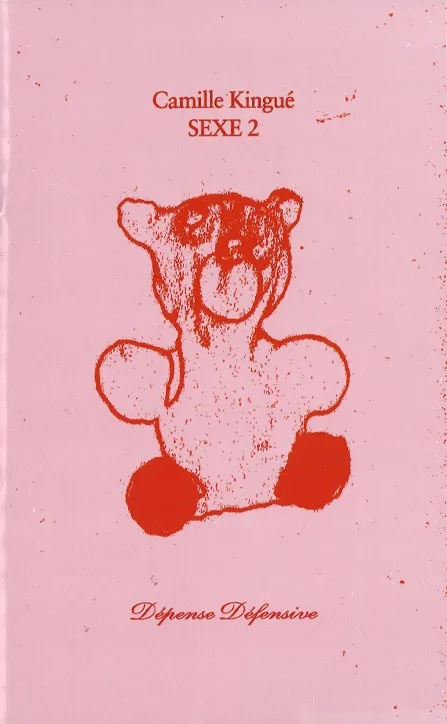
Cover of Sexe 2

Dépense Défensive

Sexe 2

Camille Kingué

Poetry €12.00

Confession sur le désir (l’action et l’objet du), les liens de mutualité et de résistance, Sexe 2 alterne prose et versification en 27 fragments numérotés à l’adresse plus ou moins dure, plus ou moins sincère, plus ou moins formulée car plus ou moins éloignée du Toi et du Je. Camille Kingué s’attache à révéler, à voir quelque chose à travers son image réelle et virtuelle, agrandie et rétrécie, droite et renversée, déployant une recherche des principes de l’amour (l’amour comme amour, pourquoi est ce qu’il y a de l’amour) où la métaphysique et la compréhension de soi – donc de l’autre – n’ont jamais été aussi sexy.

Claire Star Finch, dans la magnifique préface qu’iel signe au début de l’ouvrage, écrit : « Après avoir lu tous les livres de Kingué, je ne sais pas si je crois en “l’amour”, que ce soit en tant que substantif absolu ou en tant que proto-résidu de tout ce que “le sexe” peut signifier. Mais je crois définitivement qu’il faut l’écrire. » Définitivement.

Cover of Oraison funèbre pour Zelda1990

Dépense Défensive

Oraison funèbre pour Zelda1990

Romane Constant

Fiction €15.00

D’eux, il ne reste que les mots de celle qui a croisé leur route. Le crissement de pneus qui sifflent avant un malheur qui tarde à se produire. Sanctification plus que célébration, Oraison funèbre pour Zelda1990 est une tentative de communication au-delà de la matière physique de l’énonciation, un dialogue interne qui convoque « par moment le frère, par moment l’ami parti », toujours la ruine, la consommation de la séparation avec le tout. À travers quatre parties qui font écho à la structure des éloges funèbres de la Grèce antique, Romane Constant réouvre la poésie des plaies larges et profondes que les vers lapidaires d’Hélène Bessette – sur qui l’autrice mène un travail de recherche – ont laissé dans l’histoire moderne de la littérature, et signe un texte bouleversant sur la difficulté des choses qui ne (se) passent pas, la force de celles que l’on voit suspendues par le cou au bord d’une paix impossible à trouver. Oraison funèbre pour Zelda1990 est une douleur croissante, avec écoulement et rougeur.

Romane Constant vit et travaille à Paris. Elle explore à travers différents supports les questions relationnelles, d’intimité, du corps et du genre. Attachée aux Ardennes où elle a grandi, elle s’intéresse également à l’héritage de la classe ouvrière et aux traumatismes intergénérationnels.

Cover of BRICKS FROM THE KILN #7

Bricks from the Kiln

BRICKS FROM THE KILN #7

Matthew Stuart, Harriet Moore and 1 more

Anthology €20.00

Guest edited by artist Helen Marten and literary agent Harriet Moore with Matthew Stuart, this volume of the journal considers what it means for a publication to be an allegorical container. A simple box in which to gather multiple things, an economical set of permutations — rational in one sense, yet defiantly flexible to move. Contributors were approached with an open invitation; some explored the multiplicities of containing or containers, while others filled the printed vessel with their own ongoing preoccupations. The following pages perform as envelope, bag, shell, net, fold, alarm, letter and instruction. There are holes to disappear within; smoke to knot and wind; shadows to unfold — a context that takes in and binds, finding new kinships from unforeseen proximities.

THE FIRE FLOWERS AND THE FLOWER LIGHTS UP –
Lucy Mercer
(spine)

WE SHALL GREET THE MOON AGAIN
Walter Price
(front cover)

BACK PAGES OF ALGIERS DIARIES 2018
Lydia Ourahmane
(inside front & inside back cover)

AN INTRODUCTION TO / NOTES ON / INSTRUCTION FOR THE FRONT NOVEL
Eliza Barry Callahan
(pp.1–16)

SATURDAY MORNING
Kathryn Scanlan
(pp.25–29)

KILLDEER
Jason Schwartz
(pp.33–38)

ALARMS AND EXCURSIONS
Rosmarie Waldrop
(pp.45–61)

"THE BATHROOM"
Najwa Barakat
(pp.67–76)

ARMY ROLLS, A CIRCUMSCRIPTION
Roy Claire Potter
(pp.81–91)

CONCHOMANIA
Felix Bernstein
(pp.95–109)

O-POEM
Line-Gry Hørup
(pp.113–129)

THIS MUSCLE
Cally Spooner
(pp.133–153)

STERLING PARK IN THE DARK
Susan Howe
(pp.159–179)

COCONUTTERY
Mathelinda Nabugodi
(pp.183–193)

YOUR SELF CONFIDENT BABY
Aurelia Guo
(pp.197–206)

BIOGRAPHY OF A NET: HOLDING A VOLUME
Daisy Hildyard
(pp.211–225)

A GUIDE TO THE POETRY OF LI HO
Eliot Weinberger
(pp.229–235)

WOMEN SMOKING
Charline von Heyl
(throughout & p.239)

INFRATHIN
Marcel Duchamp
(throughout & p.239)

THE MAZED WORLD
Rachael Allen
(bookmark insert)

UNTITLED
Helen Marten
(back cover)

Cover of In Abeyance

The Last Books

In Abeyance

John Wilkinson

Poetry €14.00

With this new book of sedimented lyric, John Wilkinson’s poetry enters a terrain of creatures flattened in shale, in flat screen and in digital code. If Silicon Valley would repopulate Jurassic Park and defeat death, Wilkinson’s poetry would make actual what slides past in the disregarded day, whether the flattening of a city or the return of seasonal blossom. This poetry swells dry roots; it breaches the total coverage that flatlines the heart’s response, through its urgent and generous rhythms.

Designed and typeset by Phil Baber.

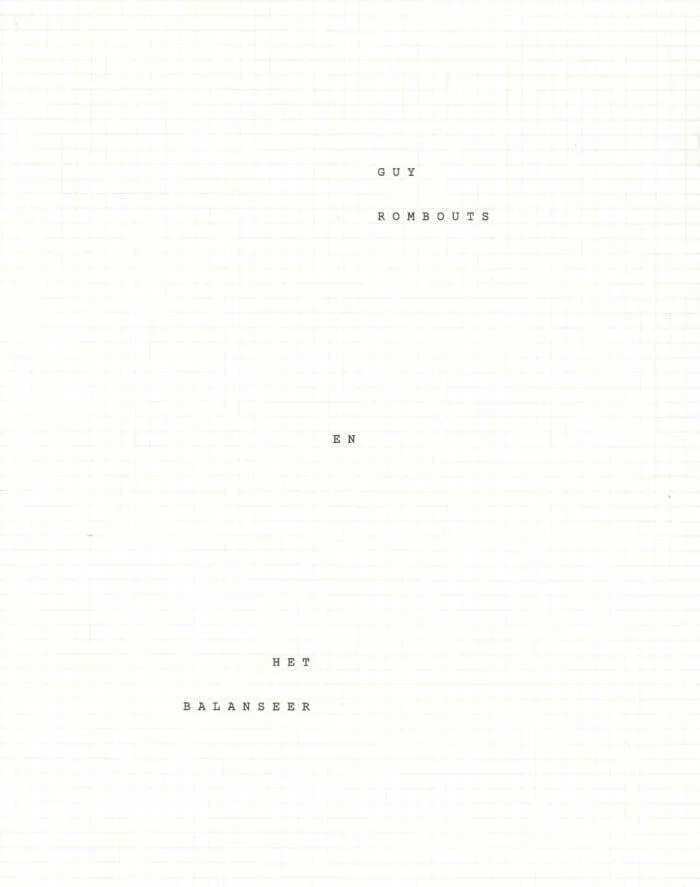
Cover of EN

het balanseer

EN

Guy Rombouts

Poetry €25.00

In het begin van de jaren 1970, hield Guy Rombouts een notaboekje bij waarin hij alle woorden, bijvoeglijk naamwoorden en werkwoorden bijhield die hij tegenkwam tijdens het lezen en die met elkaar verbonden waren door het voegwoord ‘en‘.

Ongeveer 50 jaar later en met de hulp van de grafische vormgever Jeroen Wille, is de transcriptie van zijn aantekeningen gepubliceerd als een boek dat gelezen kan worden in twee richtingen (en als enige boek coronaproof met twee tegelijkertijd).

Het boek bevat 2158 verzen met in totaal 4316 EN-combinaties.

De kortste verzen met evenveel letters:

A EN Z

4 EN 6

De langste verzen met evenveel letters:

ONUITSPREKELIJKHEDEN EN IMPONDERABILIA

ONEVENWICHTIGHEID EN ZELFOVERSCHATTING

Cover of Or, on Being the Other Woman

Duke University Press

Or, on Being the Other Woman

Simone White

Poetry €18.00

Throughout this book-length poem, Simone White considers the dynamics of contemporary black feminist life, attesting to the narrative complexities of writing and living as a black woman and artist.

In Or, on being the other woman, Simone White considers the dynamics of contemporary black feminist life. Throughout this book-length poem, White writes through a hybrid of poetry, essay, personal narrative, and critical theory, attesting to the narrative complexities of writing and living as a black woman and artist. She considers black social life—from art and motherhood to trap music and love—as unspeakably troubling and reflects on the degree to which it strands and punishes black women. She also explores what constitutes sexual freedom and the rewards and dangers that come with it. White meditates on trap music and the ways artists such as Future and Meek Mill and the sonic waves of the drum machine convey desire and the black experience. Charting the pressures of ordinary black womanhood, White pushes the limits of language, showing how those limits can be the basis for new modes of expression.

Cover of This Poor Book

Divided Publishing

This Poor Book

Fanny Howe

Poetry €15.00

For decades, Fanny Howe has been the great poet of spirit and conscience, dislocation and bewilderment. In This Poor Book, completed just before her death, she assembled a selection of her writing from the last thirty years into a single, astonishing work.

Fanny Howe is a titan. Absolutely nobody writes like her. Nobody sounds like her. This Poor Book is a miracle she left for us. —Kaveh Akbar

This Poor Book is revelatory and casts Howe’s poetry in a new light, and for those who don’t know her work already, this is a perfect introduction. Fanny Howe is an essential poet. —Rae Armantrout

Fanny Howe spoke about “the difficulty of reconciling multiple registers of consciousness and language. Soul and sticky atoms.” In This Poor Book she delineates and shifts between these layers to conjure a bewildering yet ultimately galvanizing evocation of the human psyche. We are being warned every day that robots and software will soon replace us. Howe’s poetry makes clear that such a notion is based upon a very limited conception of what it is to be a human. We are complex. We are mysterious. We don’t make sense. We do make sense. You will lose and you will find yourself in her words. — Claire-Louise Bennett

This Poor Book is a testament to Fanny Howe’s life and writing. In it, she wields her powers of perception for a long poem that turns inward on the self and out at the world and in every other direction the poet can imagine with lines that speak directly and always suggest more than they say: “There is a little trouble in my eye.” The irony and beauty of its final line—“There was no more reason to die”—will be with me for as long as my memory of Fanny Howe herself. — Jericho Brown

In her final act of literary alchemy, Fanny Howe gathers the scattered constellations of her astonishing life work and forges them into a single unwavering spiritual reckoning. At the dynamic center of the poem, a live beating heart moves through a fractured world—haunted by power, estranged from institutions, yet fiercely open to mystery. There’s a radical humility here, paired with a radiant understanding—that doubt can be a form of faith, and that hope, when unflinching, is the most defiant music of all. This Poor Book is for the ages. — Peter Gizzi

This Poor Book is an astonishing document by an irreplaceable poet. A palimpsest of decades’ worth of writing, assembled here into a long poem as fractured and multitudinous as life itself, Fanny Howe’s last work captures the brutality and beauty of the modern world better than almost anything else I’ve read: “The structure failed to cohere at the end of the struggle. / It had some music in it.” — Maggie Millner

Through Fanny Howe's eyes we look at life differently. She makes us understand that we are part of a mysterious and complex world; one which we urgently need to be receptive to. Beauty appears in unexpectedness, as in “flowers attract scissors” and “why does an eye evolve in the dark?” Who else could turn things upside down with such a sleight of hand? This Poor Book reads like the testament of a newly discovered life-form, offering vital messages from the past and into the future. — Celia Paul

At once evocative and subtly incisive Howe’s writing seems almost like a new language, a language that has been in hiding. She can make the familiar haunting and the ordinary a provocation. — Adam Phillips

This gorgeous final statement by one of our most perceptual writers is a work of accrued understanding. ... Fanny Howe leaves us with profound investigations into the capacity of words, of juxtaposition, what a line, a page, and a book can give. — Sarah Schulman

Cover of Cyclamen

Tenement Press

Cyclamen

Alix Chauvet

Poetry €25.00

A debut collection from the poet, artist and designer, a suite of unfaithful translations/transversions of works drawn from Baudelaire’s Les Fleurs du mal / Flowers of Evil, a bunch of flowers in decay, pressed and frayed, ‘a flock of pockmarked words.’

Through these creative ‘translations’ of Charles Baudelaire, Alix Chauvet—artist, designer, poet—refuses fidelity in favour of flirtation: her ‘flowers of evil’ line Amsterdam’s canals, drink from the same rainclouds as Rachel Ruysch’s bewitching bouquets, sprout through peat, and are tended by a distinctly feminist and nomadic sensibility. Chauvet—akin to Olive Moore, Sean Bonney and Lisa Robertson—takes the nineteenth-century French decadent as a contemporary accomplice for aesthetic and linguistic misbehaviour. Walter Benjamin once wrote of Baudelaire that he is ‘der geheime Architekt der Moderne,’ and in Chauvet’s hands, those foundations are made porous, unbuilt into cast shadows, into ribbons, into veins streaming across the page. Accompanied by scans of the French poems and Chauvet’s shadow photography, what Cyclamen ultimately offers us is a regenerative rewilding of the English language: a wondrous terrain ringed by vines of unruly syntax and dotted with the fruit of words refusing domestication by any single tongue. Mia You

Alix Chauvet is a Swiss-French poet and graphic designer based in Amsterdam, taking pleasure in the possibilities of translation. She received her BA in Graphic Design from the Gerrit Rietveld Academie (Amsterdam, 2020), and has since been working independently and in collaboration with contemporary artists. Investigating the relationships between language and body, intimacy and collectivity, past and contemporary, her hybrid practice covers a wide range of visual and linguistic experiments from artist’s book design to experimental translation. Her method is rooted in decelerating the creative process through the use of analogue and unprofitable techniques such as cut-outs, letterpress, linocut, handwriting and painting. Chauvet’s poetic approach follows the same logic, prioritising English over her mother tongue as a way to revise language with both critical detachment and a degree of identification. Her poems have appeared in literary magazines such as Blackbox Manifold, and Cyclamen is her debut collection.