rile*books

Search books

Search books by title, author, publisher, keywords...

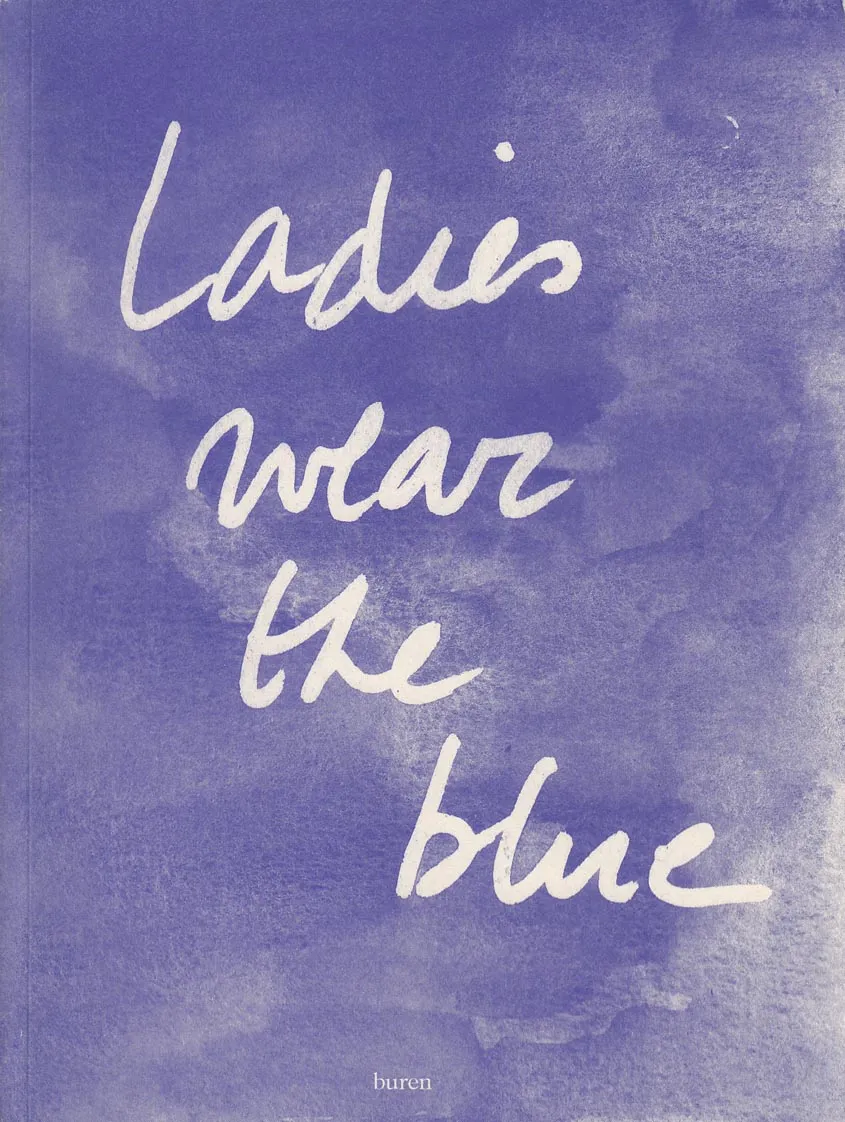
Cover of Ladies Wear the Blue

Self-Published

Ladies Wear the Blue

Buren

€22.00

Ladies wear the blue is a collection of watercolour drawings by the hand of Melissa Mabesoone and Oshin Albrecht. The blue watercolours portray women from different moments in time. The adjacent texts describe these women's existence, roles, desires or ideosyncrasies deriving from the 'blue' in their lives. From the first female police officers and Alices all around, to Courtney Love's blue baby dolls and the girl with the blue tattoo Olive Oatman, this publication is an ode to women venturing into the world, and a way to continue telling their herstories.

Language: English

recommendations

Cover of sex and place vol 1

Self-Published

sex and place vol 1

Adriano Wilfert Jensen, Andrea Zavala Folache

sex and place is a series of workshops and publications exploring score-based and semi-anonymous writing as a tool for articulating shared concerns.

Vol. 1 ‘preliminiaries’ is written by Andrea Zavala Folache and Adriano Wilfert Jensen. In the midst of (learning) child care, (unlearning) performance and (experimenting with) sex, the publication interweaves three registers of writing as analogies and interruptions of each other.

The ‘sex and place’ series is part Domestic Anarchism, a project devoted to coalition-building beyond biological, chosen, or national conceptions of family. Dance serves as a set of tools and knowledge that can be applied beyond “the spectacle” to collectively study, write, and move. 

Andrea Zavala Folache and Adriano Wilfert Jensen are choreographers and they co-parent three-year-old Penélope Cleo. Andrea and Adriano use dance and choreography to think about the distribution of care and solidarity beyond ‘the family’, and in turn consider how such a distribution could inform their dance practice. Inevitably themes like sex, economy, gender, and class get activated. But also notions such as prefiguration, anarchism, clitoridian* thinking, zones of non-domination and coalition building. They see dance as a knowledge that can be applied to different practices. Some of these include: co-habitations, score based writing and dancing, self-organised study groups and publications, workshops and dance performances. 

Cover of Cough Drop Circus

Self-Published

Cough Drop Circus

Josheph Dunkerley, Holly Miles

Poetry €5.00

This collection of 20 poems by young poets Holly Miles and Joseph Dunkerley sheds a glimpse into the bizarre journey of two isolated souls in a time of global crisis. Read along in this 24 page zine as they chart their unique perspectives of the worldwide COVID-19 pandemic!

Cover of Notes on a life not lived

Self-Published

Notes on a life not lived

Despina Vassiliadou

Poetry €30.00

This publication is based on a project by Despina Vassiliadou that ran from 2015-16. It presents a collection of photographs taken during the period, accompanied by fictional short stories.

Cover of Life with Fifi

Self-Published

Life with Fifi

Kris Dittel, Angelica Falkeling

Fiction €18.00

A children’s book without a specific age category, offering a glimpse into the small rituals and shared moments that shape a day with Fifi Paris.

Fifi, a Pomeranian-Chihuahua mix, came into the lives of Angelica and Kris a few years ago. Taking care of a puppy is taking responsibility for building their world and letting the small animal transform yours. As her human caretakers, the authors created Fifi’s world with toys, cuddles, rules, snacks and walks in the park. In return, she transforms our world by bringing our community together and reminding us of the importance of caring for one another. In this book, Kris and Angelica narrate a day in the life of Fifi, from the moment she wakes up to when she falls asleep at night. Along the way, they share how they connect with her, how they see her understanding her surroundings and what she has taught them about companionship.

Design by Amy Suo Wu
Copy-editing by Clem Edwards
Photography by Lili Huston-Hertreich

Cover of Chile Chico et le quartier Versailles

Self-Published

Chile Chico et le quartier Versailles

Ema Tytgat

Chile Chico et le quartier Versailles, c'est une exploration qui inventorie, interroge et révèle les mémoires invisibles en listes et en collections. Une mémoire qui ne soffre pas en bloc, qui résiste, se fragmente, se transforme. A travers cette archive collaborative, nous avons voulu capter ces va-et-vient ď'un passé qui dialogue avec le présent, des images qui oscillent entre Vintime et le collectif. 

Le point de départ de cette fabrique visuelle, c'est lexil des Chilien.nes, débarqué.es dans les années 70, qui se tissent une nouvelle vie sur le sol de Neder-Over-Heembeek, dans le quartier Versailles à Bruxelles. Ces trajectoires, arrachées à un ailleurs, s'ancrent dans des espaces rêvés comme de transit pour devenir des lieux d 'appartenance, où lexil se mue et les racines finissent par se déployer. A ces récits se greffent d'autres histoires, d'autres trajectoires. Un quartier comme un carrefour, ou les individualités se rencontrent, où les vies se croisent et s'allient.

Cover of #7 Schizm Magazine

Schizm Magazine

#7 Schizm Magazine

Emma Holmes

UPWARDLY/DOWNWARDS.

Contributions by Bob Ajar (NY), Jessica Bard (NY), Sam Basu (FR), Paul Birbil (NY), David Burrows (LND), John Chilver (LND), Lisa Conrad (CA), Nina Katchadourian (NY), James Chance (MEX), Jon Kinzel (NY), Roy Kortick (NY), Emily Kuenstler (CA), Cedar Lewisohn (LND), Drea Marks (MA), Francesca Mannoni (NY), & Elizabeth Tisdale (NY).

Schizm Magazine invites contemporary artists and writers to contribute pages in response to a theme which, as the title implies, engages with a paradoxical idea. Each issue combines archival material with original works and texts sent in by between ten to thirty contributors.

Cover of Exercises of Poetic Communication with Other Aesthetic Operators

axis axis

Exercises of Poetic Communication with Other Aesthetic Operators

Ernesto de Sousa

Ernesto de Sousa (1921–1988) was a major and multifaceted figure from the Portuguese avant-garde—artist, poet, critic, essayist, curator, editor, filmmaker, and a promoter of experimental ideas and artistic expressions. 
Reflecting questions of hierarchy, authorship, and the complexity of framing or dividing within the multiple and complementary practices of Ernesto de Sousa—whose motto “Your Body is My Body, My Body is Your Body” serves as a poetic manifesto—this publication explores the various aspects of his oeuvre (visual, poetical, and theoretical) and his outstanding inventiveness of concepts.

The volume brings together a selection of works, unpublished archives and their translations, and theoretical texts by Ernesto de Sousa, including the first complete translation in English of «Orality, the future of art?» (1968). Richly illustrated, the book reunites an introductory text by Lilou Vidal, two new essays by Paula Parente Pinto and by José Miranda Justo along with a text by Hugo Canoilas.

"There was a time when bread was sacred; and in a general sense, all fabricated objects deserved the respect that resulted from (for the conscience of those who used them) concretely diving into their own motivations. Human gestures, like aesthetic objects, were inseparable from their relevant functions. Naturalism prompted us to look at natural and fabricated objects with a vision that was cosmic and indifferent at the same time. The objects, today, object. In the future, objects and gestures will perhaps clothe themselves once again in their lost dignity. The word love, a bit of bread, the letter A will stop being mortal accidents of daily life. Desacralized, they will once again be as decisive as the tiniest brushstroke the painter made on his canvas. And each of these brushstrokes will reveal the structure of the world. Life can then be compared to a vast work of art. Everything will be absolutely aesthetic.."
— Ernesto de Sousa

Contributors: Hugo Canoilas, Ernesto de Sousa, Tobi Maier, José Miranda Justo, Paula Parente Pinto, Lilou Vidal

Cover of The Imaginary Republic

Errant Bodies Press

The Imaginary Republic

Brandon LaBelle

The Imaginary Republic is an artistic research project focusing on questions of social practice. In particular, it considers the creative and restless imaginaries underpinning our political selves and argues for a deeper engagement with what Elena Loizidou terms “dream-action”: the figurative and poetic staging of world making activity.

The publication brings together participating artists Tatiana Fiodorova, Octavio Camargo / Brandon LaBelle, the Sala-Manca Group, and Joulia Strauss, whose practices engage situations of struggle and autonomous cultures through a range of methods and approaches. From social fictioning to camouflaged interventions, collaborative pedagogies to gestures of care, their works propose unlikely paths of mutuality. The publication includes documentation of an exhibition held at Kunsthall 3,14 in Bergen, as well as key essays and works by theorists and artists Rhiannon Firth, Hélène Frichot, Marysia Lewandowska, Gerald Raunig, Raimar Stange with Oliver Ressler, and Manuela Zechner.