Eselsohren Dog Ears
"The impossible takes a little longer. [pen scribbling]"
Presented at Kransen in Borgerhout, 1—3 March 2024, with an exhibition titled Dog Ears and a remote reading by fellow-Stockholmian artist Dave Allen.
"The impossible takes a little longer. [pen scribbling]"
Presented at Kransen in Borgerhout, 1—3 March 2024, with an exhibition titled Dog Ears and a remote reading by fellow-Stockholmian artist Dave Allen.
Ines Cox is an artist living between the Nièvre department in central-eastern France and Antwerp. This book consists of some 300 obsessive pages of her handwritten calculations—76% of which are actually true.
Cover by Bonni Cox, back cover by Toni Matthé. Printed in Borgerhout, bound by Gazelle in Deurne. Supported by Centre de la Paresse and Flanders—State of the Art. First presented at Kransen, 23.11.2024. Edition of 100.
Twenty Bookmarks is a result of Production & Workflow class of Graphic Design Department at the Royal Academy of Fine Arts Antwerp, Ba1 Class of 2026.
Written and edited in Biarritz, Borgerhout and Midsommarkransen, 2016—2021. Dedicated to Räffi, with much love. Another version of this text was published in Pfeil Magazin 10 (Montez Press, 2018); editor: Anja Dietmann, copy-editor: Stacy Skulnik. Epigraph from Numéro Deux (1975) by Anne-Marie Miéville and Jean-Luc Godard. Presented on Saturday February 5th 2022 at Kransen, Borgerhout.
128x201mm, 40p, staple bound. Riso-printed on Arcoprint Edizioni Avorio 90g and Clairefontaine Blue 210g. Design by Kaye–Matthé, typefaces: Tribute, Gillies Gothic Light. Printed by Risiko Press at Kransen, covers silkscreened at Afreux, bound by Drukkerijcollectief De Wrikker. Edition of around 200.
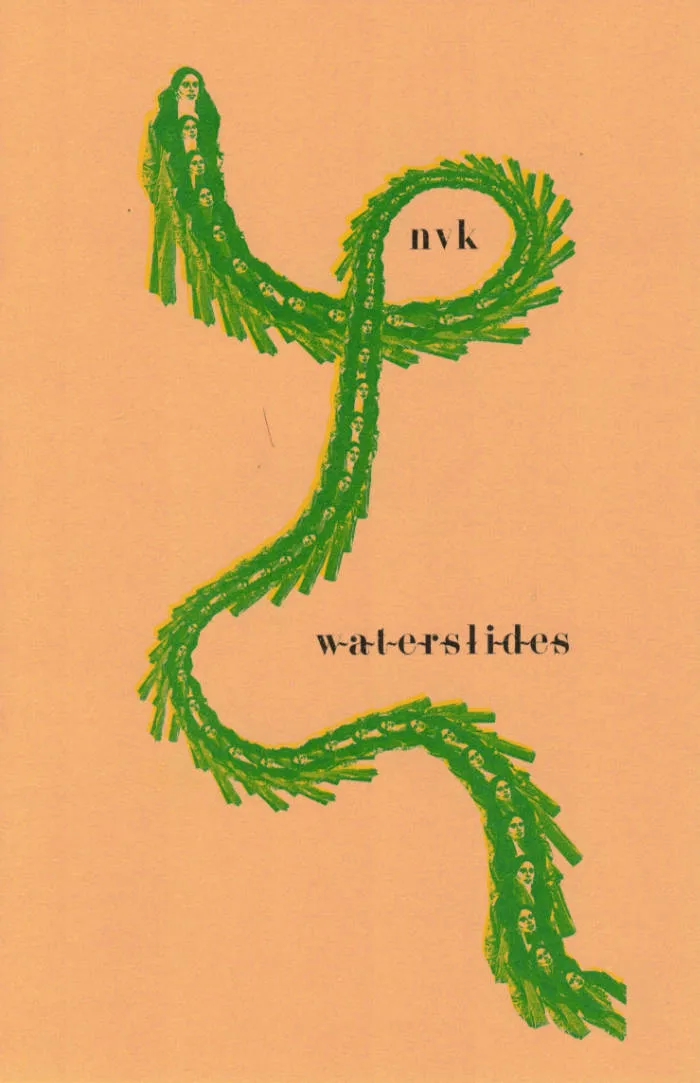
"Waterslides is a falling and plunging, short starts and stops aided by movement, until we splash, climb and plunge again. Each sliding is the same but different—with each descent new expectations and thoughts swirl, shifting focus and gaining new insights or blockages. Waterslides are brief moments of remembering, remembering as a present tense activity, one that happens as we think of it, projected on our now. The waterslide is the moment of past and present working in tandem, a movement of repeating, revisiting and remembering all at once.”
Written by nvk 2021-2023. Dedicated to Judi, MM & TNN.
A version of these poems was published as an audio work through Ignota Press’ The Mountain (2023) and included in a reading with James Loop on Montez Press Radio (2023). nvk would like to thank Jan Matthé, Stine Sampers and Michelangelo Miccolis for their patience & love.
This book was first presented at Kransen in Antwerp, May 6th 2023, with a performance by Sassy (costume by Rosa Schützendorf). Printed and bound at Risiko Press, Borgerhout. Cover image by nvk. Fonts: Adonis, Garamond Pro. Limited to 150 copies.
128x195mm, 16p., stapled, cover: green, yellow and black risoprint on 160gsm caramel paper, inside: black and blue riso on 120gsm Munken Pure paper.
C. Ondine Chavoya, David Evans Frantz
Published to accompany the artist’s first retrospective exhibition, Teddy Sandoval and the Butch Gardens School of Art examines the work of the inventive yet overlooked Teddy Sandoval, a central figure in Los Angeles’s queer and Chicanx artistic circles. Sandoval was known for producing subversive and playful artworks in a range of media that explored the codes of gender and sexuality, particularly conceptions of masculinity.
This publication surveys Sandoval’s work alongside other queer, Latinx, and Latin American artists whose practices profoundly resonate. This expansive catalogue features essays by C. Ondine Chavoya, David Evans Frantz, Raquel Gutiérrez, and Mari Rodríguez Binnie, as well as biographical entries on other artists featured in the exhibition, including Félix Ángel, Myrna Báez, Álvaro Barrios, Ester Hernández, Hudinilson Jr., Antonio Lopez, María Martínez-Cañas, Marisol, and Joey Terrill.
Design by Content Object
Co-published by Inventory Press, Williams College Museum of Art, Vincent Price Art Museum, and Independent Curators International
Tobi Maier, Cecilia Grönberg and 1 more
Once more, an astonishing issue of OEI – a thrilling, compelling, stimulating feast of ideas regarding publishing and the book: the perfect big companion to read and hug in bed while the virus spreads outside.
Bringing together contributions from circa 130 publishing structures, publishing communities, magazines, small press endeavors, artists, poets, writers, editors, theoreticians, curators, scholars, and art bookstores, OEI # 86–87 reflects upon the challenges, pressures and possibilities of publishing and creating publics in different contexts and places in a time of far-reaching – economical, medial, political, social, technological – transformations.
The potential and the versatility of publishing open it to a diversity of practices and approaches in the arts, but as an eminently social form of art, a collective or micro-collective work with shared responsibilities, it is also a never-ending process of “crafting a variegated approach to how you create, publish, distribute, and build a social ecosystem around your efforts”, of trying to “build up and strengthen the community around these printed forms” (Temporary Services).
It is the conviction of OEI #86–87 that print has the power to play an important part in the construction of social spaces, of a social world. As Benjamin Thorel puts it in one of the essays in the issue, “conceiving of the dynamics of publishing as making publics as well as making things public is not a pun – insofar as the artists/publishers encompass, beyond the book itself, its possible ‘lives’, imagining the different spaces, and the different people, amongst whom a publication will circulate.” This is what Michael Warner has called “a public [as] poetic worldmaking”, implying “that all discourse or performance addressed to a public must characterize the world in which it attempts to circulate, projecting for that world a concrete and livable shape, and attempting to realize that world through address.”
This is also, as stressed by Annette Gilbert and others, what can make publishing such an active force, a force co-constituting texts and publications and publics. Indeed, with Michalis Pichler, it is tempting to say that in publishing as practice – perhaps more than in any other art field – “artists have been able to assert the aesthetic value of their own socio-politically informed concerns and to engage, often under precarious conditions, in cultural activities fully aligned with their political values.”
OEI #86–87 also includes sections on and with contemporary poetry from Canada; Fluxus publishing; Krister Brandt/Astrid Gogglesworth; Kalas på BORD (Öyvind Fahlström); Lars Fredrikson; Claude Royet-Journoud’s poetry magazines; Carl Einstein; Gail Scott; Ållebergshändelser; OEI #79: edit/publish/distribute!; “det offentligas försvinnande” and many many other things. [publisher’s note]
Design by Konst & Teknik
“RUSTIQUE” is an artist book created by Nicola Godman. This book is sprung out of a residency in September 2021 at Hôtel Chevillon, a former Scandinavian artist colony in Grez-sur-Loing, France. Barbizon, the village where the painter Jean-François Millet (1814–1875) lived and died, is located 20 km away from there. The book interweaves the life and work of Millet with Godman’s photographs, drawings and personal anecdotes.
“RUSTIQUE” wishes to put forward the artistic gaze towards rural life by artists who themselves are born peasants. Nicola Godman (b. 1989, Rute) is an artist working with photography, video, books and stories, currently based in Stockholm, Sweden. Having grown up on an organic dairy farm, she is researching depictions of rural life in art history and contemporary culture.
Michael Cavuto, Astrid Terrazas
"From this moment / and hence backwards / a visitation / echoes thru the apparent opening / to the tomb / the narrow passage is the mind's reasoning / in clarity / as she moves like a shadow / having lived her life before " — Joanne Kyger, from Places to Go (Black Sparrow, 1970)
"All processes measured as form are traceable in curved decay. Seemingly unmeasurable, unquenchable, the heart stone harbors its own native entropy. The evolution of organs is not ours to decipher. We’re drawn slanting toward the stone in helices of approaching circles. Our movements throw shadows, our bodies ring haloes." — Michael Cavuto, "Isis Theses"
"In the dual work of Isis Theses & Pyre I-V, living, death, language’s work of remembrance, place & poetic lineage all take part in shifting throughlines of recombinant forms, as a spiral spirals back on itself, changed over time. Early on, here, Cavuto writes “There is not enough wood for coffins. There is wood enough for a boat.” a Pyre then is a boat, a burning that is going somewhere, not death-as-end but as an upward & outward movement into collectively shared air, an archeology of connection. “Kyger wrote that memory is a weird dimension carried around invisibly in the ‘mind’’ Cavuto writes, in one of those moments that feels like a key, “Writing, she said, gives history back to you.” But it is not only history that Cavuto is carrying forward in these poems, it is something more spatially complex, enlivened & embodied in the dance of the words, & in the vital breakdown of the words themselves. The poems in Pyre I-V enact their answer to the question ‘what essence is left us when no words are left,’ & leave us, after the ritual process, dazzled with the true sense that something is left, something important of resonance & remembrance, in the atomized language-space; the air around the dis-integrating morphemes shimmering on the page as dissipative, potentiate sparks. —Cody-Rose Clevidence
Michael Cavuto is a poet based in Brooklyn, New York. His books include Country Poems (Knife Fork Book, 2020) and Pyre (Spiral Editions, 2025). With the poets Dale Smith and Hoa Nguyen, he publishes the Slow Poetry in America Newsletter. Along with Tessa Bolsover, he publishes hand-bound poetry books through auric press.
Pyre, Michael Cavuto. Illustrations by Astrid Terrazas. 52p, 8.5" x 6.75", hand sewn with red linen thread. Covers letterpressed on a 1963 Vandercook proof press with Strathmore Premium Grandee paper. Copy text and illustrations printed both offset and digitally on Mohawk felt paper in a first edition of 275. Printed, assembled, and bound in “Kingston, New York,” the unceded and currently occupied lands of the Haudenosaunee, Mohican, Munsee Lenape, and Schaghticoke. With thanks to Vladimir Nahitchevansky and the various friends who helped assemble.