rile*books

Search books

Search books by title, author, publisher, keywords...

Cover of Cursive Paradise

Wendy's Subway

Cursive Paradise

Kaur Alia Ahmed

€18.00

Kaur Alia Ahmed’s Cursive Paradise asks how a refusal of cogency can lyrically expand perception. They write, “To weigh heavily on something / is to decide its shape,” and throw language into a state of excess. These poems shift and eddy, loop, and undulate, seeking out spaces of desire and onomatopoeic attraction. All the while, Ahmed offers a view of subjectivity and gender made resonant and malleable, insisting on language that is lush with what cannot be contained by the voice or the page.

Cursive Paradise is the recipient of the 2021 Carolyn Bush Award.

Kaur Alia Ahmed is an artist and writer living in New York. He is interested in destabilizing language, handling it in similar ways to ink, skin, light. His work has been presented at Interstate Projects, 77 Mulberry, Alyssa Davis Gallery, island gallery, Entrance Gallery, and The Drawing Center. His poems can be found in the Poetry Project Newsletter, Baest Journal, Spoil Magazine, BOMB Magazine, and Rhizome. Cursive Paradise is his first book.

Cursive Paradise forces us to rethink feeling, to enter a world where purple is sharp and where nectar leaves us spellbound. Kaur’s writing shapes a space where form and function give up their historical antinomy and renders the world in layers—of light, fluid, fetish, and fissure—breaking the lyric down to its guttural release. 
Bianca Rae Messinger 

Kaur Alia Ahmed offers gleaming edges around the most beautifully staged immediate action. I read certain parts over and over, becoming more conscious of the physical dependence our bodies form in relation to words and music. These lines leap at the least provocation. Ahmed infuses the overall arrangement (visual, orchestral, narrative) with as much yearning as the language itself, leaving us a perfect, wavering space to land. 
— Cedar Sigo 

This is indeed a cursive paradise, but you’ll find no italics here. Emphasis happens differently, through repetition (if you catch Stein’s drift). Kaur Alia Ahmed’s poems, odes to momentum and transformation, refuse to settle into a single form. They propel readers forward and reward their desire to linger on their electric, libidinally charged utterances by having them recur, rearranged and slightly altered, again and again.
Mónica de la Torre

Published in 2025 ┊ 160 pages ┊ Language: English

recommendations

Cover of Americón

Wendy's Subway

Americón

Nico Vela Page

Poetry €18.00

Nico Vela Page’s Americón is a collection of poems in Spanglish that weaves a space for the queer, trans body to know the land, and itself, as extensions of each other. The land is the desert of Northern New Mexico, the forgotten Pan-American Highway, the space between our thighs, the quaking cordillera of Chile, the moans of elk, and the ripe fruit waiting to be picked. Through archive, attention, and erotic ecopoetics, Page’s debut collection of poems extends far across the page, the gender binary, language, and the Americas to find out who we are by asking where we are.

Cover of A book with a hole in it

Wendy's Subway

A book with a hole in it

Kamelya Omayma Youssef

Poetry €18.00

Kamelya Omayma Youssef’s A book with a hole in it uses the poetry of the fragment and the language of everyday survival to gesture towards the fallibility of language at the juncture of the multiple, intersecting wars on women, on "terror," on the non-White body, and on people and language in diaspora. Drawn from a set of journals written over a four-month period, A book with a hole in it throws the formal, official work of poetry into relief, asking what knowledge exists beyond knowledge, which silences are too deep to be surfaced on the page, and how to pierce through trauma and violence to approach a politics of redemption.

Cover of Memorial Park: Revisiting Vietnam

Wendy's Subway

Memorial Park: Revisiting Vietnam

Minh Nguyen

€22.00

Fifty years after the Fall of Saigon and twenty years after her family’s emigration to America, Minh Nguyen returns to her native Vietnam to find out what’s left of the old revolutionary project. In Memorial Park, a collection of essays pairing travelogue and criticism, Nguyen encounters relics of proletarian romance and vestiges of authoritarian control amid an evermore corporatized society. Along the way, she considers how contemporary artspeak confuses state censors, the rise of luxury “Smart Cities” as they supplant socialist housing complexes, and the enduring appeal of propaganda signs that once promised utopia. 

Driven by a diasporic curiosity that seeks discovery over dwelling on loss, Memorial Park avoids nostalgic idealism or reflexive condemnation. Instead, Nguyen takes seriously the legacy of Vietnamese liberation by naming what it has become—and what it has not. What emerges is a complex picture of the country today and a reflection on how we inherit and reckon with radical histories that shape our world.

Minh Nguyen is a writer and curator based between New York City and Ho Chi Minh City. She is the curator of Dogma, a collection and gallery in Ho Chi Minh City focused on art and political graphics, and managing editor of e-flux journal. Her art and film criticism has appeared in publications such as Art in America, Artforum, e-flux, Momus, Mousse, and frieze, and she has curated exhibitions and programs at Wing Luke Museum, Northwest Film Forum, King Street Station, Gene Siskel Film Center, and Chicago Cultural Center. Formerly an instructor at Parsons School of Design—The New School, she has received a Warhol Arts Writers Grant, Fogo Island Arts Writing Award, and New York University’s Asia/Pacific/America Institute Visiting Scholar fellowship.

Vietnam is dissected under Minh Nguyen’s sharp scalpel. Attending to the unresolved pathologies of the past and the detours of the present, Memorial Park sketches the multiple faces of a country in full mutation. In turn lucid, sensitive, acerbic, and full of humor, this collection of essays mixes personal narrative, and social, cultural, and historical critique with discerning observations to interrogate what remains of that old dream of a communism that is “too good to be true.”
— Thuận, author of Chinatown and Elevator in Sài Gòn

What would it mean to “normalize” one of the most transformative conflicts of the Cold War in public consciousness? And how might the diasporic imaginary trouble such narratives, whether revolutionary or reactionary? Some five decades after the fall of Saigon, Minh Nguyen returns to her ancestral home to confront both the live and mediated reality of Vietnam on the ground—and elsewhere. In deeply poetic, incisive, and insightful reflections, she speaks to what is “hauntingly unassimilable” about the present tense of the American War.
— Pamela M. Lee, author of Think Tank Aesthetics

With confidence and measure, this thoughtful collection investigates culture in Vietnam in today’s so-called post-socialist context. Nguyen makes sense of the nation through the conjunction of what she was told by her parents as a diasporic kid growing up in America, and what she experiences when she returns to Vietnam as an adult. Her writing unfolds complex political histories and their ongoing implications for contemporary art and cultural practice, with unique attention to process and how research happens. This book takes the reader on a journey at the end of which everything is as it was, but different through her telling.
— Yaniya Lee, author of Selected Writing on Black Canadian Art

Cover of An Inherent Tear

Wendy's Subway

An Inherent Tear

Rodrigo Quijano, Judah Rubin

Poetry €18.00

Rodrigo Quijano’s An Inherent Tear assembles a suite of poems first published in Lima in 1998 as Una procesión entera va por dentro and his 2014 essay “A Terrace in Valparaiso,” translated into English for the first time by Judah Rubin. Written during the Fujimori years of the 1990s—a period characterized by the end of the conflict between the Maoist Sendero Luminoso insurgency, the Peruvian army, and the Marxist-Leninist Túpac Amaru Revolutionary Movement—Quijano’s bracingly mournful and incisively wry poems insist that we not turn away from the unburied dead. Shifting between neo-baroque hermeticism and a poetics of the conversational, his work destabilizes lyric subjectivity, testing the limits of the structure of metaphor to relay the impasses of the present. Reflecting almost twenty years later from the “city of wildfires,” Quijano’s essay charts the continued landscape of state violence that carries with it the “payroll of bones” Cesar Vallejo evoked nearly a century earlier. In this new, searing collection, Quijano searches amid the smoke and the ashes for “A place to spend the night, / or a language to speak in, / walking through the desert, or drilling into our / insubstantial dreams.” 

About the author
Rodrigo Quijano is a poet and art researcher. He has worked on contemporary art exhibitions in Lima, São Paulo, Mexico, Buenos Aires, Santiago, Bogotá, and the 57th Venice Biennale.

About the translator
Judah Rubin is the author, most recently, of Antiquarian Historiography (Oxeye Press, 2020). Recent translations can be found in the anthology The Beauty Salons/Salones de la Belleza (Aeromoto/Gato Negro/UNAM, 2021), the journals Firmament and Jacket2, and elsewhere. He is the editor of A Perfect Vacuum and lives in Queens, New York.

Cover of The Book of Na

Wendy's Subway

The Book of Na

Na Mira

Fiction €28.00

In The Book of Na, translation acts at the edge of perception. Tracing across projects in film, video, and performance, Na Mira reflects on the violent fragmentation of bodies while refusing the containment of geographic and corporeal borders. In 1977, a name is cut at an immigration office. This gap turns into an intergenerational score for becoming heat, hexagram, hologram. Using oracular and glitching technologies, Mira witnesses what escapes data: doppelgängers, dreams, endangered tigers, tesseracts, A. Turiyasangitananda Coltrane's stairs, Theresa Hak Kyung Cha in a theater, Korean shamanism, frozen ligaments, wildfires, borderlands, subatomic particles, and pink. Syncing to a clock with neither face nor hands, Mira’s hauntological permutations in time, death, and relation travel outside the symbolic order and draw energy from the void.

Na Mira’s autobody rites have been presented at sites including Seoul Museum of Art; Museum of Contemporary Art, Los Angeles; Portland Institute of Contemporary Art; Participant Inc., New York; and Whitney Museum of American Art, New York. She earned an MFA from the University of California, Los Angeles. She grew up between the US and East Asia and teaches outside.

Cover of Pleasureis Amiracle

Nightboat Books

Pleasureis Amiracle

Bianca Rae Messinger

Poetry €18.00

A book of poems written out of a depressive episode, in which a devotional approach to music and desire reestablishes communication between the poet's body and the world. 

In pleasureis amiracle, the poems invoke the lyric and refuse it, moving between time and sound—words re-connect and re-cohere, resisting separation and challenging readers to feel their way to meaning. Perception becomes a many-limbed entanglement from which the reader is never let go. Music is both divine and accessible, a sublimation of everyday movements into an erotics of sensation. 

An experiment in form as much as content, it asks what can be cured by music, what is trans about desire, and how can one allow the body to feel what the mind sees, or vice versa. 

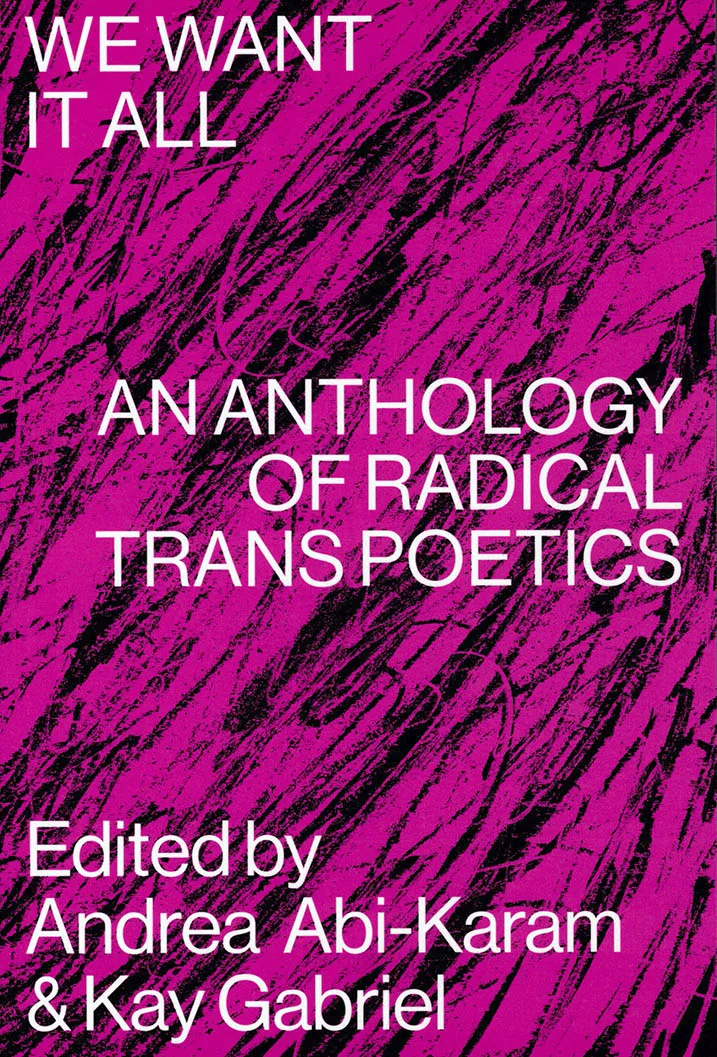
Cover of We Want It All: An Anthology of Radical Transpoetics

Nightboat Books

We Want It All: An Anthology of Radical Transpoetics

Kay Gabriel, Andrea Abi-Karam

Poetry €23.00

An anthology of formally inventive writing by trans poets against capital and empire.

With texts by: Andrea Abi-Karam, New York City Sam Ace, South Hadley, MA Bahaar Ahsan, Berkeley, CA jasper avery, Philadelphia, PA Ari Banias, Berkeley, CA Jo Barchi, Chicago, IL Joss Barton, St. Louis, MO Levi Bentley, Philadelphia, PA Jessica Bet, Baltimore, MA Rocket Caleshu, Los Angeles, CA Ching-in Chen, Seattle, WA listen chen, Vancouver, BC Faye Chevalier, Philadelphia, PA Cody-Rose Clevidence, Arkansas Miles Collins-Sibley, Easthampton, MA Valentine Conaty, New York City CA Conrad, Philadelphia, PA Jimmy Cooper, Rochester, MI Maxe Crandall, Oakland, CA José Díaz, Boston, MA Aaron El Sabrout, New Mexico Ian Khara Ellasante, Lewiston, ME Caelan Ernest, New York City, NY NM Esc, San Diego, CA joshua jennifer espinoza, Los Angeles, CA Logan February, Ibadan, Nigeria Ray Filar, Brighton, UK Nora Collen Fulton, Montreal, Canada Kay Gabriel, New York City Callie Gardner, Cardiff, Wales Jesi Gaston, Chicago, IL Harry Josephine Giles, Edinburgh, Scotland Aeon Ginsberg, Baltimore, MD Caspar Heinemann, Berlin, Germany Kamden Hilliard, Greenville, SC Stephen Ira, New York City Cyrée Jarelle Johnson, New York City Peach Kander, New York City Jayson Keery, Western, MA Evan Kleekamp, Los Angeles, CA Noah LeBien, New York City Ty Little, Richmond, VA Zavé Martohardjono, New York City Amy Marvin, Philadelphia, PA Natalie Mesnard, New York City Bianca Rae Messinger, Iowa City, IA Liam O'Brien, New York City Xandria Phillips, Madison, WI Rowan Powell, Santa Cruz, CA Nat Raha, Edinburgh, Scotland Holly Raymond, Philadelphia, PA Jackie S, New York City Trish Salah, Toronto, Canada Raquel Salas Rivera, Philadelphia, PA Mai Schwartz, New York City Kashif Sharma-Patel, London, UK Julian Talamantez Brolaski, Oakland, CA Charles Theonia, New York City Jamie Townsend, Oakland, CA Nora Treatbaby Laurel Uziell, London, UK Rachel Franklin Wood, Boulder, CO Clara Zornado Akasha-Mitra xtian w. and Anaïs Duplan, NYC.

Kay Gabriel is a poet and essayist. She's the author of Elegy Department Spring / Candy Sonnets 1 (BOAAT Press, 2017), the recipient of fellowships from Lambda Literary and the Poetry Project, and recently completed her PhD at Princeton University.

Andrea Abi-Karam is an arab-american genderqueer punk poet-performer cyborg, writing on the art of killing bros, the intricacies of cyborg bodies, trauma & delayed healing. Their chapbook, THE AFTERMATH (Commune Editions), attempts to queer Fanon's vision of how poetry fails to inspire revolution. Andrea's first book, EXTRATRANSMISSION (Kelsey Street Press, 2019), is a poetic critique of the U.S. military's role in the War on Terror.

Cover of Tongue Ring: Issue 01

Tongue Ring

Tongue Ring: Issue 01

Aodhan Madden, Claire Star Finch

Periodicals €13.12

Oh oh this is the first issue of Tongue Ring, a journal of experimental writing in English & French, with original contributions and translations of texts* by Ariana Reines*, CAConrad*, Camille Kingué, Kaur Alia Ahmed*, Rafael Moreno, Taos Bertrand, and Théo Robine-Langlois*. 

Vous voyez, c’est ça mon genre. Je ne sais pas ce que c’est. 
Mais c’est mon genre. J’ai cet esprit en moi—qui est très ému
par la féminité. Je pourrais me mettre à pleurer. Je veux poser
mon manteau par terre pour la laisser marcher dessus
—Ariana Reines

Premier numéro de la nouvelle revue fantastique et bilingue (FR + EN) d’écriture expérimentale Tongue Ring, avec des contributions originales ainsi que des traductions* de textes de Ariana Reines*, CAConrad*, Camille Kingué, Kaur Alia Ahmed*, Rafael Moreno, Taos Bertrand, and Théo Robine-Langlois*.