rile*books

Search books

Search books by title, author, publisher, keywords...

Cover of Bébé

Bébé Press

Bébé

Chloé Delchini, Mona Hackl

€6.00

Bébé c'est de la presse féminine, bébé c'est une édition qui a du corps, bébé c'est des textes qui ont du chien, bébé c'est des images qui on du coffre, bébé aboie bébé aboie, bébé arrive en bande, bébé aime quand ça déborde, bébé c'est pas biba, bébé c'est nrv, bébé sur ton chevet, dans tes réunions tupperware, dans ton sac à main, bébé c'est ___ !

Language: French

recommendations

Cover of les petites histoires

les petites histoires

les petites histoires

Sam Buouffandeau, S. M. Drogo and 2 more

les petites histoires sont quatre courtes fictions contemporaines. Entre le lonely langoureux New York des années deux mille, le pont poétique et capricieux de Louis 2 de Bavière, l'histoire vraie de Sandy Stone dans les seventies et la satire cinglante et drôle d'une galerie d'art, ces livres sont de brefs univers vivants et curieux.

En 2025, quatre petites histoires sont racontées par quatre auteurices dans quatre livres : L'effondrement du pont de Sam Bouffandeau ; The Gallery de S. M. Drogo ; Exit de Juli Le Nahelec; «Que faire de Sandy Stone?» de Mia Trabalon.

L'édition des petites histoires a été imaginée par Élise Comte, Chloé Delchini, Perrine Estienne, Gabriel René Franjou, Justine Gensse, Bastien Hauser, et Cyprien Muth. Ce collectif d'éditeurices est né à Bruxelles, où les petites histoires ont été imprimées, chez Graphius. 
La maquette, réalisée par Chloé Delchini, à été composée avec Otto, une typographie dessinée par Sam de Groot et Laura Opsomer Mironov, chez Dinamo Typefaces.

Cover of A4 review N°2

Littérature Supersport

A4 review N°2

Chloé Delchini, Justine Gensse and 2 more

Founded in 2023, A4 is a poetry review which showcases and explores contemporary writings practices. Run by Littérature Supersport collective, the object is seen as the extension of their events. The review takes the form of 4 postcards which, when placed side-by-side, form an A4-sheet. A light (even precarious) format for literature that slips into the back pocket of pants and hangs on fridge doors. Each issue features unpublished texts by 4 authors. Wrapped in colors, A4 is distributed by post and available in good bookshops, in Brussels, Liège, Paris and Marseille. 

This second issue presents texts by : Chloé Delchini, Justine Gensse, Simon Johannin and Jérôme Poloczek.

Cover of Matters of Feminist Practice

Belladonna* Collaborative

Matters of Feminist Practice

Karla Kelsey, Poupeh Missaghi

Matters of Feminist Practice, edited by Poupeh Missaghi and Karla Kelsey, brings together scholars, writers, poets, and artists of different identities and backgrounds to confer on the urgent topic of “feminist practice” through seven topics: the body, the quotidian, hybridity, language, documentation, environment, and conflict.

In the twenty-five scholarly and creative-critical pieces included in our introductory volume, each contributor brings unique visions, insights, approaches, voices, and forms to launch the conversation, which will continue to unfold online at mfpjournal.com. 

Contributors to the inaugural issue include: Alexis Almeida, Mary-Kim Arnold, Mildred Barya, Teresa Carmody, Julie Carr, Serena Chopra, Caroline Crumpacker, Lynne DeSilva-Johnson, Marcella Durand, Jennifer Firestone, Yanara Friedland, Carla Harryman, Madhu Kaza, Petra Kuppers, Jean Lee, Rachel Levitsky, Megan Madden, Saretta Morgan, Lida Nosrati, Adrienne Perry, Frances Richard, Kat Savino, Celina Su, and Rachael Guynn Wilson.

Cover of Fanzine Grrrls

Monsa

Fanzine Grrrls

Gemma Villegas

Making a fanzine is an act of rebellion, even more so if it is published and produced by a woman. The grrrls of today use them to inspire countless young people around the world, to take control of their lives and to create their own culture. These homemade publications are a quick and cheap way to spread their ideas and dismantle the usual stereotypes. Traditionally hand-drawn, photocopied, and stapled together, the format of fanzines are now as diverse as their subject matter, with online platforms and social networks fast becoming the norm. The fanzine is more alive than ever!

Gemma Villegas runs her graphic design studio based from Barcelona. She works in close dialog with commissioners and collaborators on a broad range of projects, including visual identities, exhibitions, publications, and digital platforms, overseeing the creative process during all the phases of a project. Her work is characterized by a fresh and powerful visual language focused on detail with special attention to typography.

Cover of MsHeresies 7 - Introduction to The Weather

Rietlanden Women's Office

MsHeresies 7 - Introduction to The Weather

Rietlanden Women’s Office

This seventh issue, four folded offset-printed posters, publishes sampled and reworked material from the feminist collective and publication Big Mama Rag (1972–84, Denver, Colorado), specifically focusing on the issues and articles dealing with the Palestinian and international feminist struggle. Typeset alongside this archival collage is “Introduction to The Weather” (2001) by poet Lisa Robertson.

4 folded posters (narrow A2)

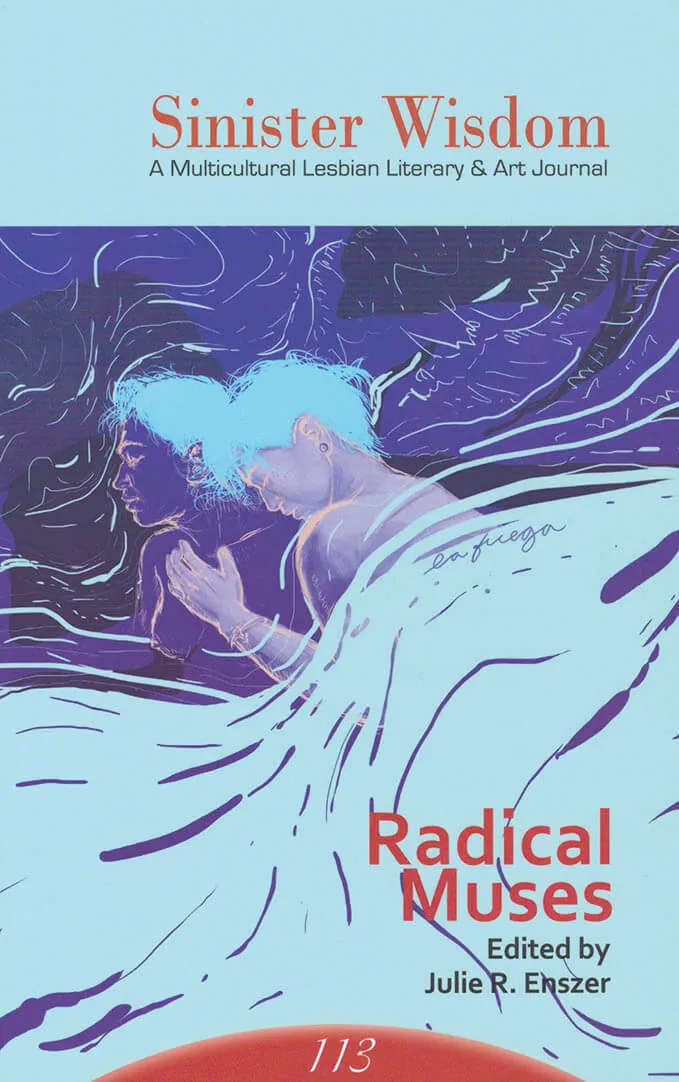
Cover of Radical Muses (Sinister Wisdom nr. 113)

Sinister Wisdom

Radical Muses (Sinister Wisdom nr. 113)

Julie R. Enszer

Sinister Wisdom 113: Radical Muses features an eclectic array of contemporary poetry, prose, and art by lesbians from around the world, including new work by: Andrea Assaf, Tara Shea Burke, Cheryl Clarke, Marina Chirkova, Estela González, Barbara Haas, Nancy E. Lake, Vi Khi Nao, H. Ní Aódagaín and much more!

Cover of Unbidden Tongues #7: Continuity Girl

Unbidden Tongues

Unbidden Tongues #7: Continuity Girl

Naomi Pearce

Unbidden Tongues #7: Continuity Girl unpacks the ‘forensic feminist methodology’ developed by writer, curator and administrator Naomi Pearce. Informed by research conducted in various personal archives of women administrators of artist studio spaces in London from the 1970s until now, the components of Pearce’s writing span mortuary field notes, interview transcripts, intimate first-person accounts and an auto-fictive mystery novella. These various evidentiary approaches blend to form an unconventional casebook that puts forward the complicating factors underpinning the process of writing history in the first place.

In this particular title, the biographical lens focuses on Shirley Read—a photographer, writer, teacher, administrator and oral historian, whose work has been largely overlooked, until now.