Mara Faye Lethem
Mara Faye Lethem
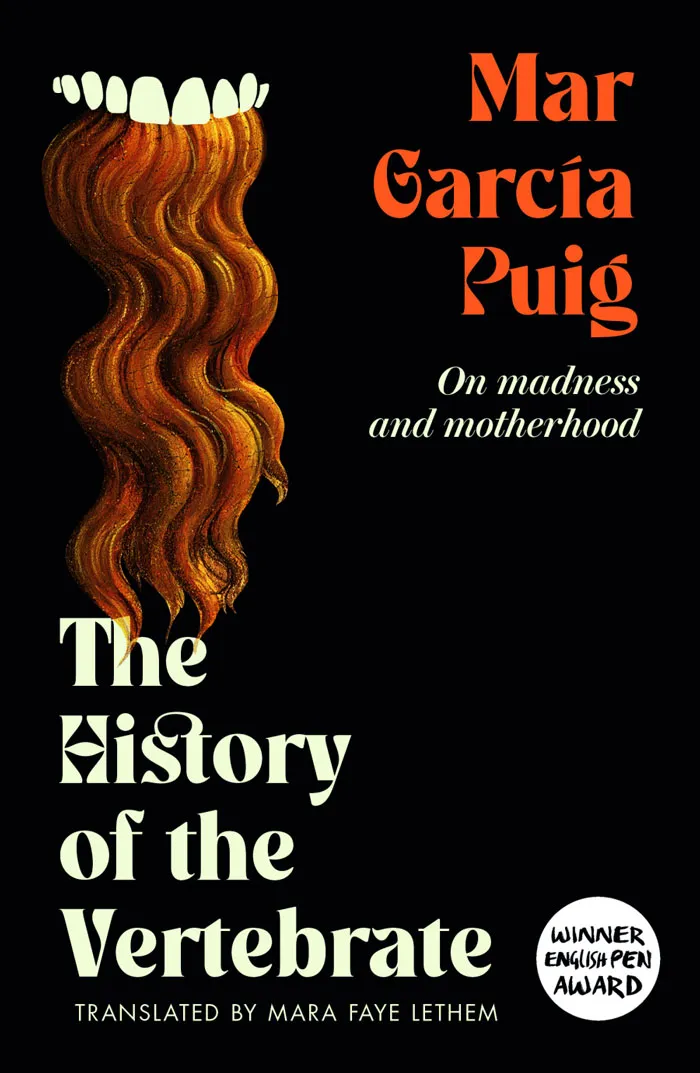
The History of the Vertebrate
Mar García Puig, Mara Faye Lethem
‘On 20 December 2015 I became a mother and I went mad.’
On a single day, Mar García Puig gives birth to twins and becomes elected to the Spanish Parliament as a member of the insurgent left-wing party Podemos. What might have been the best day of her life becomes the start of a terrifying ordeal; García Puig’s grip on reality begins to slip as she grapples with uncertainty, the weight of expectation, and misogyny in both of her new roles.
In defiance of a culture that tells her the problem lies within, García Puig chooses to look outwards, examining the imbrication of madness and motherhood across centuries of science, myth, and politics while dissecting the ways in which women have been pathologized and banished from public life.
At once intimate and epic, The History of the Vertebrate is a searing account of postpartum madness. Moving between memory, culture, and the history of medicine, García Puig transforms her experience into a story about the countless women who have felt that sanity was leaving them, and about the patriarchal forces that have silenced them.
MAR GARCÍA PUIG is an editor and author. From 2015 to 2023 she was a member of the Spanish Congress of Deputies for Podemos, where she served on the Culture Committee and the Equality Committee. Her books include The History of the Vertebrate and This Thing of Darkness.
Mentioned in

Tosquelles: Healing Institutions
Having fled to France in the aftermath of the Spanish Civil War, the Catalan psychiatrist Francesc Tosquelles joined the Saint-Alban psychiatric hospital, where he carried out a transformative clinical practice for over twenty years, in part under the Vichy regime.
Saint-Alban was an extraordinary event, a commune, an informal refuge in a time of extreme danger, a sort of upwelling spread through word of mouth. Those entering the asylum were welcomed, and that welcome never stopped. Care happened through a broad range of communal activities for staff and patients: theater, cinema, collective writing, horticulture, the sorting of colored pearls, gymnastics, singing, a monthly newspaper. The dignity of every patient was of foremost importance.
Now, as then, warmongers are willing to poison and slaughter without blinking, making all of life difficult if not impossible: the pull of such asylums is obvious. Tosquelles is a ground-breaking record of the life and work of the founder of institutional psychotherapy. Assembled by Joana Masó, with many texts translated to English for the first time, it is a direct encounter with Tosquelles’s clinical, intellectual, and political writings.
“Tosquelles’s work serves as a model for dismantling capitalist institutions, a revolutionary venture whose essence Joana Masó captures.”
Paul B. Preciado
“This remarkable collection allows us to experience the genius of Tosquelles in all its dimensions for the first time. We accompany him through his early work in Reus and Barcelona, the development of his therapeutic ideas and inventive practices in war-torn Catalonia and in exile at the Septfonds Camp, his legendary years at Saint Alban and his lesser-known later years in Melun, Nouvelle Forge and La Candélie. Joana Masó guides us to the creative heart of a man whose counter-cultural, counter-intuitive thinking excited generations of intellectuals in France and now inspires the world.”
Rosie Stockton
“Resistance hero, anti-Stalinist Marxist, Surrealist, revolutionary practitioner of social therapy, mentor to Frantz Fanon: Francesc Tosquelles was one of the most innovative thinkers in modern psychiatry, a visionary whose moment may finally have arrived.”
Adam Shatz
With texts by Francesc Tosquelles, trans. Robert Hurley and Mara Faye Lethem