Books
Books
in random order

The Cows
Lydia Davis is mathematician, philosopher, sculptor, jeweler, and scholar of the minute. Few writers map the process of thought as well as she, few perceive with such charged intelligence. The Cows is a close study of the three much-loved cows that live across the road from her. This chapbook, written with understated humor and empathy, is a series of detailed observations of the cows on different days and in different positions, moods, and times of the day.

Under The Sea
Taking the shape of an accordion-folded A3 poster, “Under The Sea” investigates the political economy of global internet infrastructures, whose material reality has temporarily become visible during fibre optic network expansion works in The Hague and other Dutch cities.
As internet users, we spend a lot of time underwater. Contrary to popular belief, satellites play a negligible role in beaming our intimate messages, cat footage and work emails across the globe.
99% of all intercontinental internet traffic travels through one of over 550 fibre optic cables criss-crossing our oceans. Despite its scale, complexity and many interlinkages with global systems of power, this network of cables and landing points commonly remains invisible.
Printing: Risograph, Stencilwerck Den Haag; English text and Photography: Livio Liechti; Dutch translation: Minke Havelaar; Design: Apsara Flury.
Edition of 250. Co-funded by Oxfam Novib.

Going Out – Walking, Listening, Soundmaking
Going Out explores the relationship between walking, listening, and soundmaking in the arts – from the first soundwalks and itinerant performances in the 1960s to today’s manifold ambulatory projects. The book consists of an extensive essay by Elena Biserna followed by an anthology of 51 historical and contemporary contributions in the form of documentation, essays, interviews, manifestos, scores, narratives and reflections.
Essay by Elena Biserna.
Contributions by Max Neuhaus, Willem de Ridder, William Levy, Collective Actions Group, David Helbich, Janet Cardiff, Jacek Smolicki, Carolyn Chen, Tao G. Vrhovec Sambolec, Hildegard Westerkamp, Albert Mayr, Tim Ingold, Akio Suzuki, katrinem, Beatrice Ferrara & Leandro Pisano, Catherine Clover, AM Kanngieser, Gascia Ouzounian & Sarah Lappin, Ultra-red, Vivian Caccuri, Stefan Szczelkun, LIGNA, Edyta Jarząb, Oupa Sibeko, Brian Hioe, Brandon LaBelle, Adrian Piper, Andra McCartney & Sandra Gabriele, Amanda Gutiérrez, Jennifer Lynn Stoever, Stephanie Springgay, Carmen Papalia, Christine Sun Kim, Charles Eppley, Budhaditya Chattopadhyay, Viv Corringham, BNA-BBOT, Ella Parry-Davies & Ann, Mendi + Keith Obadike, Gwenola Wagon & Stéphane Degoutin, Eleni Ikoniadou, Justin Bennett, Christina Kubisch & Christoph Cox, RYBN, Alisa Oleva, Naomi Waltham-Smith, Anna Raimondo, Libby Harward.

Supplication: Selected Poems of John Wieners
Supplication: Selected Poems of John Wieners gathers work by one of the most significant poets of the Black Mountain and Beat generation. Includes poems that have previously never been published, the full text of the 1958 edition of his influential The Hotel Wentley Poems, plus poems from rare sources, facsimiles, notes, and collages by Wieners. An invaluable collection for new and old fans.
John Wieners (1934-2002) was a founding member of the New American poetry that flourished in America after the Second World War. Upon graduating from Boston College in 1954, Wieners enrolled in the final class of Black Mountain College. Following Black Mountain's closure in 1956, he founded the small magazine Measure (1957-1962) and embarked on a peripatetic life, participating in poetry communities in Boston, San Francisco, New York, and Buffalo throughout the late 1950s and 1960s, before settling at 44 Joy Street in Boston in 1972. He is the author of seven collections of poetry, three one-act plays, and numerous broadsides, pamphlets, uncollected poems, and journals. Robert Creeley described Wieners as the greatest poet of emotion of their time.

The (Incomplete) Cosmic Catalogue
Mapping constellations between five specific pre-colonial cosmological examples extending from the Sahel to the Horn of Africa, this work reframes cosmology as a multi-dimensional and scalable practice of situated technologies and embodied cartographies. The resulting publication which was produced during the Jan van Eyck residency is a culmination of several years of research and exploration into precolonial cosmologies and spatial orders rooted in the African Sahel extending to the Horn of Africa.
The (Incomplete) Cosmic Catalogue is an output of a research project that was initially commissioned by the Canadian Centre for Architecture as part of the multi-disciplinary research fellowship, The Digita Now: Architecture and Intersectionality in 2022.

An Anarchist Playbook. Radical Translation Workshop
Cristina Viti, Jacob McGuinn and 2 more
The Conspiracy of Equals (1796) is often hailed as the first revolution against a revolutionary state. Even if the conspirators were soon found out and put on trial, their ideas of radical equality and liberty shaped future generations of revolutionaries worldwide. An Anarchist Playbook—the first publication in Tenement’s new imprint, No University Press—gathers together many of the key documents from their trial across a myriad forms, with a number of these texts appearing herein in their first English-language translation.
Assembled in the Playbook are the last words of Gracchus Babeuf, the leader of the conspiracy and a radical proponent of the abolition of private property, and of his fellow conspirator Augustin Darthé, as they faced the guillotine. We’ve a letter, written in the popular idiom of the sans-culottes, that urges the common soldier to rebel; the score and lyrics of a street song that names the new class enemy: the wealthy bourgeoisie who have profited from the revolution; a first-time English translation of ‘The Last Judgement of All Kings’—an extraordinary one-act play by Sylvain Maréchal, the unofficial poet of the Conspiracy, that was performed to considerable acclaim in Year II of the Revolution (and that the Workshop is in the process of adapting for contemporary audiences).
Many of these texts were never published in their own time, and form a part of the testament left behind by Philippe Buonarroti, a leading conspirator who inspired new generations of revolutionaries across Europe over the course of the nineteenth and early twentieth centuries. Among the best known works included is the Manifesto of Equals, long considered a founding text of social, communist and anarchist revolutions. The Playbook presents a translation of the Manifesto alongside other key texts by the conspirators, reconstructing the richness and variety of revolutionary communication that informs the editorship, shape, and scope of this volume.

William Scott
Covering the past thirty years of William Scott's practice, this monograph offers the largest comprehensive selection of paintings, drawings, masks and architectural models, as well as an unique insight on his creative and transformative approach.
Published on the occasion of Malmö Konsthall William Scott's exhibition at Mälmo Konsthall en 2022.
William Scott (born 1962 in San Francisco) has developed his own artistic practice while working at Creative Growth, an art center in Oakland where people with development disabilities are given the opportunity to work and advance creatively as artists. Combining image and text, his colourful paintings tie in stylistically with current popular culture. Scott's vividly graphic and highly detailed paintings, drawings, and sculptures explore the intersections of community, cultural memory, faith, and science fiction. "Rebirth" is a constant subject for the artist, who reimagines the social topography of his native San Francisco as well as new, interstellar organizations. His portraits depict family members and neighbors, and celebrate Black actors, musicians, and civil rights leaders. For Scott, painting is a transformative as well as a documentary tool; a way to re-craft his personal narrative and even undertake extraordinary acts.
Edited by Nicola Wright
Texts by Carson Cole Arthur, Nana Biamah-Ofosu, Helen Delaney, Tom di Maria, Simona Dumitriu, Nathan Hamelberg, Kathleen Henderson, Matthew Higgs, William Scott, Nicola Wright

How to Leave the World
Everyone is asking about his identity. Gay? Muslim? French? Moroccan? Instead of choosing a side, he writes a book. A book about the forest and the city, Paris and Tangiers, shame and forgiveness, dating apps and spiritual discovery. A book about growing up as a diaspora kid in rural France, with desires that want to emerge at any cost. Told in mesmerising prose, How to Leave the World is a beautiful non-answer.
A rare book that depicts the isolation and poetry of rural life. — Annie Ernaux
What it takes to imagine social and physical freedom is what it meant to keep reading this incredible book. — Bhanu Kapil
Marouane Bakhti is a writer and arts journalist. Born in Nantes, France to a Moroccan father and a French mother, he studied history and journalism at the Sorbonne. He writes criticism for Mouvement magazine and lives in Paris. How to Leave the World is his first novel.
Lara Vergnaud is a literary translator of French and has translated over a dozen novels, including works by Zahia Rahmani, Fatima Daas, Mohamed Leftah and Mohamed Mbougar Sarr. Lara was born in Tunisia, grew up in the United States and currently lives in southern France.
978-1-7395161-3-0
21.6 x 13.9 cm
112 pp, paperback
September 2024
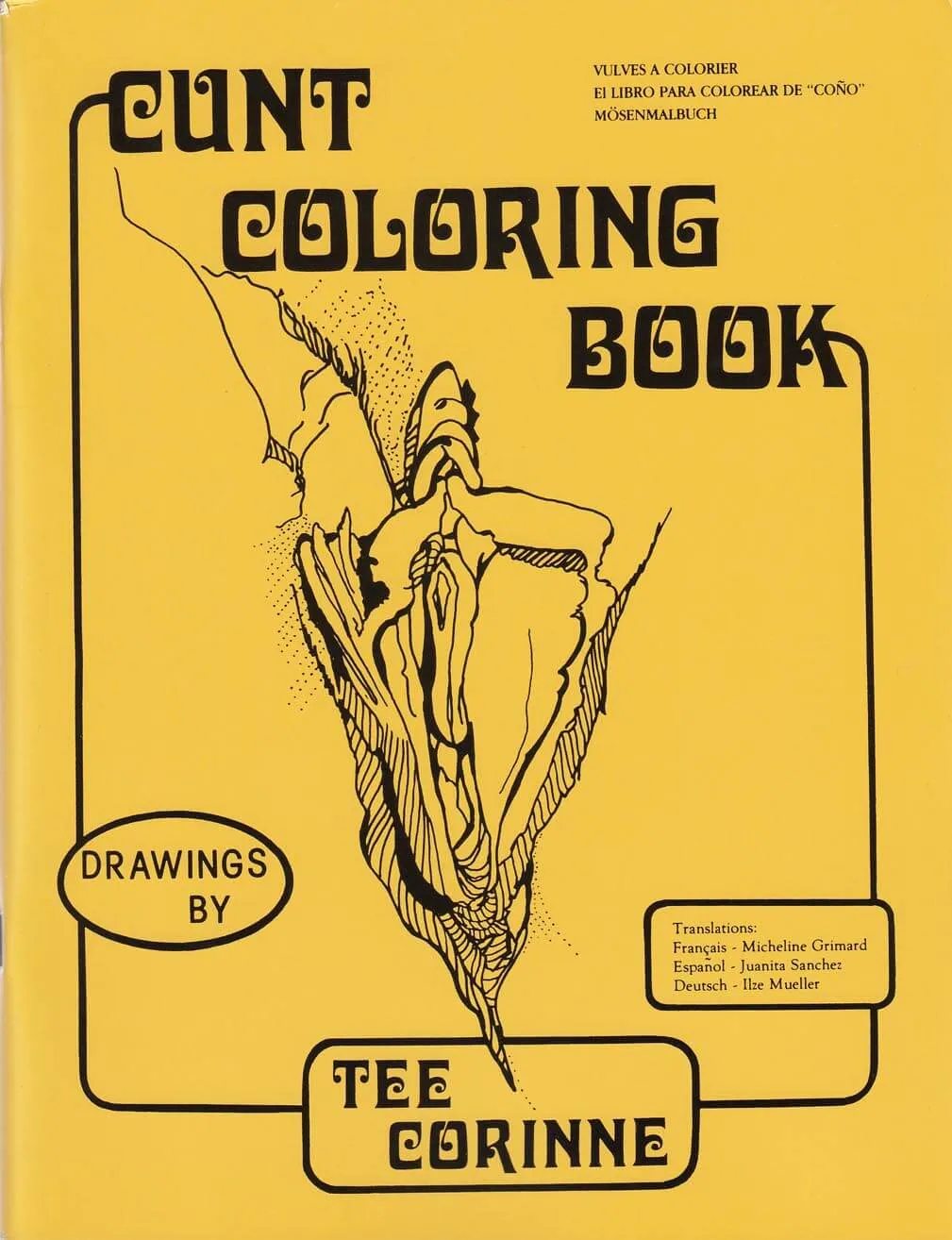
Cunt Coloring Book
Over three dozen c**ts of every size and description for you to color. Originally used for a sex-education class. Crayons not included. First published in 1975 by lesbian activist and artist Tee Corinne.
"In 1973 I set out to do drawings of women’s genitals for use in sex education groups. I wanted the drawings to be lovely and informative, to give pleasure and affirmation. I organized the drawings into a coloring book because a major way we learn to understand the world, as children, is by coloring. As adults many of us still need to learn about our external sexual anatomy." —Tee Corinne
Tee Corinne was born November 3rd, 1943 and grew up in St. Petersburg, Florida. Her mother, also an artist, introduced her to the creative principles and techniques that would serve her all her life. She received a B.A. in printmaking and painting from the University of South Florida, then went on to get an M.F.A. in drawing and sculpture at Pratt Institute, graduating in 1968. Afterwards she taught for many years, traveled through Europe, and finally became enmeshed in the back-to-the-land movement and communal living. After nearly ten years of marriage to a man she referred to as her "best friend," Corinne came out of the closet amidst severe depression in 1975. The strength to accomplish this difficult effort would later propel her to heights and achievements that would distinguish her as "one of the most visible and accessible lesbian artists in the world." From the mid-1960’s to the day she died Corinne created, published, and exhibited her art and writing around the world. She was a co-facilitator of the Feminist Photography Ovulars and a co-founder of The Blatant Image, A Magazine of Feminist Photography. She was the author of one novel, three collections of short stories, four books of poetry and numerous arts publications. In 1980, she was one of ten selected artists invited to have their work exhibited in the Great American Lesbian Art Show. The world lost Tee Corinne to cancer in 2006.

The Almond
“Today is the day with the letter,” Celan writes to Bachmann on October 30, 1957. Theadora Walsh’s essay-poem, The Almond concerns, for I hesitate to write “about” or “is in relation to”, the love between Paul Celan and Ingeborg Bachmann. Two Austrian writers flung across Europe by the atrocities of the Holocaust, excavating the narrows of a language not theirs, or taken from them. An almond is the closest two people can be, and becomes the binding structural conceit of the book, two segments reaching across the blank page to each other, across history, time and language.

Works from the Collection of Holly Van Houten
Werkplaats Typografie presents a catalog of Works from the Collection of Holly van Houten. Spanning multiple decades and personally selected from around the world, the collection includes over a thousand items that memorialize the life of this candidly private, bohemian connoisseur. Carefully examined by our specialists, a curated selection of rarities, antiquities, oddities, and works of art is available in this catalog, which accompanied an exclusive auction held during Printed Matter’s LA Art Book Fair in May 2025 in Los Angeles, Van Houten’s beloved city.
Project by: WT Year 25 & Year 26 for LA PMABF led by Hannes Drißner, Lisa Lagova, Nuno Beijinho
Designer: Hannes Drißner, Lisa Lagova, Nuno Beijinho. Objects photographed by Augustinas Milkus and Jordi de Vetten

The Hungering Years
Utterly magnetic, Summer Farah’s debut poetry collection The Hungering Years is a rush of breathless song, voicing confessions so often left unsung amidst personal and collective crisis. “I am afraid of asking the right questions,” Farah admits. But through intimate conversations with fellow Arab-American writer and literary ancestor Etel Adnan, this work finds the courage to ask: What is art? An escape? A reflection? Another unhealthy attachment? Though the answers are elusive, what steps into the light is a collective of friends whose genuine care and companionship anchor these poems through their spiraling search.
“I am always looking for Palestine, and yes, I am always looking for love,” these poems croon, holding so much of the world even as they trace an inheritance of displacement. The Hungering Years conjures startling landscapes where we may also experience what it is to be consumed by obsession, echoing with songs by Mitski, iconic scenes from Supernatural, and the sound of the Mediterranean Sea. But as Lena Khalaf Tuffaha writes in her introduction, Farah’s repetitions “are more than echo. They are a vernacular of this unspeakable era,” anchored in “questions that keep us reaching toward life,” and questions toward each other.
Building glass structures from her questions, Farah pushes their architecture almost to breaking. Then breaking, the spirit—luminous, actualized—reveals itself through the cracks. Through the landscapes of California, Palestine, and all of the distances in between, there emerges a new sense of devotion to what is possible which might thrust us, together, “off the edge, / in love, towards God.”
With an introduction by poet, essayist, and translator Lena Khalaf Tuffaha.
Summer Farah’s debut collection The Hungering Years bubbles with language, is desirous, sensitive, and hysterically (ferociously) human. “I” is I, is mother, is the guiding wisdom of Etel Adnan, is Palestine, is the work that writes Palestine into the future, is the epistolary thread of love that holds this daring young poet’s work together. “i am an enemy of dust i am an amalgamation of everyone i have ever loved …” writes Farah, enlisting us in this vital poetry against the death cult, lush with solidarity, teeming with the futurity we need. — Wendy Xu, author of The Past
What I most adore about Summer Farah's work, and what most comes alive in The Hungering Years is that there is no such thing as an unworthy affection, nothing unworthy of close and careful attention, nothing unworthy of being pressed up against the undeserving world and becoming something greater. This is a gift and a delight, and through that gift, these poems are richly and generously populated, and teeming with beauty. — Hanif Abdurraqib, author of There’s Always This Year
Summer Farah's words ease me, compel me, motivate me. Her work is agile and brilliant, her mind potent and illustrious—like air, a song, rhythmic and concise. These poems move me to my core, rupturing something deep inside of me about place, Palestine and Etel Adnan. "I memorize no language/but their voices," she writes as I memorize her words again and again, uttering gratitude that I get to be alive and read Summer's words. This book is both a spell and an oracle. — Fariha Róisín, author of Survival Takes a Wild Imagination

Broken Villas
Written in response to three “physical” photographs, ‘Broken Villas’ contains and considers how a vessel might clasp tightly to known volumetric identities, but also loom with a set of accentuated clues towards otherness: the excavated seams in the earth and what we fill those holes with, imaginary or otherwise; the glacial erraticism of the boulder; the queer crimping of a hotel pillowcase; the modes via which objects are housed as display, but also packaged away, with sorrow, with fear, with erotism etc.

Fidback, Revue de cinéma n° 01
Le numéro 1 de la revue de cinéma Fidback éditée par le FIDMarseille, avec un retour sur la 35e édition du festival, un regard rétrospectif sur des films qui ont fait l'actualité mondiale du cinéma en 2024, une carte blanche à Clara Schulmann, et un portrait de l'artiste et cinéaste Declan Clarke par Alice Leroy.
Retour sur six films issus de la sélection officielle du FID, par des auteurs, critiques et écrivains de langues française et étrangères. Les textes critiques sont accompagnés d'entretiens, de documents ou de matériaux inédits. De Amsevrid, premier film magistral du cinéaste algérien Tahar Kessi, jusqu'au Tríptico de Mondongo du maestro argentin Mariano Llinás, ce bouquet de films est un condensé de l'édition 2024 du festival – une poignée de films parmi tous ceux qui auraient mérité le retour.
Le choix des huit films sur lesquels nous avons invité des auteurs et autrices à poser leur regard est en soi un geste critique. Il nous a semblé que les derniers films d'Albert Serra, Miguel Gomes, Alain Guiraudie, Jia Zhangke et Victor Iriarte méritaient plus que d'autres l'inscription dans le temps long de la revue. Films restaurés, écrits édités, rétrospective et exposition au Jeu de Paume : Chantal Akerman fut pour beaucoup, cette année, une révélation. Naked Acts, le film ressuscité de Bridgett Davis, aura marqué ceux qui ont eu la chance de le voir.
Pour sa carte blanche, Clara Schulmann a choisi le film Lucciole (2021), de Pauline Curnier Jardin. Mais son texte porte au-delà de l'œuvre, il déplace le geste critique en un récit spéculatif sur la manière dont une vie et un travail se tissent sur une trame faite de lieux, d'histoires, de personnes.
Alice Leroy est la première à faire le portrait de l'artiste et cinéaste irlandais et berlinois Declan Clarke : à prendre la mesure, à tracer les perspectives d'une œuvre majeure, bien qu'encore méconnue, du cinéma d'aujourd'hui.
Fidback est une revue de cinéma éditée par le FIDMarseille. Chaque année, elle dessine une image-constellation du cinéma aimé et défendu par le festival.

Pages 11 - Stage So Near So Far
Nasrin Tabatabai, Babak Afrassiabi
The new issue consists of 8 plays and performance texts by Iranian women writers living in or outside Iran. Whether based on actual experience, fictional, or drawn from archives, these texts deal in one way or another with the question of the stage. They produce a contested space of performance that is inevitably linked to the performer's body, whose thresholds are stretched and contracted into potentially new forms of staging. The authors in this issue place their writing in performative relation to the specific historical and sociopolitical conditions in which they live and work. In many ways, the writings interrogate the politics that delineate the stage itself.
The authors in this special issue are: Nasim Ahmadpour, Nil (Alista) Aghaee, Naghmeh Manavi, Athena Farrokhzad, Nazanin Sanatkar, Azade Shahmiri, Zahra Mohseni and Naghmeh Samini.

Goblinhood: Goblin As A Mode
As formally inventive as readers have come to expect from one of the most daring writers around, and as wild and tricky as its subject matter requires, Goblinhood: Goblin as a Mode presents us with a series of essays and poems that playfully, artfully propound JEN CALLEJA'S theory of ‘goblin hood’—a theory that takes in all aspects of pop culture from film, literature and art as well as the author’s personal and original examinations of grief, lust, family histories and the physical fact of living in the world as it is.
Obsessed with green objects, strange pop culture films, and puppets, and haunted by her family memories, Jen Calleja explores in Goblinhood her relationship with her body and self-loathing, desire, sex, food, and grief. She mischievously develops a hybrid thought process that combines essay, autofiction, poetry, and goblin theory.
Goblinhood is a perpetually and variously curious, visceral addition to Calleja’s remarkable oeuvre.

Standpoint Autotheory – Writing Embodied Experiences and Relational Artistic Practices
Ana de Almeida, Mariel Rodríguez
In this anthology of essays, twelve artists explore radically self-reflexive research attitudes integrating embodied experiences within the production of theory.
Standpoint Autotheory encompasses a multitude of manifestations of radically self-reflexive research attitudes. It traces research based artistic practices through twelve contributions that propose a performative integration of the personal within the production of theory and explore the entanglements of subjectivity with criticality aimed at social transformation by questioning dominant epistemologies.
The positions assembled in the book are permeated by different modes of thinking and practice such as autoethnography, practices of the self, auto-historia teoría, standpoint theories, strong objectivity and situated knowledge, self-authority, narrativity and storytelling, radical positioning, performative philosophy, autofiction, thinking-feeling, and other methods that, through the interrogation of embodied experiences, illuminate the connections between the personal and the political, as well as the individual and the communal.
Edited by Ana de Almeida and Mariel Rodríguez.
Contributions by Ana de Almeida, andrea ancira, Cana Bilir-Meier, Nina Hoechtl, Olena Khoroshylova, Sanja Lasić, Mai Ling, Stephanie Misa, Lena Ditte Nissen, Mariel Rodríguez, Ruth Sonderegger, Elif Süsler-Rohringer, Verena Melgarejo Weinandt.

Carmelina: Figures
Ronaldo V. Wilson’s Carmelina: Figures excavates the territory between memory, nation, and embodiment, exploring place as a discipline of the body and an extension of the hand. Through poems, photographs, drawings, records of performance, and home movies recorded in Guam, Tennessee, and the Subic Bay between 1962 and 1979, Wilson reckons with familial heritage, diaspora, and legacies of militarism.
The book pays homage to Wilson’s mother, Carmelina, who served for most of her working life as a certified nursing assistant at Florin Convalescent, an assisted living facility in South Sacramento, California. A glut of signals and media recovers Carmelina’s vivid and urgent experience of exile from the Philippines to marry Wilson’s father—a Black American soldier—being disowned, and before that, of her parents’ assassinations during the Japanese Occupation. Through a visual logic of repetition and reenactment that works to unmoor sensory expectation and narrative logic, Wilson renders her figure as trace, melody against paper, drawing within song, mixed media, dance, and through improvised, masked, and recorded performances in the Berkshires, MA; Long Island, NY; Emeryville, CA; and Boulder, CO. Carmelina: Figures is a book of the Psoas, ice, smudge, and light.

For Chris Mann (Open Space Magazine #22)
Dorota Czerner, Elaine Radoff Barkin
Special issue of this US magazine dedicated in its entirety to the late Australian artist/compositional linguist/raconteur Chris Mann, who died in 2018. The magazine contains tributes from Mann associates and admirers, including Warren Burt, Amanda Stewart, Pi-0, Ronald Robboy, Linda Kouvaras, Alvin Lucier, Ruark Lewis, Annea Lockwood, as well as Mann’s own writing and an interview with him by Philip Blackburn.
88 pages bound in soft-cover glossy colour cover by Brigid Burke.

RUSTIQUE
“RUSTIQUE” is an artist book created by Nicola Godman. This book is sprung out of a residency in September 2021 at Hôtel Chevillon, a former Scandinavian artist colony in Grez-sur-Loing, France. Barbizon, the village where the painter Jean-François Millet (1814–1875) lived and died, is located 20 km away from there. The book interweaves the life and work of Millet with Godman’s photographs, drawings and personal anecdotes.
“RUSTIQUE” wishes to put forward the artistic gaze towards rural life by artists who themselves are born peasants. Nicola Godman (b. 1989, Rute) is an artist working with photography, video, books and stories, currently based in Stockholm, Sweden. Having grown up on an organic dairy farm, she is researching depictions of rural life in art history and contemporary culture.

Bourgeois Coldness
Bourgeois coldness refers to an affective strategy that offers an explanation for how self-preservation works. Bourgeois coldness is one of the most advanced affective and aesthetic forms of preserving the structure of the colonial status quo. It creates an affective shelter in the world, unencroached upon by the immediate consequences of its many catastrophes. It functions like air conditioning – a complex technology which reliably stabilises the climate until those inside consider it natural. Bourgeois spaces – institutional and affective – stay cool and pleasant. But outside it’s burning.
Canonical critical theory by Adorno and Horkheimer enters a dialogue with Black studies through Hartman and Moten.
Foregrounding affect, this timely book provides an inestimable philosophical argument for the centrality of Blackness in critical examinations of capitalism’s violence. —Denise Ferreira da Silva
Elegant and erudite in equal measure, this book will stand as a landmark diagnosis of the practices of denial in our time. —Andreas Malm

Red Seed: Poems for Luno
Cruz Alejandra Lucas Juárez, Wendy Call and 1 more
Through a voice at once intimate and collective, Lucas Juárez expands the powerful presence of Tutunakú roots to open up territories and to interweave desirous bodies, dream relationships, and the memories of women ancestors. This beautiful translation by Wendy Call and Whitney DeVos, in a precious handmade edition, affirms the trilingual (Tutunakú, Spanish and English) as an ethical strategy of listening to and translating the world. Red Seed collects twelve poems of women's sexualities and spirits in which body, language and territory are political spaces that Indigenous memory expands within and renews.
—Maricela Guerrero, author of The Dream of Every Cell

The Alphabet Book
In 1971, Michael Morris and Vincent Tarsov—founders of the Vancouver-based artist network Image Bank—invited Eric Metcalfe, Gary Lee Nova, Glenn Lewis and Paul Oberst to create their own, unique alphabet. NowForty years later, with the permission of the participating artists and the help of Image Bank, these historic silk-screened alphabets have finally been published together. The Alphabet Book is designed by Marc Hollenstein, who was inspired to reinitiate the alphabet publication project after having a conversation with Glenn Lewis during the opening of Lewis’ retrospective exhibition at Kunstverein back in 2014.

Prepositions
Prepositions enacts a distinction between what language says and what it does. A catalogue of exercises, interviews, essays and creative explorations, this workbook-compendium invites the reader to investigate how we practise empathy, understanding, and contact, by learning and teaching all at once. Building on the archive of Montez Press Radio show Tongue and Cheek, and featuring work from a stellar cast of previous participants in the broader project, Prepositions asks us what active and embodied participation really means, not just in teaching, but across a whole life.
This book will change your body—and your mind. Prepositions is a set of bite-sized propositions for being and thinking otherwise. Put it under your tongue and see what happens.
— Leah Pires
This compendium of witty exercises, moving personal reflections, curious propositions, and carefully selected graphics invites readers to explore what it means to inhabit a book. It is the product of many hands, a polyphonic choir, filled with immense care and a deep sense of friendship. As one feels its weight, moves around it, folds its pages, breaths with it, or reads it out aloud, one begins to wonder: what does the book need to be completed?
Prepositions—inscribed in the tradition of works as disparate as Robert Filliou’s Teaching and Learning as Performing Arts and CAConrad’s poetry rituals—is an exercise of radical pedagogy and readership. Everyone who enters this book becomes part of its contents.
— Alice Centamore