
Was that a Pat or a Slap?
€5.00


An essay in the form of painting studies - including persons, dogs, a frog, a hoofed animal, fish, hare, trees and plants.

Strange Biology, Charlotte Strange’s first chapbook, opens with a social media advertisement marketing a probiotic as an alternative to the “nuclear bomb” of antibacterial acne medication. As Strange investigates the treatment of the human body as a landscape submissive to medical intervention, they ruminate on the contemporary relationship between microbes, gut-directed medical technologies, and capitalism’s encroachment on life. Drawing on the vernacular of social media marketing, they deftly oscillate between instructive and personal registers, stretching the private across a nexus of microbial interminglings. Strange Biology reflects on the semiotic science of the gut: how the language of medicine defines the mutating edges of the human body.
Jasbir K. Puar, Nasser Abourahme and 1 more
The publication of The Right to Maim by Jasbir K. Puar in 2017 was critical to advancing studies on disability and to further articulating how the body figures in the nexus of capacity and debility across racializing and extractive neoliberal lines. It offered a complex and rigorous anti-capitalist account of disability that is useful to both scholarly work and political and social organizing. However, despite its paramount contribution to scholarship on Palestine, delivered by its scathing analysis of the Israeli biopolitical policy—its right to maim—in how the injured Palestinian body is produced and reproduced, its reception was difficult, and hard to stomach. It cohered a political logic in writing before it was visibly evident on the ground. In the moment and aftermath of the Great March of Return (2018-19), Puar’s offerings became much harder to ignore, as the event crystallized a mass maiming campaign of Palestinian protesters inside the edges of the militarized borders of Gaza.
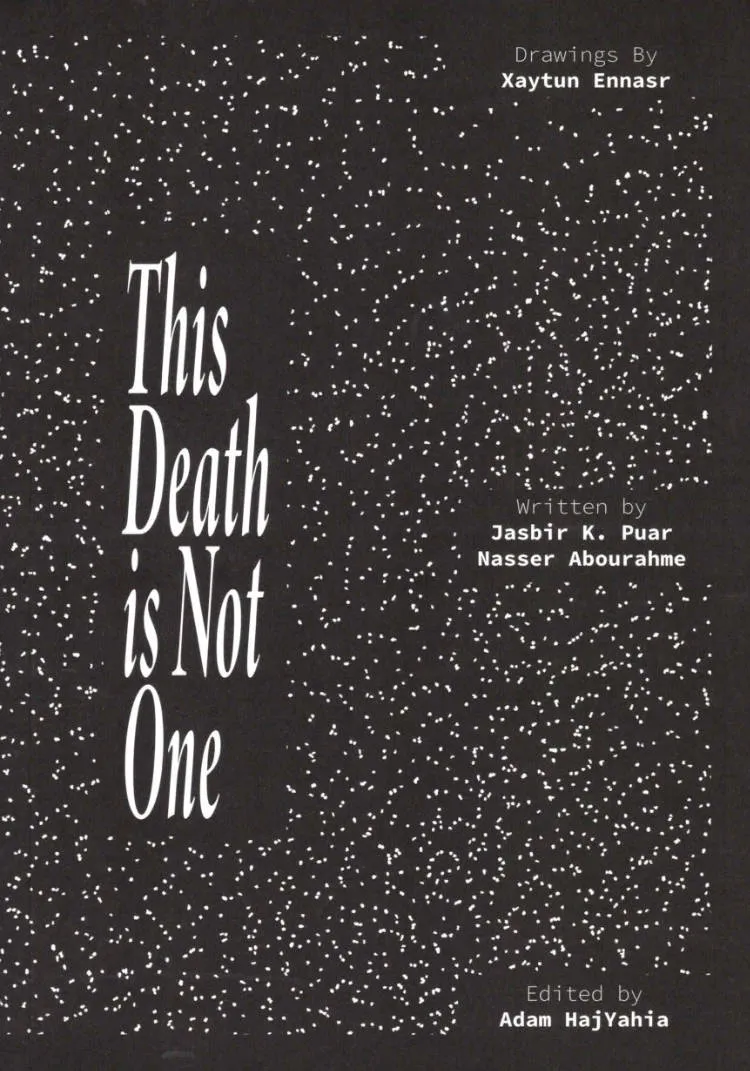
The occasion of this publication by Bilna’es marks the first translation into Arabic of the chapter “Will Not Let Die”: Debilitation and Inhuman Biopolitics in Palestine, alongside the postscript of The Right to Maim. Not simply a reissue of previously published work or a translation, This Death is Not One includes a new preface from Jasbir K. Puar revisiting the right to maim from within this moment of genocide in Gaza that interrogates the new vectors of living and dying under settler-colonialism, and how maiming, in fact, speaks of extermination; an introduction by Nasser Abourahme reflecting on the book’s stakes in the present and its reception in the past, alongside searing analysis of genocide in excess of the law, and what this reveals and forecloses in how we understand the juridical body and militancy in the wake of Zionism; and original drawings by Xaytun Ennasr that inscribe a relation between land and body mapped through cosmological patterns tracing the relation between martyrs, who are referred to as moons, and the moon, a symbol for martyrdom in Palestine.
Jasbir K. Puar is Distinguished Faculty of Arts Professor in the Social Justice Institute at the University of British Columbia, Extraordinary Professor in the Women’s and Gender Studies Department at the University of the Western Cape in Cape Town, South Africa, and Professor Emerita at Rutgers University where she was faculty in the Women’s, Gender, and Sexuality Studies Department for 23 years. Puar is the author of the award-winning books: The Right to Maim: Debility, Capacity, Disability (2017), and Terrorist Assemblages: Homonationalism in Queer Times (2007).
Nasser Abourahme is a writer and teacher, and is currently assistant professor at Bowdoin College. He’s the author of The Time beneath the Concrete: Palestine between Camp and Colony (Duke University Press, 2025), which was awarded the 2025 Palestine Book Award.
Xaytun Ennasr is an artist and designer. She works across experimental video games, paintings, prints, ceramics, installations, and text. She often uses science fiction, folklore, and radical softness as affective tools for revolutionary cultural production, specifically Palestinian liberation and sovereignty. Her work often deals with questions of land, cartography, transness, gender, and the living environment.
Drawings by Xaytun Ennasr
Translation to Arabic:
“Living in Genocide” by Jasbir K. Puar, translated by The Archilogue
“Our names, our remains” by Nasser Abourahme, translated by The Archilogue
The Right to Maim, Chapter 4: “Will not let die: Debilitation and Inhuman Biopolitics in Palestine ” and the The Right to Maim Postscript by Jasbir K. Puar, translated by Bekriah Mawasi

Written in the course of the year following the publication of Book of Mutter, and inspired by the lectures of Roland Barthes, Anne Carson, and Jorge Luis Borges, Appendix Project collects eleven talks and essays. These surprising and moving performances, underscored by the sleeplessness of the first year of their child’s life, contain their dazzling thinking through the work of On Kawara, Roland Barthes, W.G. Sebald, Bhanu Kapil, Walter Benjamin, Theresa Hak Kyung Cha, Marguerite Duras, Marlene Dumas, Louise Bourgeois, Doris Salcedo, Jenny Holzer, and more.

susan abulhawa, Huzama Hubayeb
In early 2024, writer and activist susan abulhawa managed to enter Gaza twice through the Rafah crossing. There, at the Culture and Free Thought Association, susan held a series of workshops for young people who had been displaced to tent encampments. The lives of all participants were marked by unrelenting Israeli violence and extraordinary loss—of home, family, safety, education, electricity, and all the structures of life. They’d fled from place to place as Israel’s colonial violence swirled around them, complete with food and water insecurity and constant threat. Still, despite the bitterness of life in tents and the dangers of travel, they came together to share in the refuge of writing and community.
Samya recounts a tender moment with an old man mending shoes in the street, while her cousin Saja hides books in her closet, hoping they and her home will still be there when she returns. Ghassan is haunted by the baby he rescued from the rubble, who for a time became his son. Fatima risks it all retrieve her clothes from a danger zone buzzing with drones and warplanes. Maram’s loving aunt is gone, and chaos inhabits Amr’s mind. Samah, Lubna, Rizq, and Nebal take us by the hand through raining death, trails of tears, classroom shelters, and shared clothes in crowded tents.
Every Moment Is a Life delivers rare, unfiltered portraits of life under genocide, platforming the emerging voices struggling to survive in Gaza today. These essays are raw and real, capturing human moments—buying bread, going to the bathroom, sharing a meal, drinking coffee—all set against the backdrop of history’s first livestreamed ethnic cleansing. With courage, anger, love, agony, and—impossibly—hope, these achingly tender voices from Gaza will stay with us, captured in these pages, forever.
In these essays, Ben Burgis criticizes fashionable radical-liberal identity politics and makes the case for universalism about rights and an unabashedly “class-first” approach to socialist political strategy. This may sound to some ears like a call for abandoning marginalized people. On the contrary, he argues, focusing on economic inequality empowers the victims of bigotry and retrograde social practices the resources and material security to stand up for themselves far more effectively than any diversity trainer or “anti-racism” consultant could represent their interests. As we face a rising tide of reactionary authoritarianism, it’s more important than ever to ditch the identitarian pieties of the recent past and think hard about how the Left can actually win.