rile*books

Search books

Search books by title, author, publisher, keywords...

Cover of UNIVERSAL PRODUCT CODE

Tabloid Publications

UNIVERSAL PRODUCT CODE

Kelly Clare

€12.00

"Like the Elizabeth Bishop painting “Interior with Extension Cord,” Kelly Clare’s helical, light-filled Universal Product Code delicately traces a bewildering infrastructure. This incantatory song, “busy in green,” points its reader to the disturbing beauty in stripey checksum barcodes, to arrays of imported figs at the grocer, to words like cloud or lime that now mean too much. Humorous, musical, perspicacious, this chapbook rocks."

- Katherine Gibbel, April 2026

Includes 3 poems by Dre Roelandt.
Published as part of Paraphernalia and Addenda 2.2 of Tabloid Publications.

Published in 2026 ┊ 20 pages ┊ Language: English

recommendations

Cover of GOAT FOIL

Tabloid Publications

GOAT FOIL

Maxwell Gontarek

Poetry €14.00

"Marie’s fragrance, smashed out of the bottle for another breath. We should always doubt that the air is pure. We should always doubt that the air is not." 
–Alexandre Curlet

Includes an excerpt from Josh Barber's "Omnipotence".
Published as part of Paraphernalia and Addenda 2.2 of Tabloid Publications.
Cover of PARANOID CITI

Tabloid Publications

PARANOID CITI

Shannon Hearn

Zines €12.00

"Desperate and playful. This iterative poetic series cries through the panic of now to bestill an ecstatic people. Paranoid Citi finds no doubt that if understanding is a matter of form, survival necessitates transformation." - Crystal Odelle, author of Trans Studies

"Who doesn't like to post ethereal lightly? Who isn't a citizenry draped in lilac ethics? Are you a froth? In Shannon Hearn's PARANOID CITI, an interrogative story is shaping up. She's uploading music for grace in crisis. She's writing poems for you, citizen, and kindly so." - Nick Sturm

Includes a bag tag and drawing by Elise Houcek.
Published as part of Paraphernalia and Addenda 2.2 of Tabloid Publications.

Cover of The Flesh

Tabloid Publications

The Flesh

Yves B. Golden

Poetry €18.00

The Flesh is a collection of Yves B. Golden's poems, lyric essays and social criticism – and often these generic distinctions become blurred. Published by Ediciones La Escocesa (Barcelona, ES), TABLOID facilitated this book's production as editors and book designers. A selection of Golden's texts are also translated by Leto Ybarra, rendering the author's work into Spanish for the first time.

“Respectfully! The Flesh feels like a conjuring and a force of nature—unyieldingly raw, full of delectable sensitivity that shapes a world Yves B. Golden deliveries with formidable honesty—where her word is the journey, the body and the bond. Yves writes: ‘not one bird is declined entry into heaven’. The Flesh is succulent in the mouth of the mother— Yves is a steward of time machines, celestial bliss and untethered healing. The Flesh unties the tongue, waters the mouth and the garden. Within Yves’ 5th book she offers us a timeline in recognizing that all birds and angels alike can touch the sky. We are always, already, held and drenched in glory and deserving of love and safety. The Flesh is Black like obsidian. May our love bloom like the flesh in every lifetime.”
- keioui keijaun thomas

“Yves B Golden has given us a protection spell against tyranny; a Blue Guide for the conscious and the daydream; raw free jazz that knows the standards as well. Golden’s linguistically liberated fantasies can transmute into a body of politically imperturbable ethoses in the same sentence. This book offers information for an evolutionary sensitivity, for the next level of sense-making and particularity of the human being. Though the poet urges us to de-realize the flesh, to split our own heads open, we must also accommodate the flesh’s intangibles that interlock, conjoin, negate, and negotiate: such ‘outward and inward facing conundrums’ go on and on. Welcome this ‘bearer of turbulent news.’”
- Losarc Raal

Cover of Juvenilia #2

Tabloid Publications

Juvenilia #2

Willa Smart

Poetry €12.00

Ludi Juvenales (Latin for "juvenile games') is a poetry, art and games series interested in youth, childhood, play, and immaturity. 

Ludi Juvenales is edited by Elise Houcek & Zoe Darsee

www.ludijuvenales.com

Juvenilia #2 by Willa Smart.
Copyright C Willa Smart 2024. All rights reserved.
Cover art by K. Fabricant.
Design by Elise Houcek & Zoe Darsee.
Risograph printed with BearBear in Milwaukee, Wisconsin.
Edition of 50.

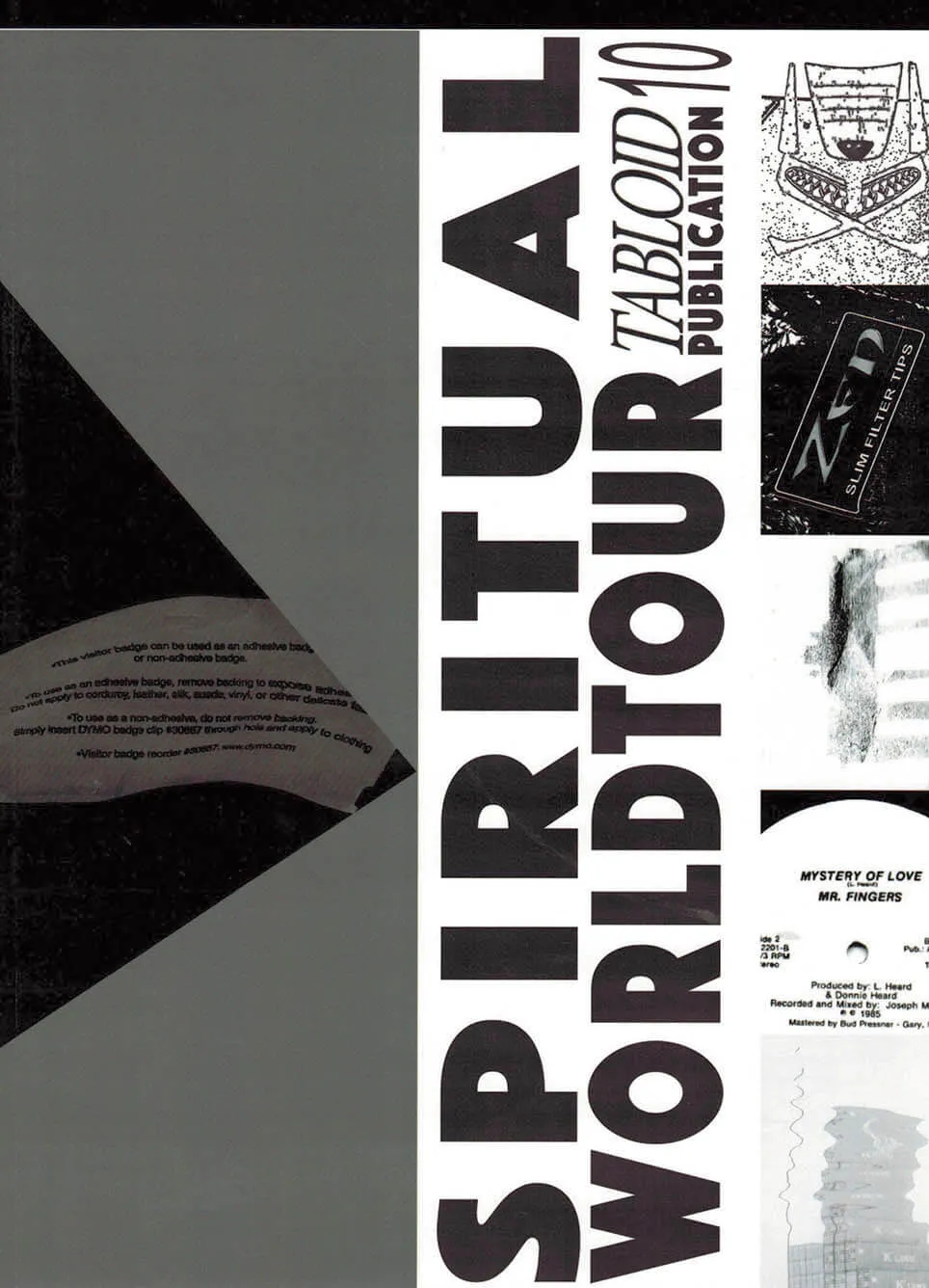
Cover of Spiritual World Tour

Tabloid Publications

Spiritual World Tour

Nat Marcus

Spiritual World Tour by Nat Marcus.
Cover of DUB

Duke University Press

DUB

Alexis Pauline Gumbs

Poetry €25.00

Dub: Finding Ceremony takes inspiration from theorist Sylvia Wynter, dub poetry, and ocean life to offer a catalog of possible methods for remembering, healing, listening, and living otherwise.

"In DUB Alexis Pauline Gumbs continues with the third book in her poetry series, the first two books being Spill, inspired by Hortense Spillers, and M Archive, inspired by Jacqui Alexander. Whereas Spill deals with the contemporary afterlives of slavery and M Archive describes the post-dated evidence of our imminent apocalypse, DUB destroys Gumbs' own origin story, as she questions the assumptions and histories she has held onto most of her life. This text, through engagement with Sylvia Wynter's rigor, reinvents language outside of personal histories.

DUB is organized into topical sections, where spacious prose poems animate the voice of an underwater chorus in ceremonies that flow into one another. Beginning a daily writing practice, Gumbs wrote DUB based on moments of emphasis in Sylvia Wynter's essays (and one interview over several decades).

This book is influenced by the promiscuity and prolificity of dub music, the confrontational home-grown intimacy of dub poetry, and the descendants of this work. Dub uses the impact of repetition and the incantatory power of the spoken broken word. Gumbs uses dub to emphasize that Sylvia Wynter learned every colonial language and came to the conclusion that the ways of thinking that made colonialism and slavery imaginable were constructed over time and heretical to the ways of thinking that came before them; and so it must be possible to construct ways to understand life and place differently now as well.

Gumbs goes back to the origin stories that precede her and turns the blood into paint, emphasizing that "then" is also "now" through the broken and intense voices of ancestors. Inspired by Wynter's heretical poetic action against our deepest beliefs, DUB is an artifact and tool for breath retraining and interspecies ancestral listening.

Throughout the text, listening includes speakers who have never been considered human: whales and algae. Gumbs is attentive to kindred beyond taxonomy, questioning kinship loyalty, and suggests that our perceived survival needs are responses to a story we made up and told ourselves was written by our genes, a story that can be changed. This book will be of interest to scholars of African-American studies, diaspora studies, feminism, queer theory, English, creative writing and poetry"

Cover of Don't Call Us Dead

Graywolf Press

Don't Call Us Dead

Danez Smith

Poetry €16.00

Award-winning poet Danez Smith is a groundbreaking force, celebrated for deft lyrics, urgent subjects, and performative power. Don’t Call Us Dead opens with a heartrending sequence that imagines an afterlife for black men shot by police, a place where suspicion, violence, and grief are forgotten and replaced with the safety, love, and longevity they deserved here on earth. Smith turns then to desire, mortality—the dangers experienced in skin, body, and blood—and a diagnosis of HIV positive. “some of us are killed / in pieces,” Smith writes, “some of us all at once.” Don’t Call Us Dead is an astonishing collection, one that confronts America where every day is too often a funeral and not often enough a miracle. 

Danez Smith is the author of [insert] boy, winner of the Lambda Literary Award for Gay Poetry and the Kate Tufts Discovery Award. Smith has received fellowships from the McKnight Foundation and the Poetry Foundation, and lives in Minneapolis.

Cover of Algeria: Capital Algiers

CUNY Center for the Humanities

Algeria: Capital Algiers

Anna Gréki, Marine Cornuet

Poetry €22.00

Algeria, Capital: Algiers by Anna Gréki is co-published by Pinsapo Press and CUNY Lost & Found, translated by Marine Cornuet, and introduced by Ammiel Alcalay.

Anna Gréki (1931-1966) was an Algerian poet of French descent. A member of the Algerian Communist Party, she was arrested and imprisoned for her participation in the Algerian liberation struggle in Algiers, in 1957. Algérie, capitale Alger, a collection of poems written during Gréki's imprisonment, was published in 1963 in a French and Arabic bilingual edition. Algeria, Capital: Algiers makes this work available to English readers for the first time.

"Anna Gréki was a particularly inconvenient pied noir—not loyal enough for the French colonists and too compromised for the Algerian nationalists—and so she was shunted to the margins of Algerian literary history. Nevertheless, it’s time she takes her place at the center of that narrative, and these accomplished translations constitute a necessary English-language introduction to this secret garden of Maghrebi poetry. Gréki’s poetry is electrified by the heady heights of the war of liberation, but arguably it finds its truest expression in her paeans to the wild hills and impregnable peaks of the Aurès mountains, where she was born and where she found a sense of peace which otherwise eluded her in her brief life." —André Naffis-Sahely

“Nothing happens here but everything burns.” From the prison where she was tortured by French authorities in 1950s Algeria, Anna Greki stays in touch, feverishly, with “this world of vulnerable flesh.” Addressed to her friends and comrades in struggle, to the land and the leaves and the birds, these poems defy “the war, this male ax,” invoking the future with “a trust so total / I can almost touch it.” Marine Cornuet’s translation deftly conveys Greki’s intimate language of the senses, to “transcribe with words what is done without them.” —Omar Berrada

"How fitting that a bilingual edition of Anna Gréki’s poems should be published now: a French poet born in Algeria, anti-colonialist (imprisoned for that) as Algeria battled for independence, writing in French, like Kateb Yacine, to show her freedom from French hegemony, but also her freedom as a woman writer to forge a transcendent and engaged poetics." —Marilyn Hacker