rile*books

Search books

Search books by title, author, publisher, keywords...

Cover of The Tarot of Leonora Carrington

Fulgur Press

The Tarot of Leonora Carrington

Leonora Carrington

€55.00

An oracular Surrealism: the debut presentation of Leonora Carrington's recently discovered tarot deck.

The British-born artist Leonora Carrington is one of the more fascinating figures to emerge from the Surrealist movement. As both a writer and painter, she was championed early by André Breton and joined the exiled Surrealists in New York, before settling in Mexico in 1943. The magical themes of Carrington's otherworldly paintings are well known, but the recent discovery of a suite of tarot designs she created for the Major Arcana was a revelation for scholars and fans of Carrington alike.

Drawing inspiration from the Tarot of Marseille and the popular Waite-Smith deck, Carrington brings her own approach and style to this timeless subject, creating a series of iconic images. Executed on thick board, brightly colored and squarish in format, Carrington's Major Arcana shines with gold and silver leaf, exploring tarot themes through what Gabriel Weisz Carrington describes as a "surrealist object." This tantalizing discovery, made by the curator Tere Arcq and scholar Susan Aberth, has placed greater emphasis upon the role of the tarot in Carrington's creative life and has led to fresh research in this area.

The Tarot of Leonora Carrington is the first book dedicated to this important aspect of the artist's work. It includes a full-size facsimile of her newly discovered Major Arcana; an introduction from her son, Gabriel Weisz Carrington; and a richly illustrated essay from Tere Arcq and Susan Aberth that offers new insights—exploring the significance of tarot imagery within Carrington's wider work, her many inspirations and mysterious occult sources.

Leonora Carrington (1917-2011) was born in Lancashire, England. In 1936, she saw Max Ernst's work at the International Surrealist Exhibition in London, and met the artist the following year. They became a couple almost immediately. When the outbreak of World War II separated them, Carrington fled to Spain, then Lisbon, where she married Renato Leduc, a Mexican diplomat, and escaped to Mexico, where she became close with Remedios Varo and other expat Surrealists.

Language: English

recommendations

Cover of The Hearing Trumpet

New York Review of Books

The Hearing Trumpet

Leonora Carrington

Fiction €17.00

An old woman enters into a fantastical world of dreams and nightmares in this surrealist classic admired by Björk and Luis Buñuel.

Leonora Carrington, painter, playwright, and novelist, was a surrealist trickster par excellence, and The Hearing Trumpet is the witty, celebratory key to her anarchic and allusive body of work. The novel begins in the bourgeois comfort of a residential corner of a Mexican city and ends with a man-made apocalypse that promises to usher in the earth's rebirth. In between we are swept off to a most curious old-age home run by a self-improvement cult and drawn several centuries back in time with a cross-dressing Abbess who is on a quest to restore the Holy Grail to its rightful owner, the Goddess Venus. Guiding us is one of the most unexpected heroines in twentieth-century literature, a nonagenarian vegetarian named Marian Leatherby, who, as Olga Tokarczuk writes in her afterword, is "hard of hearing" but "full of life."

Cover of The Debutante and other stories

Silver Press

The Debutante and other stories

Leonora Carrington

Fiction €15.00

A debutante frees a hyena from the zoo so that it might take her place at her coming-out ball; an artist paints a portrait of a man’s dead wife, but finds she has painted herself instead; a woman makes love to a boar underneath a mountain of cats; a chicken is roasted with the brains and livers of thrushes, truffles, crushed sweet almonds, rose conserve and drops of divine liqueur; two noble sisters wonder whether anybody can be ‘a person of quality if they wash away their ghosts with common sense’; a psychoanalyst must decide what to do with the gift of a team of Russian rats trained to operate on humans. In this first complete edition of Leonora Carrington’s short stories, written throughout her life from her early years in Surrealist Paris to her late period in Dirty War-era Mexico City, the world is by turns subversive, funny, sly, wise and disarming.

Cover of The Stone Door

New York Review of Books

The Stone Door

Leonora Carrington

Fiction €16.00

The Stone Door is a surrealist allegory intertwining myth, mysticism, and romance. Written by Leonora Carrington after World War II, the novel follows a woman's symbolic journey through esoteric teachings, ancient lands, and dreamlike visions in pursuit of spiritual awakening and the unification of male and female forces. Both a metaphysical adventure and a tribute to Carrington's personal love story, it offers a visionary exploration of transformation and liberation.

Cover of Miam 08 : Artefact

Miam Editions

Miam 08 : Artefact

Various

"Cet ouvrage est un magazine participatif regroupant les oeuvres de 48 artistes autour d'un thème commun, l'artefact. Vertige du passé ou projection contemporaine, l'artefact nous parle. Il raconte les cultures, en façonne le souvenir et promet ainsi un voyage à travers les créations humaines. Ce sont ces témoignages tangibles de l'existence que nous souhaitons vous offrir grâce aux interprétations captivantes de l'artefact. Chaque page de ce nouveau numéro est une invitation à plonger dans les méandres de l'histoire ou de la fiction, à explorer les différentes strates de l'humanité à travers le primes de ses réalisations matérielles."

Alexandre Daram, Alice Royer, Audrey Poujoula, Audrey Ramos, Basile, Bordel j’ai glissé, Cel, Charlie Udave, Collectif IPN, Elliott Sanchez, Emilia Pesty, Marie Derrien, Fils Kurylak, Flora Rushiti, Hélène Berlemon, Inès Day, Julie Plantefeve, Kaspar kaspar.wtf, Kawani DS, Kiara Patry, Laura Zanti, Lauriane Rolo, Le Bayou Club Graphique, Lea Canovas, Lili Archer, Lily Terrible, Lisa Dehove, Lola Marty, Louis Kervel, Lutine Cabarrou, Maeva Iorio, Maké, Martin Régnier, Maxoy, Meuneurol, Nathanael Brelin, Nurzen & Jack Montaly, Oscar, Pierre Touron, Ptit Lylou, Rachel Roland, Rose Meybeck, Sarah Josserand, Theo Grandchamp. 

Cover of The Premise of a Better Life

After 8 Books

The Premise of a Better Life

Sam Pulitzer

An artist's book by New York-based author and artist Sam Pulitzer (born 1984), The Premise of a Better Life combines photographs with ethical and existential questions addressed to the viewer, in an allegory of the contemporary condition. These photographs of everyday things, ambiguous details, nondescript landscapes and cityscapes were mostly taken in New York, although the city appears as the pale reflection of a model city.

Each picture is accompanied by a question: "Can you afford yourself?" "Are you waiting for a moment that just won't come?" "If you knew then what you know now, would it make a difference?" "Do you trust happiness?" The montages offer a complex, personal, at times satirical image of the present age.

An original essay by Pulitzer unfolds the project's philosophical and political issues, notably discussing a key reference for the project, Ernst Bloch's The Principle of Hope.

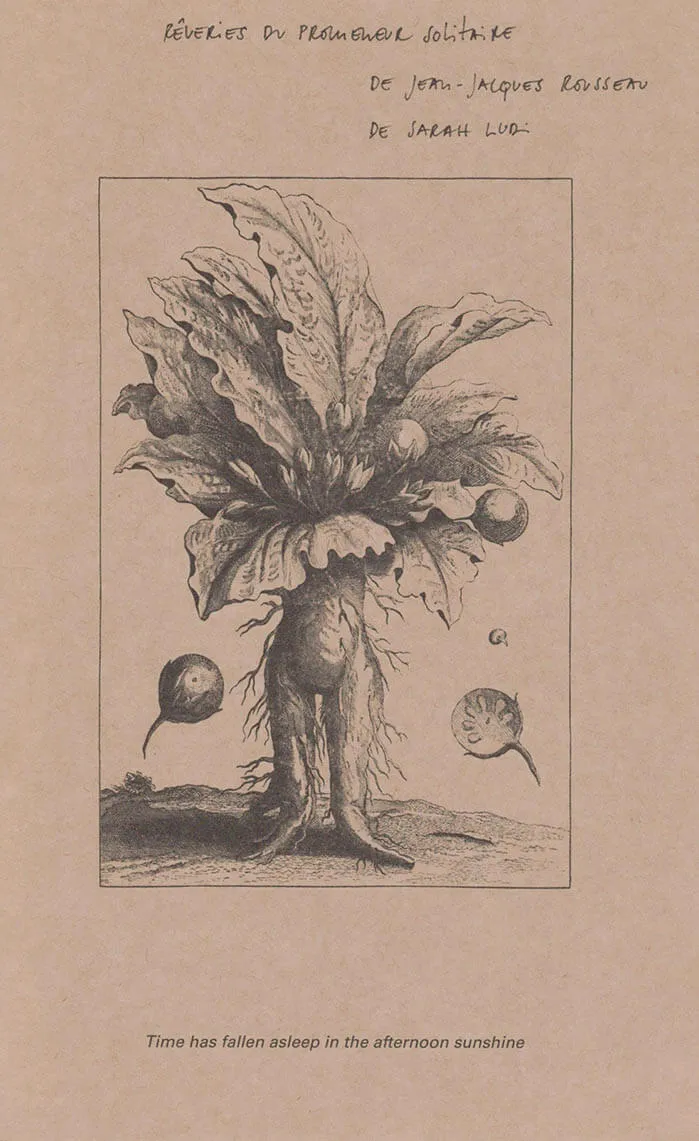
Cover of Rêveries du promeneur solitaire

Time has fallen asleep in the afternoon sunshine

Rêveries du promeneur solitaire

Sarah Ludi

For the project Time has fallen asleep in the afternoon sunshine a group of people/ performers memorize a book of their choice. Together they form a library collection consisting of living books. After years of learning by heart and reciting for readers, some of the books have now been written down from memory to create new editions, versions resulting from this process. This book is one of those books, chosen by one person, learned by heart and recited many times, and now written down again from memory. This edition is not a re-edition of the original text. It is a re-writing of the text after the process of reading, memorizing and reciting, with all the alterations that might have occured in the course of this process.

Cover of Pia Arke

KW Institute for Contemporary Art

Pia Arke

Pia Arke, Ros Carter and 1 more

Pia Arke (1958–2007) was a Greenlandic Inuk and Danish artist, writer and photographer. She is known for her self-portraits and landscape photographs of Kalaallit Nunaat (Greenland), as well as for her paintings, collages, performative film works and writing. Arke strove to make visible the silence that surrounded the colonial history and complex political and cultural relationship between Greenland and Denmark.

This publication accompanies the first international exhibitions of Arke’s work outside of Greenland and the Nordic countries, happening over the course of 2024 at John Hansard Gallery in Southampton (UK) and at KW Institute for Contemporary Art in Berlin (DE). It reflects on Arke’s ideas and legacy in a wider international context and aims to demonstrate how the work she made and the ideas she expressed connect with current discourse and contemporary thinking.

Texts by Krist Gruijthuijsen, Woodrow Kernohan, Ros Carter, Alice Maude-Roxby, Mette Sandbye, Tiara Roxanne, Sofie Krogh Christensen, Nivi Christensen, Siri Paulsen, Trinh T. Minh-ha

Cover of A Faggot is a Unit

Have a Nice Day Press

A Faggot is a Unit

Padraig Robinson

This publication brings together two original screenplays for yet-realized video works by Robinson along with a collection of research material presented as a retrograde calendar. The screenplays, / Imagine Prompt: Catfish Monogamy and The Jealousy of Sagittarius A*, both deal with contemporary life and creative labor as they intersect with digital culture and current anxieties regarding AI. In addition, the screenplays are followed by A Faggot is a Unit (Homage to Hanne Darboven), a collection of archival photographs, scanned objects and ephemera, as well as stock imagery and graphics from the internet collected by Robinson over the course of seven years (2015–2021). The imagery further splits the disorienting narratives presented in the two screenplays to offer a kaleidoscopic and unpredictable way of reading stories while functioning simultaneously as visual companion and counterpoint to the scripts.

Writing and editing is central to Robinson’s published and film work, inquiring into queer histories and the contemporary economy of the image, not as novelty subjects in themselves, but as forms of knowledge integral to questioning histories of perceived liberation. We are committed to representing diverse voices and perspectives that challenge and build upon our vision of bringing material from the fast-paced digital experience to the book form.

Padraig Robinson is a Berlin-based artist, filmmaker and writer.