rile*books

Search books

Search books by title, author, publisher, keywords...

Cover of The Nancy Reagan Collection

Futurepoem

The Nancy Reagan Collection

Maxe Crandall

€18.00

THE NANCY REAGAN COLLECTION is a response to growing up queer and trans under the rise of HIV-AIDS. Crossing genres and generations, this performance novel remixes the AIDS archive through an ever-spiraling politics and aesthetics of mourning. Alternating chapters offer up a narrative throughline composed of hallucinogenic episodes from the perspective of a nameless, grieving protagonist in the midst of the global carnage of the Reagan dynasty. Part revenge, part fantasy, the book experiments with poetic practices that challenge conceptions of memory and morality, activism and escapism, grief and beauty.

Maxe Crandall is a poet, playwright, and director. He is the author of the chapbooks Emoji for Cher Heart (Belladonna*, 2015) and Together Men Make Paradigms (Portable Press @ Yo-Yo Labs, 2014), and is the founder of the theater company Beautiful Moments in Popular Culture, which produces a poets theater series at the Stud in San Francisco. He has received fellowships from the Poetry Project, Poets House, Lambda Literary, and the Millay Colony for the Arts. Maxe is a lecturer in the Feminist, Gender, and Sexuality Studies Program at Stanford University.

Language: English

recommendations

Cover of Not a Force of Nature

Futurepoem

Not a Force of Nature

Amy De'Ath

Poetry €21.00

If capital makes life a seething, complex nightmare for most people on the planet's surface, if "words do cleave the producer from the land," then what does all this dispossession feel like? Amy De'Ath turns poetry into a hot, potent, and highly funny form of criticism, in which social force is felt intimately, and voiced in the acid niceness of a work email. Amy's poems move like pieces of machinery in a cognitive amusement park, which spit you a thousand feet into the air but keep your viewpoint fixed on the same spot as before—what's different? "Land in Saskatchewan, land in Delhi," or "everything…that you want from women and gays." Not a Force of Nature makes me want to change everything. "Behold me I'm you now," Amy writes—we should be so lucky, to be thus transformed. — Kay Gabriel

Not a Force of Nature's expertly crafted poems explore the catastrophe we live among and speak through. They form a sort of feminist manifesto addressed to all forms of resistance. But also: here are love sonnets! This book is angrily precise and always a lot of fun. "No, you're a Canadianist!" — Kevin Davies

Not a Force of Nature is the kind of book that becomes possible only after rejecting the "we" evoked so often in contemporary literary culture—sometimes said to need poetry now more than ever, sometimes called community. Amy De'Ath's motley vision of solidarity, of "actual emboldened people," is way weirder, more lively, and possible. Nor do these poems content themselves, like the ghost of Marxist theory past, with pointing towards the contradictions that surround them. Do you remember email? Sonnets? Not a Force of Nature is like that, thrashing inside generic forms and always coming next: after the tendency of the rate of profit to fall, after Jane's abortion service, after the 1970s, 80s, and 90s, after Creeley, after Raworth, after Mayer, after the Xenofeminist Manifesto, after Pluto enters Aquarius. "There are still tactics like this roaming free," De'Ath writes. There are still these fervent lyric parries. Be with Not a Force of Nature now. — Stephanie Young

Through slips of verbal acuity, Amy De'Ath scrapes her way out of determinism to a world "made by hands," where our material relations are ours to make and break. History is long and history is short. History is translucent. De'Ath presents the Ferris wheel of capitalist production, where the subject lives once as worker, twice as commodity. Here, in these "concrete trousers," is a "totally liberated" working class poem turning everything into nothing as praxis. — Anahita Jamali Rad

Cover of The Autobiography of a Language

Futurepoem

The Autobiography of a Language

Mirene Arsanios

Poetry €22.00

Here the mirror image of the almost hallucinatory, heart-rending loss of the familiar is literary defamiliarization. Arsanios both mourns and blasts apart the notion of the mother tongue, reminding us that for each “mother tongue” at least another tongue is silenced. Desire propels her genre-defying writing, which grief notwithstanding still manages to tongue languages, and that is her genius. — Mónica de la Torre

Mirene Arsanios is the author of the short story collection The City Outside the Sentence (Ashkal Alwan). She has contributed essays and short stories to e-flux journal, Vida, The Brooklyn Rail, The Rumpus, and Guernica, among others. Arsanios co-founded the collective 98weeks Research Project in Beirut and is the founding editor of Makhzin, a bilingual English/Arabic magazine for innovative writing. She teaches at Pratt Institute and holds an MFA in Writing from the Milton Avery Graduate School for the Arts at Bard College. Arsanios currently lives in New York where she was a 2016 LMCC Workspace fellow, and an ART OMI resident in fall 2017. With Rachel Valinsky, she coordinated the Friday night reading series at the Poetry Project from 2017–19.

Cover of Tripwire 16

Tripwire Journal

Tripwire 16

David Buuck, Kevin Killian

Poetry €18.00

A special issue focused on performance writing, with work by Tanya Lukin Linklater (with Michael Nardone), Jibade-Khalil Huffman & Simone White, Jean-Thomas Tremblay, Claudina Domingo (trans. Ryan Greene), Kim Rosenfield, Nathan Walker, Liz Knox, Rona Lorimer, Léo Richard, & Hector Uniacke, Mohamed A. Gawad & Dalia Neis, Mei-mei Berssenbrugge & Teddy Yoshikami, interviewed by Michelle N. Huang, Kyoo Lee and Jocelyn Saidenberg, Adriana Garriga-López, Gabrielle Civil, plus a Kevin Killian Tribute, with Eileen Myles * Scott Hewicker * Cliff Hengst * Karla Milosevich * Craig Goodman * Michelle Rollman * Anne McGuire * Wayne Smith * Tanya Hollis * Steve Orth * Lindsey Boldt * Maxe Crandall * Arnold J. Kemp * Carla Harryman, Lee Ann Brown & Tony Torn * Susan Gevirtz * Laynie Browne * Patrick Durgin * Norma Cole * Jo Giardini. & reviews: Jessica Lopez Lyman & Jocelyn E. Marshall on Gabrielle Civil, alex cruse on Merce Cunningham, Rob Stanton on Anne Boyer, Jack Chelgren on Miyó Vestrini, David Grundy on Stephen Jonas, Virginia Konchan on Sarah Vap.

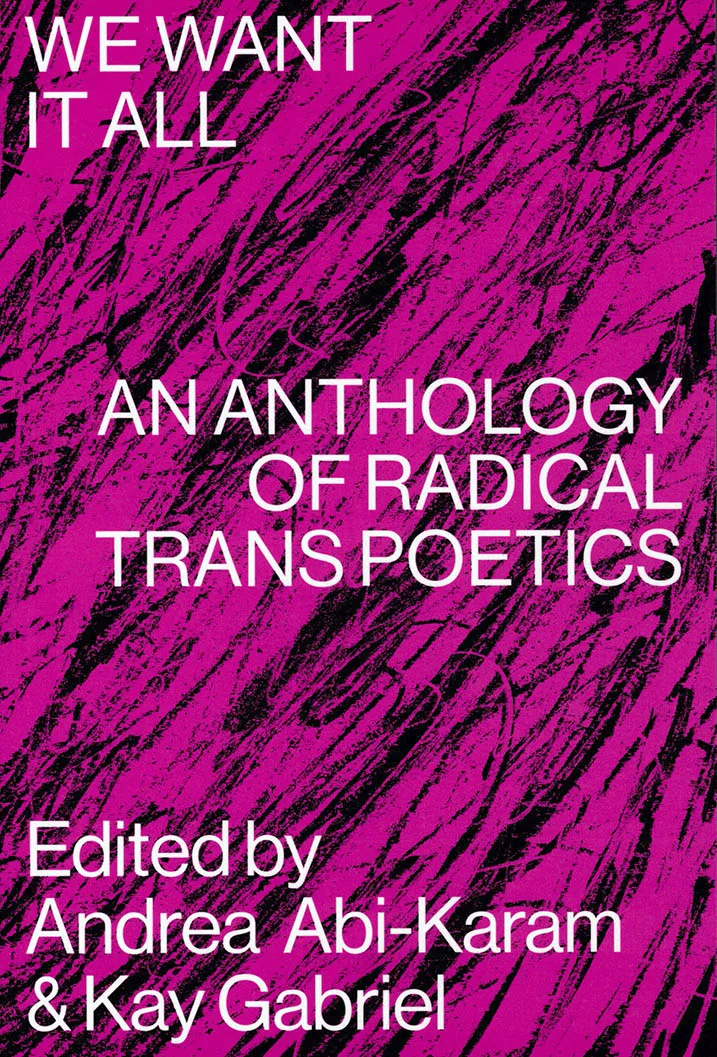
Cover of We Want It All: An Anthology of Radical Transpoetics

Nightboat Books

We Want It All: An Anthology of Radical Transpoetics

Kay Gabriel, Andrea Abi-Karam

Poetry €23.00

An anthology of formally inventive writing by trans poets against capital and empire.

With texts by: Andrea Abi-Karam, New York City Sam Ace, South Hadley, MA Bahaar Ahsan, Berkeley, CA jasper avery, Philadelphia, PA Ari Banias, Berkeley, CA Jo Barchi, Chicago, IL Joss Barton, St. Louis, MO Levi Bentley, Philadelphia, PA Jessica Bet, Baltimore, MA Rocket Caleshu, Los Angeles, CA Ching-in Chen, Seattle, WA listen chen, Vancouver, BC Faye Chevalier, Philadelphia, PA Cody-Rose Clevidence, Arkansas Miles Collins-Sibley, Easthampton, MA Valentine Conaty, New York City CA Conrad, Philadelphia, PA Jimmy Cooper, Rochester, MI Maxe Crandall, Oakland, CA José Díaz, Boston, MA Aaron El Sabrout, New Mexico Ian Khara Ellasante, Lewiston, ME Caelan Ernest, New York City, NY NM Esc, San Diego, CA joshua jennifer espinoza, Los Angeles, CA Logan February, Ibadan, Nigeria Ray Filar, Brighton, UK Nora Collen Fulton, Montreal, Canada Kay Gabriel, New York City Callie Gardner, Cardiff, Wales Jesi Gaston, Chicago, IL Harry Josephine Giles, Edinburgh, Scotland Aeon Ginsberg, Baltimore, MD Caspar Heinemann, Berlin, Germany Kamden Hilliard, Greenville, SC Stephen Ira, New York City Cyrée Jarelle Johnson, New York City Peach Kander, New York City Jayson Keery, Western, MA Evan Kleekamp, Los Angeles, CA Noah LeBien, New York City Ty Little, Richmond, VA Zavé Martohardjono, New York City Amy Marvin, Philadelphia, PA Natalie Mesnard, New York City Bianca Rae Messinger, Iowa City, IA Liam O'Brien, New York City Xandria Phillips, Madison, WI Rowan Powell, Santa Cruz, CA Nat Raha, Edinburgh, Scotland Holly Raymond, Philadelphia, PA Jackie S, New York City Trish Salah, Toronto, Canada Raquel Salas Rivera, Philadelphia, PA Mai Schwartz, New York City Kashif Sharma-Patel, London, UK Julian Talamantez Brolaski, Oakland, CA Charles Theonia, New York City Jamie Townsend, Oakland, CA Nora Treatbaby Laurel Uziell, London, UK Rachel Franklin Wood, Boulder, CO Clara Zornado Akasha-Mitra xtian w. and Anaïs Duplan, NYC.

Kay Gabriel is a poet and essayist. She's the author of Elegy Department Spring / Candy Sonnets 1 (BOAAT Press, 2017), the recipient of fellowships from Lambda Literary and the Poetry Project, and recently completed her PhD at Princeton University.

Andrea Abi-Karam is an arab-american genderqueer punk poet-performer cyborg, writing on the art of killing bros, the intricacies of cyborg bodies, trauma & delayed healing. Their chapbook, THE AFTERMATH (Commune Editions), attempts to queer Fanon's vision of how poetry fails to inspire revolution. Andrea's first book, EXTRATRANSMISSION (Kelsey Street Press, 2019), is a poetic critique of the U.S. military's role in the War on Terror.

Cover of Drafts

TEXTS press

Drafts

Allison Parrish

A weaving draft is a kind of notation for planning and sharing woven textil structures. The threading, along the top, shows how the warp is threaded through the heddles and frames; the treadling, along the right-hand side, show the order in which the treadles of the loom are to be pressed; and the tie-up, in the upper right-hand corner, shows how each treadle interacts with the loom’ frames. The drawdown, in the lower left, shows whether the warp or weft will be on top at any particular intersection of threads—thereby providing a “preview” of the completed textile. Often a draft diagram will indicate the intended color of the warp and weft threads, and the drawdown will show the completed textile’s color patterns. In “Drafts,” Allison uses letters instead of colors, melding digital weaving with writing.

WITHOUT THE E is a series of pamphlets responding to a presence or an absence felt in contemporary digital culture.

Cover of The Spiritual Hunt

Inpatient Press

The Spiritual Hunt

Arthur Rimbaud, Emine Ersoy

Poetry €20.00

A long lost poem purportedly by Rimbaud is finally made available in English.

Referenced only in a few letters of Paul Verlaine, The Spiritual Hunt is Arthur Rimbaud's forgotten masterwork, a poem in five parts that explored the mystic philosophy that guided the young poet's heart and hand. Considered lost for years, a typewritten manuscript appeared in Paris in the late 1920s, circulating around a close-knit group of booksellers, poets, and playwrights. Yet it wasn't until 1949 that Mercure de France took the initiative to publish the unauthenticated galley and unleashed a literary controversy that shook France. Sides were drawn, with Andre Breton leading the charge of forgery, calling the work an utter hoax, and others defending it as legitimate and an essential key to understanding Rimbaud and his work. Bookstores were raided for copies, critics were skewered in journals, and tempers flared on radio and in print, but no conclusive judgement could be drawn and Mercure de France withdrew the work from publication and pulped all the copies they could find.

Now, seventy-five years after its initial imbroglio, The Spiritual Hunt is available in English for the first time with a facsimile letterpress edition of the original. Featuring Pascal Pia's original introduction along with an edifying afterword by translator Emine Ersoy.

Cover of Citizens of Beauty: Poems of Jean Sénac

Michigan State University Press

Citizens of Beauty: Poems of Jean Sénac

Jean Sénac

Poetry €27.00

This stunning collection of poems by the Algerian poet Jean Sénac (1926–1973) was originally published when he was forty-one. Sénac represented the hope of the new generation of Algerians who were celebrating their independence from France after 130 years of colonialism, and in the tradition of René Char and the early Albert Camus, he portrayed an Algeria whose land and people would finally sing with their own voice. 

Sénac celebrates revolution, love, and the body, beginning with the resonant verses: “And now we’ll sing love / for there’s no Revolution without love.” He sang, as well, of beauty: “No morning without smiling. / Beauty on our lips is one continuous fruit.”

Translated by Jack Hirschman

Cover of Gay Pompeii 79 A.D.

GenderFail

Gay Pompeii 79 A.D.

Legacy Russell

Poetry €20.00

With her debut chapbook, award-winning author and curator Legacy Russell returns to poetry with her GAY POMPEII, a collection of lyric poems that begin at the end of the world.

Rising out of Russell's 2022-2023 Digital Fellowship for Pompeii Commitment. Archaeological Matters, the first long-term, contemporary art programme established by the Archaeological Park of Pompeii, the author and curator explores ash, filth, dirt, and decay, intersectional with the fetishistic mythos of Pompeii and its destruction in 79 CE by the eruption of Mount Vesuvius. Pompeii today is a UNESCO World Heritage Site that receives over two million visitors per year to view its archeological excavation. Russell puts the mass voyeurism, sensation, extraction, and loss of Pompeii—a devastating moment frozen in time—to work. In GAY POMPEII, the site becomes a device with which Russell unspools birth, death, genocide, visual culture, and space-time. The title of this compilation underscores the essence and demand of capitalism: to be carefree in the face of looming extinction. Russell's GAY POMPEII is a selfie taken at the edge of catastrophe and a polyphonic elegy.

Legacy Russell (born 1986 in New York City) is a curator and writer. She is the Executive Director & Chief Curator of the experimental arts institution The Kitchen. Formerly she was the Associate Curator of Exhibitions at The Studio Museum in Harlem. Russell holds an MRes with Distinction in Art History from Goldsmiths, University of London with a focus in Visual Culture. Her academic, curatorial, and creative work focuses on gender, performance, digital selfdom, internet idolatry, and new media ritual. Russell's written work, interviews, and essays have been published internationally.