rile*books

Search books

Search books by title, author, publisher, keywords...

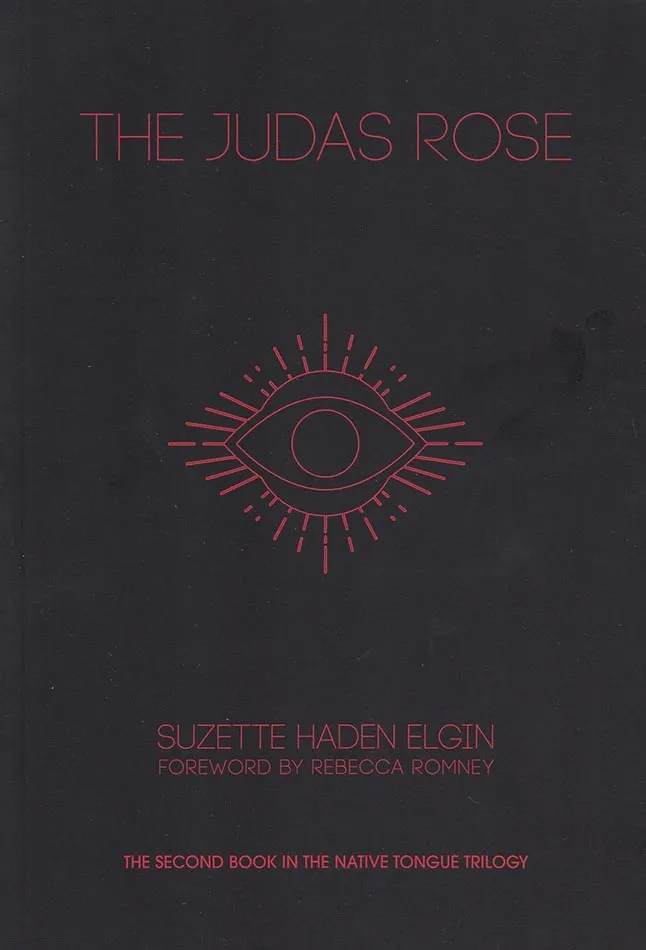
Cover of The Judas Rose

Feminist Press

The Judas Rose

Suzette Haden Elgin

€18.00

In the second volume of the Native Tongue trilogy, the time has come for Láadan—the secret language created to resist an oppressive patriarchy—to empower womankind worldwide. To expand the language’s reach, female linguists translate the Bible into Láadan, and a group of Roman Catholic nuns are tasked to spread the language. But when outraged priests detect their sabotage, they send a double agent to infiltrate and destroy the movement from the inside.

With a foreword by Rebecca Romney

Suzette Haden Elgin (born Patricia Anne Wilkins; 1936–2015) was an American science fiction author. She founded the Science Fiction Poetry Association, and was considered an important figure in the field of science fiction constructed languages. Elgin was also a linguist; she published non-fiction, of which the best-known is the Gentle Art of Verbal Self-Defense series.

Published in 2019 ┊ 425 pages ┊ Language: English

recommendations

Cover of Little F

Feminist Press

Little F

Michelle Tea

A new epic novel about a teenage queer runaway from cult classic author of Black Wave and Valencia Michelle Tea. A Literary Hub Notable Small Press Book of 2025.

In Spencer's fantasies, the breezy, queer streets of Provincetown, MA, are utopia, a place where he can be free. Yet when a violent attack in his suburban Arizona schoolyard sends him to the hospital, he decides queer utopia can't wait. And one night, with the help of his best friend, the teenage witch Joy, he hitches a ride to find it.

The cross-country road odyssey that follows brings Spencer from new moon rituals in Arizona canyons to Texas bus stations, from the luxe drag stages of Houston's Montrose district to the jazz-soaked streets of the French Quarter and beyond. This new novel from Michelle Tea tells the story, by turns raw, romantic, and sweet, of a sheltered boy taking his first leap into queer life, among all the complicated queers who live it.

"Tea's conversational tone and her way of writing deeply personal experience . . . presents a very necessary counter-narrative to mainstream histories of American punk, feminism, and sexual identity." – The Brooklyn Rail

Michelle Tea is the author of over twenty books of fiction, memoir, poetry and children's literature. Her autofiction Valencia, a cult classic, won the Lambda Literary Award for Best Fiction. Her essay collection Against Memoir was awarded the PEN/Diamonstein-Spielvogel Award for The Art of the Essay. Tea is also the recipient of awards from the Rona Jaffe Foundation and the Guggenheim Foundation. The founder of Drag Queen Story Hour, she has received honors from the American Library Association and Logo Television. Tea curated the Sister Spit Books series at City Lights Publishers and founded the ongoing imprint Amethyst Edition at the Feminist Press.
Cover of Johnny Would You Love Me If My Dick Were Bigger

Feminist Press

Johnny Would You Love Me If My Dick Were Bigger

Brontez Purnell

LGBTQI+ €18.00

A dirty cult-classic put out in a small batch by an underground publisher (Rudos and Rubes) in 2015, Johnny Would You Love Me If My Dick Were Bigger recounts the life of an artist and "old school homosexual" who bears a big resemblance to author Brontez Purnell.

Our hero doesn't trust the new breed of fags taking over San Francisco, though. They wear bicycle helmets, seat belts, and condoms. Meanwhile, he sabotages his relationships, hallucinating affection while cruising in late night parks, bath-houses, and other nooks and crannies of a newly-conservative, ruined city.

Furiously original, vital, and messy, this funny "non-memoir" uncovers a revelatory truth for the age: there are things far scarier than HIV.

Cover of Native Tongue

Feminist Press

Native Tongue

Suzette Haden Elgin

Originally published in 1984, this classic dystopian trilogy is a testament to the power of language and women's collective action. 

In 2205, the Nineteenth Amendment has long been repealed and women are only valued for their utility. The Earth's economy depends on an insular group of linguists who "breed" women to be perfect interstellar translators until they are sent to the Barren House to await death. But instead, these women are slowly creating a language of their own to make resistance possible. Ignorant to this brewing revolution, Nazareth, a brilliant linguist, and Michaela, a servant, both seek emancipation in their own ways. But their personal rebellions risk exposing the secret language, and threaten the possibility of freedom for all.

Cover of Cockfight

Feminist Press

Cockfight

María Fernanda Ampuero

Fiction €16.00

Thirteen stories explore domestic horrors and everyday violence, providing an intimate and unflinching portrait of twenty-first-century Latin America.

Named one of the ten best fiction books of 2018 by the New York Times en Español, Cockfight is the debut work by Ecuadorian writer and journalist María Fernanda Ampuero.

In lucid and compelling prose, Ampuero sheds light on the hidden aspects of the home: the grotesque realities of family, coming of age, religion, and class struggle. A family’s maids witness a horrible cycle of abuse, a girl is auctioned off by a gang of criminals, and two sisters find themselves at the mercy of their spiteful brother. With violence masquerading as love, characters spend their lives trapped reenacting their past traumas.

Cover of Boys Alive

New York Review of Books

Boys Alive

Pier Paolo Pasolini

Fiction €17.00

A daring novel, once widely censored, about the scrappy, harrowing, and inventive lives of Rome's unhoused youth by one of Italy's greatest film directors.

Boys Alive, published in 1955, was Pier Paolo Pasolini's first work of fiction and it remains his best known. Written in the aftermath of Pasolini's move from the provinces to Rome, the novel captures the. hunger and anger, waywardness and squalor of the big city. The life of the novel is the life of the city streets; from the streets, too, come its raw, mongrel, assaultive language. Here unblinkered realism and passionate lyricism meet in a vision of a vast urban inferno, blazing with darkness and light.

There is no one story to the book, only stories, splitting off, breaking away, going nowhere, flaming out, stories in which scenes of comic debacle, bitter conflict, wild joy, and crushing disappointment quickly follow. Pasolini's young characters have nothing to trade on except youth, and the struggle to live is unending. They loot, hustle, scavenge, steal. Somehow money will turn up; as soon as it does it will get spent. The main thing, in any case, is to have fun, and so the boys boast and vie, the desperate uncertainty of their days and nights offset by the fabulous inventiveness of their words. A warehouse heist, a night of gambling, the hunt for sex: The world of Boys Alive is a world in convulsion where at any instant disaster may strike.

Tim Parks' new translation of Pasolini's early masterpiece brings out the salt and brilliance of a still-scandalous work of art.

Cover of The TV Sutras

Ugly Duckling Presse

The TV Sutras

Dodie Bellamy

Fiction €24.00

Inspired by visionaries like Moses, William Blake, and Joseph Smith, Bellamy spent five months in 2009 receiving transmissions from her television set and writing brief commentaries on each. The sutras and commentaries in the present volume are the beginning of an intensive investigation into the nature of religious experience. What are cults? Are they limited to wacko marginal communities, or do we enter one every time we go to work or step into a polling place? What is charisma and why are we addicted to it? Bellamy speaks candidly and intimately to her own experience as a woman, a writer, and former cult member. This commingling of memoir, fiction, collage and essay makes room for horny gurus, visitors from outer space, the tenderness of group life, and maybe the beginnings of a hard-won individualism.

Cover of Trans Girl Suicide Museum

Hesse Press

Trans Girl Suicide Museum

Hannah Baer

Fiction €16.00

One part ketamine spiral, one part confessional travelogue from the edge of gender, TGSM is a hallucinatory transmission on sex, identity, the internet, and the flickering wish not to exist in a given body at a given point in time. TGSM raises questions with which we have begun to negotiate broadly as a culture: what is actually happening to someone when they transition? how should we understand or describe such processes? what is the role of drugs, of hallucination, of imagination, in transition? is being a trans person in this moment in history, when the identity is ever more carefully traced [and tracked] by larger cultural forces, more liberated than before? 

Drawing its source material from chance encounters, wordless interactions in basements or bathrooms or hotel rooms, to archives of 20th century critical theory, sleepover secrets exchanged between old friends, rhetorical barbs deployed in the classrooms of elite universities, arguments on the phone with your parents across timezones, the nonverbal codes of high and low fashion, and scribbled notes on the backs of receipts for medicines you don't know how they work, TGSM is a morbid yet strangely hopeful meditation on the possibilities and meanings of gender variation in our time.

Hannah Baer runs the meme account @malefragility on instagram, and studies clinical psychology in new york city.

Cover of The Years

Seven Stories Press

The Years

Annie Ernaux

Fiction €20.00

The Years is a personal narrative of the period 1941 to 2006 told through the lens of memory, impressions past and present—even projections into the future—photos, books, songs, radio, television and decades of advertising, headlines, contrasted with intimate conflicts and writing notes from 6 decades of diaries.

Local dialect, words of the times, slogans, brands and names for the ever-proliferating objects, are given voice here. The voice we recognize as the author’s continually dissolves and re-emerges. Ernaux makes the passage of time palpable. Time itself, inexorable, narrates its own course, consigning all other narrators to anonymity. A new kind of autobiography emerges, at once subjective and impersonal, private and collective.

On its 2008 publication in France, The Years came as a surprise. Though Ernaux had for years been hailed as a beloved, bestselling and award-winning author, The Years was in many ways a departure: both an intimate memoir “written” by entire generations, and a story of generations telling a very personal story. Like the generation before hers, the narrator eschews the “I” for the “we” (or “they”, or “one”) as if collective life were inextricably intertwined with a private life that in her parents’ generation ceased to exist. She writes of her parents’ generation (and could be writing of her own book): “From a common fund of hunger and fear, everything was told in the “we” and impersonal pronouns.”