rile*books

Search books

Search books by title, author, publisher, keywords...

Cover of The Author as Producer of Nothing

Rab-Rab Press

The Author as Producer of Nothing

Peter Gidal

€14.00

The first publication of a lost 1978 text by Peter Gidal—one of the most influential experimental filmmakers ever.

The book includes the first publication of Peter Gidal's text from 1978, with a new introduction. Gidal in this dense theoretical essay deals with the limits of language and representation in the practice of experimental filmmaking and writing. Gidal's lost text The Author as Producer of Nothing will give a new insight into the theoretical and political context to experimental film practices.
The afterword by Sezgin Boynik discusses in detail the political contradictions of Gidal's filmic non-objectivity.

"The process of the film's making deals with devices that result in demystification or attempted demystification of the film process. But by 'deals with' I do not mean 'represents'. In other words, such films do not document various film procedures, which would place them in the same category as films which transparently document a narrative, a set of actions, etc. Documentation, through usage of the film medium as transparent, invisible, is exactly the same when the object being documented is some 'real event', some 'film procedure', some 'story', etc. An avant-garde film defined by its development towards increased materialism and materialist function does not represent, or document, anything. The film produces certain relations between segments, between what the camera is aimed at and the way that 'image' is presented. The dialectic of the film is established in that space of tension between materialist flatness, grain, light, movement, and the supposed reality that is represented. Consequently a continual attempt to destroy the illusion is necessary."—Peter Gidal

Peter Gidal (born 1946 in New York) is an influential British film theorist and avant-garde filmmaker, associated with the English "Structural/Materialist" movement (along with Malcolm Le Grice notably). He has published in numerous magazines (Studio International, Screen, October, Undercut) and is the author of several books, including Andy Warhol: Films and Paintings (1971), Materialist Film (1988) and Understanding Beckett: A Study of Monologue and Gesture in the Works of Samuel Beckett (1986).
Published in 2021 ┊ 96 pages ┊ Language: English

recommendations

Cover of Iliazda at the Birthday Party – Autobiographical Lecture, 1922

Rab-Rab Press

Iliazda at the Birthday Party – Autobiographical Lecture, 1922

Iliazda

The English translation of Zdanevich's Dadaist autobiographical lecture in Paris in 1922, where he adopts the name Iliazda. In this entertaining lecture, the achievements of the avant-garde is presented as a combination of zaum, polymorphous sexuality, aleatory forms and scatological interpretation of culture.

The second volume of the bie bao series presents a eulogy entitled Iliazda at the Birthday Party, a pseudo-autobiographical lecture delivered by Ilya Zdanevich in Paris in 1922. It reports on Zdanevich's artistic and political adventures up until then. Along with an autobiography full of self-admiration, in this lecture Zdanevich gives an interpretation of his zaum dramas inspired by Freudianism, and humorously describes a colourful image of the Russian microcosm in Montparnasse. 

Additionally, this second volume also includes Iliazd's letter to Ardengo Soffici from 1964, where one can read, in the most unambiguous terms, about Zdanevich's positions against war, imperialism, and all forms of nationalism. Subtitled 50 Years of Russian Futurism, the letter to Soffici presents us with an altogether new Zdanevich—a "fellow traveller" in both leftist and avant-garde circles. As well as the extended introduction and extensive annotations, the texts are further contextualised with Johanna Drucker's visual presentation of the birth of the Iliazd cult.

The bie bao series will include eight publications, covering many layers of Zdanevich's rich theoretical and artistic output. Each volume consists of a bio-bibliographical introduction, a commentary, a translation with annotations, and artistic intervention.

Iliazd (Ilya Zdanevich, 1894-1975) was a Russian poet, designer, typographer, theoretician, art critic, and publisher, close to the avant-garde circles and one of the promoters of Futurism in Russia, author of a poetic work, drama written in zaum abstract poetic trans-sense or "transrational" language, and novels.

Cover of Wanting Something Completely Different – 111 Vignettes of Left-Wing Figures, Themes, Films, and Writers

Rab-Rab Press

Wanting Something Completely Different – 111 Vignettes of Left-Wing Figures, Themes, Films, and Writers

Jairus Banaji

Non-fiction €20.00

A collection (montage) of biographies and themes written by Jairus Banaji.
Wanting Something Completely Different discusses a range of political figures, themes, directors and writers in a series of brief, evocative descriptions ('vignettes') aimed at laying out a vision of a modern, cosmopolitan left that can think creatively about the world we live in. The political figures include both thinkers and activists from a wide range of backgrounds—from Frantz Fanon and the Palestinian novelist Ghassan Kanafani to the theologian Dietrich Bonhoeffer and the murdered Russian journalist Anna Politkovskaya. The themes range equally widely from the death of Walter Benjamin (reconstructed here from a remarkable documentary on the same theme) and the slaying of Pasolini to the work of British Marxist Perry Anderson, or the corrupt nature of India's leading corporate groups, or the outstanding contributions of Italian and U.S. Black feminists to feminist theory. And under the rubrics which discuss film and literature, there is the same striving for diversity and depth.

The vignettes collected in this Rab-Rab book first circulated on Facebook over some seven years or more and are reproduced here with a new introduction and extensive bibliographical references and notes.

Jairus Banaji is a historian and revolutionary Marxist activist. He received the Isaac and Tamara Deutscher Memorial Prize in 2011. His academic work has ranged widely across sources and languages, with major books on Late Antiquity and commercial capitalism as well as numerous papers and articles.

Cover of Rab-Rab, Issue 5

Rab-Rab Press

Rab-Rab, Issue 5

Rab-Rab

Periodicals €27.00

The fifth issue of Rab-Rab: Journal of Political and Formal Inquiries in Art includes stories about nation traitors, fierce masses, socialist women struggles, love-forms, psychedelic counter-revolutionaries, workers unions, Brecht fiddlers, jazz surrealism, Soviet trains, and anti-fascism.

Among the contributors to the fifth issue are Anna Thew, Yehuda Safran, Peter Gidal, Cana Bilir-Meier, David Black, Marjo Liukkonen, Alejandro Pedregal, Peter Hallward, Minna Henriksson, and Jyrki Siukonen.

It has also two extensive dossiers. One dedicated to Franklin Rosemont is presented by Joe Feinberg and is introducing some unpublished and difficult to find texts parallel with writings of T-Bone Slim and Joe Hill. The other dossier on Robert Linhart is presented by Tevfik Rada, and it includes a translation of a chapter from Linhart's book on productivism, an article against Western bourgeois dissidents, and an interview with him.

Cover of About Narration – Materials, Comments, Interventions

Rab-Rab Press

About Narration – Materials, Comments, Interventions

Ingemo Engström, Harun Farocki

Published in collaboration with Harun Farocki Institut, this book unpacks About Narration [Erzählen], a 1975 essay film directed by Ingemo Engström and Harun Farocki.

Edited and introduced by Sezgin Boynik and Tom Holert, this book focuses on About Narration [Erzählen] directed by Ingemo Engström and Harun Farocki.
It includes the film's script alongside the historical documents related to its making and Farocki's previously unpublished theoretical and programmatic essay on the film. The publication also includes a retrospective essay by Ingemo Engström on the film's political and artistic background.

Volker Pantenburg's detailed elaboration of the conditions of its making, alongside Boynik and Holert's concluding remarks, further contextualizes the film. The interview with Cathy Porter on Larisa Reisner, a heroine of About Narration, gives an overview of the life of a militant writer who inspired Engström and Farocki.

Edited and introduced by Sezgin Boynik and Tom Holert.

Cover of Biting the Hand – Traces of Resistance in the Art & Language diaspora

Rab-Rab Press

Biting the Hand – Traces of Resistance in the Art & Language diaspora

Paul Wood

€30.00

Extensive survey of the politically outward-looking Conceptualism emerging from Art & Language in the UK. Especially considering its critique of the norms of Modernist art practices in contemporary art, particularly practices of art education.

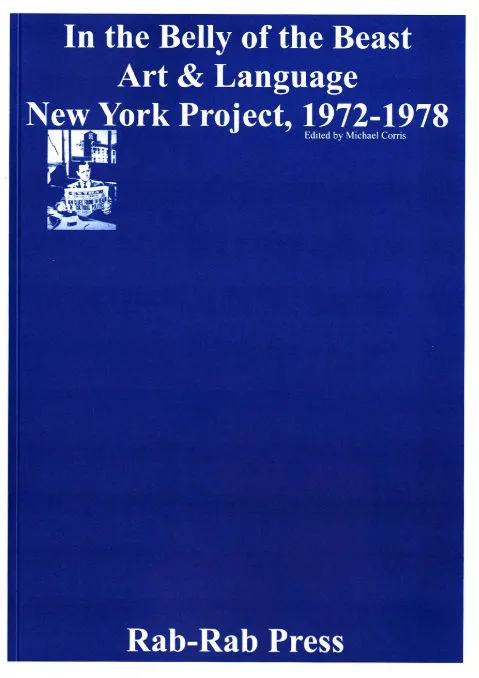
Edited, compiled and introduced by Paul Wood, Biting the Hand: Traces of Resistance in the Art & Language diaspora is about a dissident formation of artists active in the UK in the 1970s and 80s.

The book tells the story of artists engaging with a critique of then-contemporary modernist art education, who have embarked on a series of theoretical investigations which became increasingly politicised under the pressures of an evolving social crisis. Increased racism, unemployment and attacks on the organised working class all raised questions about how a critical art might respond.

By the late 1970s, these radical artists, mostly in the orbit of the Art & Language group, were producing posters and leaflets for a wide range of left-wing causes, as well as analyses of the politics of art and design education and the role of cultural ideology in maintaining consensus. In the 1980s, as Thatcherism tightened its grip, those involved went their separate ways into areas as diverse as media work, trade unionism, health and education.

Biting the Hand has three parts: a retrospective introduction setting the formation in its historical context, and two annotated documentary sections presenting examples of the work as both text and image, written and edited by Paul Wood.

It also includes a foreword by Sezgin Boynik, publisher, and an afterword by Ann Stephen, curator and art historian, further expanding on the book's subject.

For many years Paul Wood worked for the Art History Department of the Open University. His publications from that period include Conceptual Art (2000), Western Art and the Wider World (2013), and the four-volume anthology Art in Theory (1990-2020), co-edited with Charles Harrison and others.

Edited, compiled and introduced by Paul Wood.
Foreword by Sezgin Boynik; afterword by Ann Stephen.

Cover of Els Dietvorst E.D. (2010–2014)

Argos Arts

Els Dietvorst E.D. (2010–2014)

Els Dietvorst

This publication presents a survey of the work of Els Dietvorst from 2010 to 2014. This is also the period in which she left Brussels to live in a village on the south-east coast of Ireland, where she focused on projects such as The Black Lamb. The audio piece One was killed for beauty, another one was shot, the two others died naturally is included on an audio CD.

Els Dietvorst E.D. (2010–2014), Rolf Quaghebeur, Eva Wittocx, Katleen Weyts, Els Dietvorst, Brussels, 2014.

Cover of History Of A Tree

Silvana Editorial

History Of A Tree

Flatform

In a reality in which the boundaries between cinema, art, installation and multimedia experimentation seem to be increasingly blurred, History of a Tree by Flatform is a project that sets out to radically alter the idea of the portrait in western art. 

A non-human living organism – the Oak of the Hundred Knights of Tricase, the oldest Vallonea oak in Europe at the age of 900 years – and the territory in which it has stood for centuries become the subject: through a film and a robotized video installation, statements become a portrait, and are transformed into a work of art. 

The book retraces the genesis, development and implementation of this original idea, providing a visual score, the film in 80 images, dialogues in ten languages, the contributions of a tree searcher, an art historian and two philosophers, as well as a series of in-depth essays drawing on the fields of science, history, anthropology, music and linguistics. 

Cover of Perestroika / Perestroika: Reconstructed

LUX, London

Perestroika / Perestroika: Reconstructed

Sarah Turner

An autobiographical documentary, a fiction that's also an essay and an extended poetic meditation on the ability of the image to represent experience. Sarah Turner's film is a ghost story that explores what we forget and how we remember. The stunning imagery comes solely from the window of the Trans-Siberian train, shot first in 1987-8 and then again in 2007-8. The re-enactment of the journey is a memory work, a re-enactment of the past in the present through the process of filming. But the return journey is haunted by the voices of two dead friends that dominate the soundscape of the 'archive' footage. The film culminates at the haunting expanse of Lake Baikal, the deepest lake in the world.

Perestroika: Reconstructed re-mixes and extends Perestroika, into two sequences. Sequence one constitutes the 2009 version of the film, whilst the second sequence constructs a new framing narrative that reinterprets and reconfigures both the imagery and the experience of the first. Part psycho-geography, part dream and part environmental allegory, both sequences of Perestroika : Reconstructed conclude at Lake Baikal, contrasting experiences of terror and apocalypse with those of beauty and tranquility, the one contaminating the other. In this uncanny return, form stages thee through twinning the instability of memory and re-enacting that within the projective experience of cinema. This extended work delves further into ideas of momentary truth, identity, and how an uncontaminated experience of landscape is literally and metaphorically something that only exists in memory.

Publication contains DVD of Perestroika, which was released theatrically, blu-ray of Perestroika:Reconstructed, first exhibited as a gallery installation at London's Carroll/Fletcher Gallery April-May 2013, and a booklet of three essays by Elizabeth Cowie, Sophie Mayer, and Paul Newland.