rile*books

Search books

Search books by title, author, publisher, keywords...

Cover of Last Utopia

Jan Van Eyck Academie

Last Utopia

Persis Bekkering

€15.00

The bilingual book (NL-EN) contains one chapter of her recent novel Exces (Prometheus, 2021), which she has been working on during her stay at the academy. Set in the rave scene of 90s' Berlin, Last Utopia sketches the emotional landscape of an era that was supposed to be liberated, a time when the future was ostentatiously hailed. Yet in between the markers of optimism and progress, the first cracks announcing the permanent crises of today are revealed. Understanding techno as narrative device, this short novella - which can be read independently from the novel - traces echoes of utopian imaginary. 

Persis Bekkering is a sophisticated maker of scenes, her prose is strongly physical and immersive. In her work, human relations are scrutinized and exposed in its ambiguity. In 2018 she published her first novel, Een heldenleven (Life of a Hero) with Prometheus, which was shortlisted for the ANV Debut Prize. She writes essays, art - and literary criticism and columns, for Mister Motley, NRC Handelsblad and other publications. An excerpt of Last Utopia was used as libretto for Stine Janvin and Ula Sickle's concert performance Echoic Choir, which premiered at the Wiener Festwochen. 

Language: English, Dutch

recommendations

Cover of The (Incomplete) Cosmic Catalogue

Jan Van Eyck Academie

The (Incomplete) Cosmic Catalogue

Miriam Hillawi Abraham

Enchanted €75.00

Mapping constellations between five specific pre-colonial cosmological examples extending from the Sahel to the Horn of Africa, this work reframes cosmology as a multi-dimensional and scalable practice of situated technologies and embodied cartographies. The resulting publication which was produced during the Jan van Eyck residency is a culmination of several years of research and exploration into precolonial cosmologies and spatial orders rooted in the African Sahel extending to the Horn of Africa.

The (Incomplete) Cosmic Catalogue is an output of a research project that was initially commissioned by the Canadian Centre for Architecture as part of the multi-disciplinary research fellowship, The Digita Now: Architecture and Intersectionality in 2022.

Cover of Terra Nova

Jan Van Eyck Academie

Terra Nova

Esther De Soomer, Rudolph Glitz

Zines €25.00

Terra Nova combines fragments from a novel in the making by Esther De Soomer, in which she explores the parallels between the loss of language and forest dieback, between climate grief and linguistic mourning. Reflecting on her own relationship with language and multilingualism, she traces the feelings of grief that accompany the loss of German, one of her mother tongues. Drawing on existing narratives — such as fairy tales and family stories — she examines the critical state of the disappearing Hambacher Wald in Western Germany and presents language as a means to name and hold on to things.

Cover of One hundred and six EROTIC short stories

Extra Extra

One hundred and six EROTIC short stories

Fiction €27.50

To be erotic is to be alive. In this collection of erotic short stories, desire and imagination meet in stairwells, apartments, bars and glances that linger just a little longer. Commissioned for and first published in Extra Extra magazine, these unique stories range from vibrant encounters of mere minutes to hours of simmering tension.

Carefully curated and unapologetic in its imagination, it’s an invitation into a literary space shaped by lust and longing.

One Hundred and six erotic short stories contains erotic stories by Obe Alkema, Karin Amatmoekrim, Mischa Andriessen, Sarah Arnolds, Simone Atangana Bekono, Gerbrand Bakker, Maria Barnas, Leonieke Baerwaldt, Persis Bekkering, Abdelkader Benali, Hannah van Binsbergen, Marion Bloem, Fiep van Bodegom, Daan Borrel, Charlotte van den Broeck, Saskia de Coster, Eelco Couvreur, Daniël Dee, Nikki Dekker, Maxime Garcia Diaz, Don Duyns, Rob van Essen, Edwin Fagel, Mira Feticu, Moya De Feyter, Andy Fierens, Gamal Fouad, Johan Fretz, Steff Geelen, Maureen Ghazal, Arnon Grunberg, Esha Guy Hadjadj, Thomas Heerma van Voss, Mariken Heitman, Tom Hofland, Philip Huff, Auke Hulst, Nicole Kaandorp, Asha Karami, Maite Karssenberg, Mensje van Keulen, Emy Koopman, Falun Ellie Koos, Willemijn Kranendonk, Selin Kuşçu, Rachida Lamrabet, Jordi Lammers, Wietske Leenders, Sandro van der Leeuw, Sun Li, Gilles van der Loo, Hannah Chris Lomans, Alma Mathijsen, Kiriko Mechanicus, Jens Meijen, Lars Meijer, Carmien Michels, Kaweh Modiri, Roelof ten Napel, Richard de Nooy, Joost Oomen, Jamal Ouariachi, Iduna Paalman, Gustaaf Peek, Elvis Peeters, Froukje van der Ploeg, Marja Pruis, Julius Reynders, Hannah Roels, Astrid H. Roemer, Martin Rombouts, Daniël Rovers, Alfred Schaffer, Marijke Schermer, Koen Sels, Vamba Sherif, Frank Siera, Louise Souvagie, Yentl van Stokkum, Florence Tonk, Elfie Tromp, Joost Vandecasteele, Dominique van Varsseveld, Annelies Verbeke, Peter Verhelst, Wytske Versteeg, Daniël Vis, Dirk Vis, Sven Vitse, Maria Vlaar, Marwin Vos, Nadia de Vries, Niña Weijers, Han van Wieringen, Romy Day Winkel, Maartje Wortel, Pete Wu, Kira Wuck, Mia You, and Ivo Victoria

Cover of Unconscious/Television

becoming press

Unconscious/Television

Lucas Ferraço Nassif

Essays €18.00


This book stems from the author’s discontents with Lacanian Psychoanalysis, by drawing from psychoanalysts like Félix Guattari and Sándor Ferenczi, as well as authors like Viveiro DeCastro, and Thomas Lamarre, to whom the book is dedicated. 

As Lucas Ferraço Nassif elaborates on the possibility of a multiplicitous Unconscious, or rather, a mass of many Unconscious(es), he attempts here to fold the book itself into the text, to make the organisation of the physical book itself a part of the elaboration. 

This 2nd Edition comes with a few editorial changes, and a slightly different design approach. It is being presented now with a suite of endorsements from a group of exciting writers and researchers, including Persis Bekkering, Thomas Lamarre, and Yuchen Li. Much of the first edition is preserved, and an extra text has been added, written by the editor as a part of the lecture at Ifilnova. There has been a focus on making this book more accessible, so we have reworked the design of this edition in Black & White. 

The Unconscious is Semiotic, not Linguistic, and it only jumps out when you read between the lines. Do you remember, back in 1997, when 600 kids had epileptic shocks whilst watching Television—the Pokémon Shock? This might sound strange at first, but Lucas Ferraço Nassif theorises that, contrary to the claim that this was caused by oscillations of blue and red light alone, it could have been caused by microperceptions and intensities within narrative. As Porygon takes Ash and friends into the digital world, the immanence of unconscious assemblages drags viewers in, too. 

Such is the haptic and imagetic nature of this book. Using several design and editorial strategies, and a particular mode of writing, the author attempts to elaborate on their work on the Unconscious by recreating a similar possibility—where book, language and reader collapse into a composition, an assemblage or a haecceity. Unconsciousness operates as the multiplanar compositions of Japanese Anime do, so this book has been organized accordingly—different texts, different temporalities, different voices—and like the Japanese concept of Ma (negative space), or even like CoreCore, something jumps out of the breaks, the gaps in between the layers, and therein lies, for this book, a departure point for elaborating on not just one, but many, Unconscious(es). 

Cover of Spectres IV: A Thousand Voices

Shelter Press

Spectres IV: A Thousand Voices

Bartolomé Sanson, François J. Bonnet

The fourth issue of the annual publication dedicated to sound and music experimentation, co-published by Shelter Press and Ina GRM – Groupe de Recherches Musicales, around the topic of voice.

The voice is everywhere, infiltrating everything, making civilisation, marking out territories with infinite borders, spreading from the farthest reaches to the most intimate spaces. It can be neither reduced nor summarised. And accordingly, when taken as a theme, the voice is inexhaustible, even when seen in the light of its very particular relation with the sonic or the musical, as is the case in most of the texts collected in this volume. There is no point therefore in trying to circumscribe or amalgamate the multiple avatars of the voice. We must rather try to apprehend what the voice can do, to envisage its landscape, its potential effects.
 
Spectres is an annual publication dedicated to sound and music experimentation, co-published by Shelter Press and Ina GRM – Groupe de Recherches Musicales.

Edited by François J. Bonnet and Bartolomé Sanson.

Contributions by Joan La Barbara, Sarah Hennies, Peter Szendy, Youmna Saba, Lee Gamble, Ghédalia Tazartès, David Grubbs, Stine Janvin, Pierre Schaeffer, Akira Sakata, Haela Ravenna Hunt-Hendrix, Yannick Guédon, François J. Bonnet, John Giorno.

Cover of Nymph: A Novel

Verso Books

Nymph: A Novel

Stephanie LaCava

Fiction €20.00

A young woman from a long line of assassins, lives her life with the ardent mission to avoid the trappings of any enduring romantic love, while keeping one on the pursuit of an untimely death for herself. 

Not yet thirty, Bathory, or 'Bat' to those near to her, has assembled a peculiar Model, sex worker, linguist and scholar of Latin. But nothing in her lively job history employs the singular traits she inherited from her strange family, chief among them an uncanny ability to sidestep seemingly certain death(s). An appropriate atavistic instinct, for someone from a long line of assassins and spies. Her clan are assassins of a romantic bent, her parents issuing theories on love galore. However Bat is set on swerving any enduring romantic loves, and she's set on dying young. Now, if she could only avoid that one alluring figure from her father's past.

A thriller, a love story, and a dynamic examination of class, violence and connection. The images we make to share and those we strive to conceal, alienation and salvation, magic and technology, LaCava's bold new novel is propelled by the compelling violence one can seed in contradiction.

Cover of The Activist

Krupskaya Books

The Activist

Renee Gladman

Poetry €17.00

The Activist begins in the middle of a revolution. There is a protesting group of commuters with a missing leader. There is a bridge that may or may not have been bombed. People speak in nonsense and cannot stop themselves. In the midst of all this, the language of news reporters mixes with the language of confession. The art of this beautifully written book is in how it touchingly illustrates that relations between humans and cities are linked in a more complex interface than most realize. The book is full of entrances and exist, alternate routes and incommensurate geographies. The Activist does not analyze or explain the hopeful desires of protest at the turn of the century, but it does enable us to see them differently. — Juliana Spahr

"Whether this is a dream in which I'm captured or I've been captured and made to think I'm in a dream, I can't figure." Apropos to the rapturous tension The Activist evokes. A covert narrative operating as an event disguised as a repot. A grass trap glimpsed through the lashes of a sleepwalker. Topography of disrupted positionality, reflection girders flaccid memory against the romantic high up. Flea-bitten news and neuralgic placards. You are here**. Is dreaming the medium for crossing the ambiguous borders of talk, responsibility, collectivity, solitude? Or does reading anatomize a phantom bridge that carries you over to an unmappable reality and calls you by your secret name? Root, plan and faction, armed with tongue-tied intensity. You may ask how Renee Gladman knows that this city of slippage is your city, how she holds you within it, riveted. And therein lies the magic of this book. — Tisa Bryant

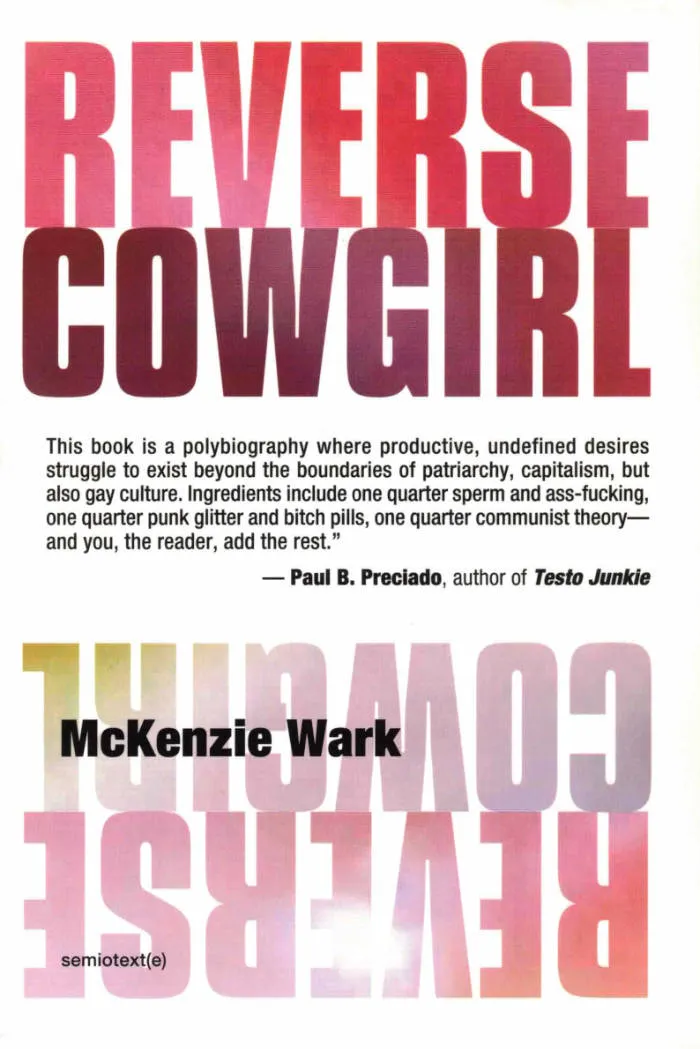
Cover of Reverse Cowgirl

Semiotext(e)

Reverse Cowgirl

McKenzie Wark

Fiction €16.00

McKenzie Wark invents a new genre for another gender: not a memoir but an auto-ethnography of the opacity of the self.

Another genre for another gender.

What if you were trans and didn't know it? What if there were some hole in your life and you didn't even know it was there? What if you went through life not knowing why you only felt at home in your body at peak moments of drugs and sex? What if you expended your days avoiding an absence, a hole in being? Reverse Cowgirl is not exactly a memoir. The author doesn't, in the end, have any answers as to who she really is or was, although maybe she figures out what she could become.

Traveling from Sydney in the 1980s to New York today, Reverse Cowgirl is a comedy of errors, chronicling the author's failed attempts at being gay and at being straight across the shifting political and media landscapes of the late twentieth century. Finding that the established narratives of being transgender don't seem to apply to her, Wark borrows from the genres of autofiction, fictocriticism, and new narrative to create a writing practice that can discover the form of a life outside existing accounts of trans experience: an auto-ethnography of the opacity of the self.

Cover of The Seers

Prototype Publishing

The Seers

Sulaiman Addonia

Fiction €16.00

The Seers follows the first weeks of a homeless Eritrean refugee in London. Set around a foster home in Kilburn and in the squares of Bloomsbury, where its protagonist Hannah sleeps, the novel grapples with how agency is given to the sexual lives of refugees, insisting that the erotic and intimate side of life is as much a part of someone’s story as ‘land and nations’ are.

Hannah arrives in London with her mother’s diary, containing a disturbing sexual story taking place in Keren, Eritrea, where the Allies defeated the Italians in the Second World War. In a gripping, continuous paragraph, The Seers moves between the present day and the past to explore intergenerational histories and colonial trauma alongside the psychological and erotic lives of its characters as their identities are shaped, but refused to be suppressed, by the bureaucratic processes of the UK asylum system. 

Sulaiman Addonia is an Eritrean-Ethiopian-British novelist. He spent his early life in a refugee camp in Sudan, and his early teens in Jeddah, Saudi Arabia. He arrived in London as an underage unaccompanied refugee without a word of English and went on to earn an MA in Development Studies from SOAS and a BSc in Economics from UCL. His first novel, The Consequences of Love (Chatto & Windus, 2008), was shortlisted for the Commonwealth Writers’ Prize and was translated into more than 20 languages. His second novel, Silence is My Mother Tongue (Indigo Press, 2019; Graywolf, 2020), was a Finalist for the Lambda Literary Awards 2021, the Firecracker (CLMP) Awards, the inaugural African Literary Award from The Museum of the African Diaspora (MoAD) in San Francisco, and longlisted for the 2019 Orwell Prize for Fiction. Addonia’s essays appear in LitHub, Granta, Freeman’s, The New York Times, De Standaard and Passa Porta. He is a contributor to Tales of Two Planets (Penguin, 2020) and Addis Ababa Noir (Akashic Books, 2020). 

Cover of Shagging the Boss

Filthy Loot

Shagging the Boss

Rebecca Rowland

Fiction €14.00

Rebecca Rowland is one of the sharpest writers that I know. This little book combines elements of life in the publishing industry, #MeToo, and a literal boogeyman. It’s long been my desire to do more “social horror.” And Shagging the Boss is the stick I use to measure other submissions in that vein. (Back Cover Text) “Lesson number one: don’t get attached to anyone. Being a cannibal is the only way to truly succeed in this business.” He placed one hand on the door handle, then thought a moment and smiled to himself. “The problem is, once you take a bite, it will never be enough.” After a fortuitous encounter at a local book convention, a liberal arts graduate accepts a position at a flashy publishing company under the tutelage of its charismatic owner only to learn that the press is led, and fed, by a literal boogeyman.

“Rowland tells an exceptionally tight and fast-paced tale about a unique legendary creature stalking the modern publishing industry” — Michael Arnzen, Bram Stoker Award-winning author of Licker and 100 Jolts

“Rowland’s tale is a transgressive mindf*ck that will leave you irreparably unnerved” — L. Stephenson, author of The Goners

“Rowland has a narrative mastery that makes you feel as if a good friend is pulling you in close to tell you some special secret…You’ll be left shook” —Tim Murr, Stranger With Friction