rile*books

Search books

Search books by title, author, publisher, keywords...

Cover of Girls Like Us #11 - Economy

Girls Like Us

Girls Like Us #11 - Economy

Jessica Geysel ed., Sara Kaaman ed., Katja Mater ed., Marnie Slater ed.

€8.00

Framed as inescapable, indescribable, uncontrollable and essential, economies are everywhere. Oppressive and enabling, lucrative and undervalued, there are economies that trade our emotional labour, desires, love, fertility, time, minds, queerness, politics and clicks. There are economies that we can control and that control us, and those that we can subvert to serve our collectives. A mark, a yen, a buck or a pound, in a conversation with a cat, an app-enabled journey through a rainy Shanghai night, in the margins between intimacy and power, in the kitchen, with your record collection, under the tip of the iceberg, at the foot of a tower she built, dancing at the lesbian bar.

Language: English

recommendations

Cover of Girls Like Us #6 - Secrets

Girls Like Us

Girls Like Us #6 - Secrets

Jessica Geysel, Sara Kaaman and 2 more

A secret can be a private space for self-creation – or a shared site of pleasure.

We explore secrets in a plethora of forms and contexts. From layered accounts of mediaeval ecstasy to the unexplored sensory experience of smell. From camouflaged play to queer readings of astrological charts and the hidden history of house music. From a very analog point of view to the outskirts of the internet.

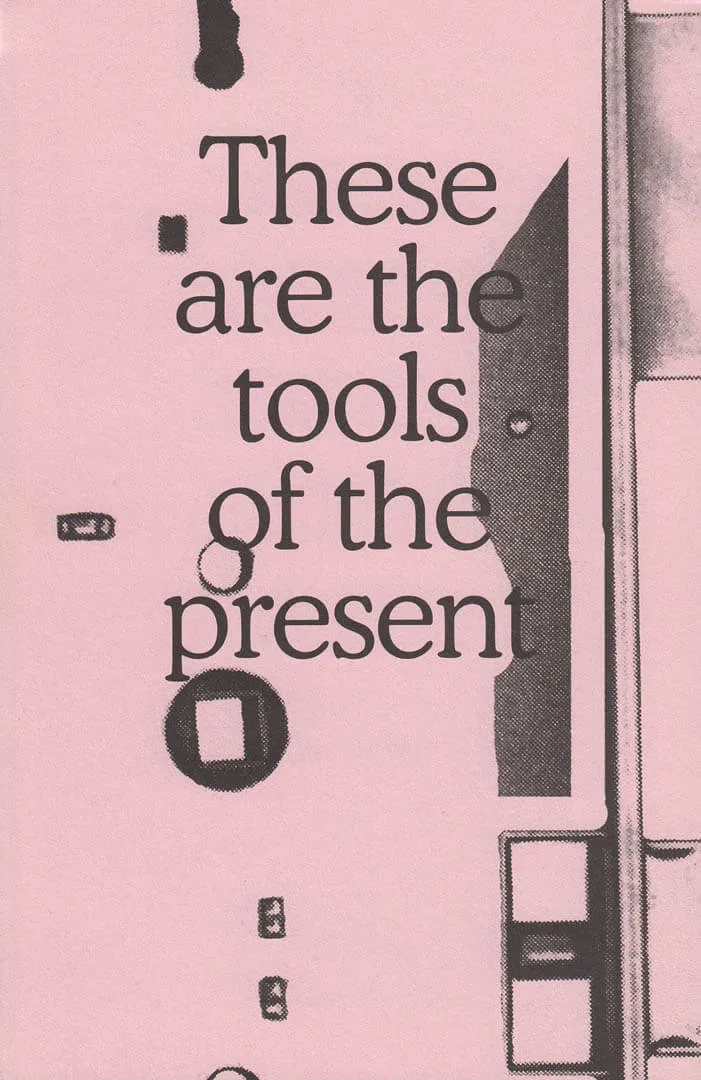
Cover of These are the tools of the present

Mophradat

These are the tools of the present

Mai Abu ElDahab, November Paynter and 1 more

This publication comprises a series of interviews with contemporary artists, musicians, and writers who are in dialogue with Beirut and Cairo. While not purporting to be an overview of the art scenes in these cities, this book begins to draw a picture of how artists think about what it means to be active in the contexts of these cities. It offers insight into the circumstances that structured these artists’ stories, and the often accidental influences that have shaped how their practices have developed.

Cover of A Book Knot Book

Body Text

A Book Knot Book

Sara Kaaman

Performance €20.00

A Book Knot Book is a 208 pages long performance, the first from the research and publishing initiative Body Text. In this study of language in action systems of meaning-making crash, sparkle and swoon. In a playful voice over A Book Knot Book self-reflects on the materialities and choreographies of publishing, reading and writing. With guest stars in fragments; Monique Wittig, Yvonne Rainer, Cristina Rivera Garza, Amiri Baraka, Will Rawls, David Abram, Thich Nhat Hanh and more. 

Edited and designed by Sara Kaaman. Published with the support of Stockholm University of the Arts.

Cover of Natural Enemies Of Books: A Messy History Of Women In Printing And Typography

Occasional Papers

Natural Enemies Of Books: A Messy History Of Women In Printing And Typography

Sara Kaaman, Maryam Fanni and 1 more

Natural Enemies of Books is a response to the groundbreaking 1937 publication 'Bookmaking on the Distaff Side', which brought together contributions by women printers, illustrators, authors, typographers, and typesetters, highlighting the print industry’s inequalities and proposing a takeover of the history of the book. Edited by feminist graphic design collective MMS, the publication includes newly commissioned essays and poems, conversations with former typesetters Inger Humlesjö, Ingegärd Waaranperä, Gail Cartmail, and Megan Downey, and reprints of the original book and other publications.

Cover of Efemmera Reissue #3: Saving Seeds: Metaphors of Lesbian Growth

Alder & Frankia

Efemmera Reissue #3: Saving Seeds: Metaphors of Lesbian Growth

Jennifer Weston

Originally published in 1987, Saving Seeds: Metaphors of Lesbian Growth, a special issue of Maize: A Lesbian Country Magazine, was created by artist and writer Jenna Weston as a tribute to "magical female-oriented gardens."

From her Introduction: "I have found that, generally speaking, lesbian gardens are works of art. We make intricate designs with twine between sapling posts. Later, these weavings support tomato vines. Bright colored ribbons flutter from the tops of tall bean poles. Raised vegetable beds are sculpted into various graceful shapes. The winding paths are edged in pieces of broken pottery and stones we've found. We build altars in the centers of our gardens, and hold rituals between the onions and the lettuce."

"I asked wimmin to send me drawings and photos and descriptions of their magical female-oriented gardens. The replies came from near and far, and make up a part of this book. The rest of the book contains poems and prose that came directly from my experiences as a gardener and a lesbian."

This reissue reimagines the black and white stapled original in a bounty of earth tones: different colored French Papers are risograph printed in green, brown, and orange ink. The book is handsewn with gradient thread. Also included is a recent interview with Jenna Weston printed as an 11x17 leaflet, reversed with a poster of one of the garden diagrams in the book.

Cover of Pages 9 - Seep

Pages Magazine

Pages 9 - Seep

Babak Afrassiabi, Nasrin Tabatabai

Periodicals €12.00

This issue of Pages assumes seep as a post archival mode: in the Merriam-Webster dictionary the verb 'seep' is translated as follows: to flow or pass slowly through fine pores or small openings, to enter or penetrate slowly, to become diffused or spread.

The biology or politics of seeping is like that of raw petroleum oozing at natural oil seeps. Unlike refined oil which has sponsored modernization and its aligned archives, crude oil pours beyond historical purpose and defies structural elevations. It instead disfigures the ground through which it dubiously spreads.

Seeping is a posthumous affair. It is the gradual leaking of a long withdrawn interior. Like the bleeding of a punctured corpse, when the pumping of the heart has stopped, when the body is lifeless and apathetic to any 'hail', yet continuing to bleed. Seep as archive is an eternally post-apocalyptic expansion, retraction, deviation, subtraction, or simply the arrival of (non-)things.

With contributions by:

- Mariam Motamedi Fraser / Geo-Archive
- Richard Goldstein / Dennis Oppenheim's Dilemma: Should he Sell Art to the Shah?
- Babak Afrassiabi, Nasrin Tabatabai / Contemporary Hole / Unfilmable
/ Seep
- Saleh Najafi / Wounds of Archive¹
- Mark von Schlegell / The Artist Abstract #6
- Nima Parzham / The underground
- Adam Kleinman / Vanished Theories
- Suzanne Treister / Algorithm
- Alexi Kukuljevic / The Dissolute Subject
- Matts Leiderstam / Andy Warhol, Suicide (Purple Jumping Man), 1963
- Eugene Thacker / Black Infinity; or, Oil Discovers Humans
- Vivian Ziherl, Natasha Ginwala / Infrastructural Suspensions: Global Spanning, Atmospheric Seepage and Measures of the Undecidable

Cover of Bad Language

Peninsula Press

Bad Language

So Mayer

Non-fiction €20.00

There is no such thing as a safe word. 

In Bad Language, So Mayer blends memoir and manifesto as they explore the politics of speech, while looking at how language has been used – and abused – in their own life. What is the relationship between language and sexual violence? And how can we ‘make ourselves up’ in language when words themselves are encoded by a dominant culture that insists we see ourselves as powerless listeners rather than active speakers? 

Examining the semantic traps of their multi-lingual childhood – and taking in texts from the Torah to Grimms’ Fairytales, from protest bust cards to the works of Ursula K. Le Guin – Mayer asks who gets to speak, and who is forced into silence. Bad Language calls out the harm that words can do, while searching for crafty ways through which we can collectively reclaim language for protest and pleasure. 

‘Mayer’s writing is generous, astute and sincere; in Bad Language, they choose their words carefully, using incantation and spell to distil a complex argument – the transformative power of language lay in its ability to shape sense perception. For Mayer, the task of ‘making ourselves up’ is another way of asking, what kind of world do we want to live in?’ – Lola Olufemi

SO MAYER is a writer, editor, bookseller and organiser. Truth & Dare, their first collection of speculative fiction, was longlisted for the Republic of Consciousness and Edge Hill Short Story prizes. With Sarah Shin, they co-edited Ursula K. Le Guin, Space Crone, winner of the 2024 Locus Award for non-fiction. Bad Language is their second book for Peninsula, after A Nazi Word for a Nazi Thing.

Cover of Engagement Arts Zine #1

Self-Published

Engagement Arts Zine #1

Engagement Arts

First edition of the Engagement Arts Zine.

Published May 2019